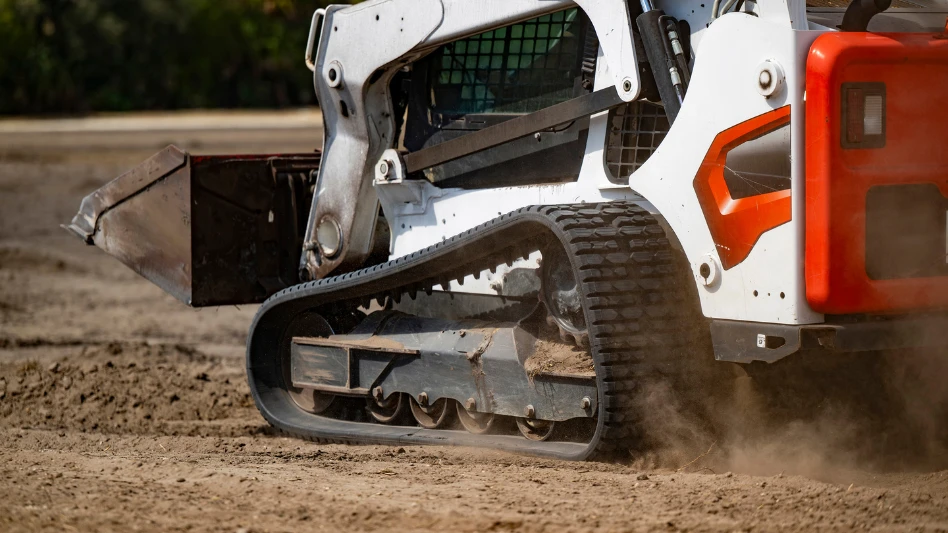
Sometimes it takes a small guy to save the day. In the world of movies, this is often illustrated in a scene where the scrawny underdog is the only fellow nimble enough to extricate his cohorts from a jam. In the world of mini skid steers and compact utility loaders, the growing popularity of pint-sized versions proves they’re powerful enough to compete with their big brothers while still being small enough to maneuver around the limitations imposed by modern landscapes. But in order to save the day, it’s crucial to have the right attachments for the job. By buying the right attachments, contractors can ensure they get the most out of what their compact skid-steer or loader can offer.
HONEY, I SHRUNK THE SKID STEER. As houses have grown closer together, the demand for equipment that can fit through existing gates and lawns has increased, says Rob Otterson, marketing manager, Bobcat, West Fargo, N.D.
While full-size skid steers have been standard landscape equipment for years, smaller versions are relatively new tools for contractors.
Andy McMurry, president, Southern Shade Tree Co., Charlotte, N.C., says when he began using compact loaders 10 years ago, he was impressed with how much strength and versatility was contained in such a small package. “It has made landscaping a whole lot easier logistically because you don’t have to use much bigger trailers to haul around the equipment,” he says. “It’s kind of a win all the way around.”
With each successive generation, compact skid steers and loaders continue to shrink in size without sacrificing power. “The exciting part of that is that we’re able to make them smaller without giving up the hydraulic power, so we’re able to deploy small stand-on machines that provide as much hydraulic power to the attachment and sometimes more hydraulic power to the attachment than the larger sit-in machines have traditionally done,” explains Roger Braswell, chief executive officer, Compact Power, Charlotte, N.C.
| RENT OR OWN? |
With the cost of a compact skid-steer or loader ranging from $12,000 to $20,000 and attachments from $300 to $8,000 each, many contractors choose to try out a potential purchase by renting the equipment first to make sure it will meet their needs. Manufacturers estimate that renting an attachment for a compact machine can range from $10 to $100 per day depending on whether the part is hydraulic or non-hydraulic and if it has wearable parts. “If you’re renting a grapple bucket, it might be an extra $10 to $20 per day, but if you’re renting a $6,000 backhoe then of course it’s going to be more expensive,” says Brad Lemke, director of product development, ASV, Grand Rapids, Minn. “There are some attachments that require more maintenance, so the rental store has to charge more.” Roger Braswell, chief executive officer, Compact Power, Charlotte, N.C., says that if contractors find they are renting a particular attachment once per week, they might want to look into purchasing it. “If I’m renting it once a week, then I could own it through a finance or lease since one month’s payment would be equal to about one day’s rental,” he says, adding that it takes just one incidence of the attachment not being in stock at the rental house to cost a company extra money in the additional labor needed to complete the job by hand. When contractors do decide to purchase a compact equipment attachment, they need to realize that with an increase in the complexity of the part comes an increase on the price tag. Braswell says a non-hydraulic attachment like a bucket can range from $300 to $1,000, and a hydraulic attachment, such as an auger, is typically in the $1,500 to $5,000 range. |
The fact that machines are getting smaller reflects just one end of the growing spectrum of size options in the skid-steer market, says Sarah Bemowski, sales and marketing specialist, CE Attachments, Cedarburg, Wis. “Smaller machines have become smaller and large machines have become larger – up to 100 horsepower,” she says.
With such power inside a small package, there’s a veritable plethora of specialized attachments contractors can choose from to get the job done.
VARIETY IS THE SPICE OF LIFE. Braswell says when it comes to compact equipment attachments, it helps to think of the drive unit as a ratchet and the attachments as different sockets. “The tools allow you to perform various functions on a construction site that you might typically do either by hand or with a larger machine that would damage the terrain or damage the fixtures like the curbs and sidewalks and irrigation systems,” Braswell explains.
For contractors using manual labor on the job, having the right attachment can save time and money. “You alleviate the worry of having to find three or four more workers for a project with an attachment doing the work instead of a shovel,” Otterson says.
The amount of time a contractor can save by using the right attachment on compact skid-steers or loaders varies dramatically depending on the task. For example, digging a hole with a posthole auger vs. an auger attachment could result in “astronomical” timesavings, says Brad Lemke, director of product development, ASV, Grand Rapids, Minn.
POPULARITY CONTEST. So what are the best attachments for mini skid-steers and compact loaders? Well, Bemowski says that depends on what business the contractor is in. “For instance, a landscape contractor may be smart to purchase a stump grinder, brush mower and power landscape rake,” she explains. “A building or utility contractor’s smart attachments may be completely different – a trencher, backhoe and breaker, for example.”
Manufacturers say their five top-selling attachments are buckets, augers, forks, trenchers and breakers. In the last few years, compact backhoes have also been gaining popularity, says Lemke. “I think people are finding that a lot of time you can do just as much with a small backhoe as you could by owning or renting a mini-excavator and it’s a lot cheaper to have just a backhoe attachment if you don’t need a real mini excavator,” he explains.
Otterson stresses that contractors need to keep in mind that the top five sellers in compact equipment attachments aren’t necessarily indicative of the best choices for an individual contractor’s needs. “These mini loaders are really getting a lot of their own dedicated attachments now that weren’t there five or six years ago,” he says.
McMurry says the first two attachments he bought were a simple bucket and a trencher for installing irrigation systems. Bruce Moore, owner, Eastern Land Management, Stamford, Conn., says he purchased a trailer full of attachments for his compact skid steer, but says his company relies most often on attachments, including a broom, blade and v-plow for winter snow removal. “The rest of the year we use the auger most often, but we also use the trencher for drainage work,” he says.
SMART SHOPPING. So what is the best route to ensure the perfect match between equipment and attachment? Two words: Buy smart. “You need to evaluate your needs and what you’re going to be using the machine for,” Moore advises.
Though it may seem like common sense, making sure the attachment is compatible with the compact skid steer or loader is essential. Lemke says he often sees contractors try to use attachments designed for use with large skid steers on compact skid steers. Not only does this result in decreased performance, he warns, but it also can pose a safety hazard. “If you put on a bucket that’s too big for a small machine, it’s going to be tippy when you load it,” he says. “You need to look at the manufacturer’s recommendations for what size attachments go on the machine.”
It’s also a good idea to watch for which services are becoming popular in contractors’ specific markets that, with the addition of a particular attachment, could become profitable to add to the mix. “Smart attachment buying is choosing something that you can do more than one task with or be able to bid more than one job and also keep your eyes out for the jobs that are increasing or growing so you can capture some of that growth just by adding an attachment,” Otterson advises.
Bemowski says to check with dealers to find out what’s available as well as researching attachments on the Internet. “There are probably a lot of attachments out there that even the dealers don’t know about,” she says.
For contractors who want to get the most versatility for their dollar, manufacturers suggest looking for an attachment that will serve more than one purpose, such as a four-in-one bucket, which can also be used as a blade, a backdragger or to grab items such as rocks and logs. “If I could only get one attachment, that’s the one I’d get,” Lemke says.
Once a contractor thinks he has found the right attachment, it’s important to ask a few final questions before making the purchase. Bemowski advises going back to the dealer and asking about attachment setup and maintenance, which need to be taken into the cost consideration of the attachment. Otterson adds that buying from a reputable company is important, as well. “In terms of smart purchasing, your warranty, dealer support and the product’s performance are going to be a lot stronger with a more reputable company,” he says. “You could buy something that works well from someone, but if it falls apart, then you end up buying it all over again.”
THE FUTURE. Manufacturers say the future of compact equipment attachments involves a wider variety of tools targeted to meet landscape contractors’ specific needs.
“What we see in the future is just a broader range,” Otterson says. “An attachment’s main goal is to be good at one thing, whereas the reason a machine is good at a ton of different things is because it can take attachments. So the attachments are where the dedicated performance comes from.”
Lemke estimates that 70 to 80 percent of the attachments available for full-size loaders and skid-steers are available for their compact counterparts, and he imagines that number will continue to increase over the next few years. “It may never be 100 percent because there are some attachments that need lots of power to run, like a coal planer, which is for grinding asphalt,” he explains. “You’re not going to put that on a tiny machine. But there may be more attachments that are only useful on small machines that aren’t useful on big machines.”
Otterson says that ultimately it’s the contractor who drives what new attachments appear on the market. He says, “If the contractor has a request, we will build it.”

Explore the February 2005 Issue
Check out more from this issue and find your next story to read.
Latest from Lawn & Landscape
- Irrigreen partners with Netafim on smart drip system
- Do your people enjoy the work?
- New Holland adds E25X electric mini excavator, C314X electric mini track loader,
- Takeuchi adds Admar Construction Equipment & Supplies as dealer
- RC Mowers adds 3 new dealers
- The real March Madness: NCLC
- Rotary expands lineup of tree care products
- Heritage Landscape Supply Group adds Nebraska's Heritage Nursery