John Deere was manufacturing equipment for commercial purposes before the Civil War. Since its inception 163 years ago, the John Deere name and its green and yellow colors have become one of the best known brands in the country, largely due to the company’s success in the agricultural arena.
As farmers encountered new and more challenging obstacles the last few decades, John Deere realized it needed to broaden its horizons to continue growing. Consumer yard and garden equipment soon joined combines in the John Deere fleet, and commercial landscape equipment wasn’t far behind.
But truth be told, John Deere never pursued the commercial landscape customer with the focus that a company with its tremendous name, resources and research and development skills could. However, that changed earlier this year when John Deere acquired Great Dane Power Equipment and McGinnis Farms within the span of one month.
Soon, people were talking of the sleeping giant awakening, and many debated why a manufacturer would purchase a distribution-focused company like McGinnis Farms. Plus, were more acquisitions planned? Would the company sell equipment outside of its dealership network?
I traveled to Moline, Ill., John Deere’s world headquarters, and spent part of an afternoon with John Jenkins, president, John Deere Consumer & Commercial Worldwide Equipment Division, to learn about these surprising acquisitions and gain some insight into John Deere’s plans for the future. (For a story about what a visit to the heart of John Deere is like, as well as more from this interview, please click here: Conversation Series Extra: John Jenkins, John Deere.)
BOB WEST: Why has John Deere been able to build such a powerful brand?
JOHN JENKINS: I think this is a very good company to work for. This is a company that is 163 years old, and the reason is that it has been able to renew itself about every 20 years and position itself to be reflective of the times. It’s also located in a lot of smaller communities, and therefore, when you go to work for Deere you’re not as apt to leave because it would require a geographic move. I’ve never had a reason to leave - we refer to it as the ‘John Deere experience.’
But I think the brand started with John Deere himself, and he said he wouldn’t put his name on a piece of equipment that didn’t have the best of him within it. From our start, quality has been synonymous with Deere, and I think in today’s society, more and more consumers want dependability, quality and service. We were fortunate enough to have that in our heritage.
BW: Do you see that same level of demand for quality from your consumer and commercial customers?
JJ: Frankly, most of the commercial users we have demand 24/7 support because they’re literally making a living with our equipment, and if our equipment is down they’re not making any money. We attempt to deliver the best service response in the industry, and I think we do.
BW: The Great Dane and McGinnis Farms acquisitions would seem to signal that John Deere has intensified its focus on the landscape industry. Is that accurate?
JJ: We view both residential and commercial markets as not only taking care of the lawns that are in place, but we really want to take care of the landscape. When we talk about a John Deere on every landscape, which is our strategic intent, we’re not just talking about Mary just putting equipment on there, but trying to let the homeowner or the commercial contractor know that they only need one partner. And we’ll take care of making sure that their investment is sound and that their facilities are displayed the way they want them. The green industry gives us a day-to-day touch, and we like that because our customers become better customers as we get to know each other better
Over the last 10 years, we went into the golf business, and now we’re the No. 1 supplier of equipment to golf courses. As that has happened, we got more interested in landscaping and irrigation, so the green industry has been a natural growth.
BW: Based on these two acquisitions, it seems that your goal is to be more than just involved in the green industry, though.
JJ: I think that’s right. The reason for our acquisitions, especially in service-related businesses, is that we want to be sure that we know the business and how to operate in it. By buying a top company, it brings with it people who have knowledge in that part of the business. We can teach them the John Deere experience and they can teach us how to better interface.
BW: Why Great Dane and why McGinnis? What made them attractive acquisitions?
JJ: I think McGinnis had a proven track record of taking irrigation and landscape installers and bringing them together. That was interesting to us. They built that model, they built it regionally, and it looked to us like a model that could be expanded. They were looking for someone to help them expand. We were also interested in broadening our touch to that customer base
As far as Great Dane, we not only picked up very innovative products, but Dane Scag (founder of Great Dane Power Equipment) will continue to work with us in helping us better understand and design what the commercial mower needs. Again, it looked to us like a company that not only gave us products that we needed to fill out our line, but it gave us insight and expertise in design.
BW: What is it about the irrigation industry that attracted you?
JJ: Well, it’s natural when you look at golf courses. One of our competitors usually gets its first connection to the golf course with irrigation and then follows on with equipment and other things. I think it was a need to round out our arsenal so we were on a level playing field.
BW: When you look at the product line for John Deere, are you satisfied with what you’ve got now?
JJ: I think our basic product offering with the Great Dane acquisition and the things we’ve done in the last half dozen years is a pretty good offering. We’ve got skid steers and we’ve got the major commercial machines for golf and turf. All of those things are reflective of our getting the technology and the business right. Now we’re getting the service right, and when we get those three lined up it looks to us like a national support network is the right thing to do.
BW: What does the Great Dane acquisition do for the John Deere product line?
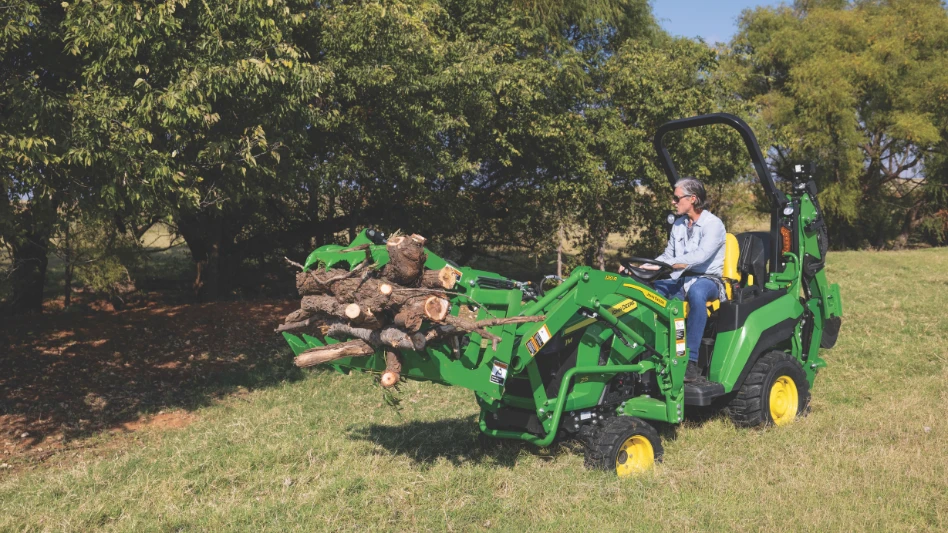
JJ: Let me start by saying that I want this business to be known as the innovator in the industry, and I think in Dane’s case, the equipment we are putting out there has a leading edge look. The new skid-steer tractor we’re bringing into the marketplace is another reflection of that leadership vision.
We’re not just about bringing yesterday’s technology to this business. We want to be leading edge. I believe that very shortly we’ll be able to mow golf courses at night, and the reason is because we’ll have autonomous machines. The technology is here - it’s a matter of refining it.
BW: Could this technology filter down to the landscape arena?
JJ: Absolutely, especially as water becomes more scarce and we need to figure out how irrigation systems can be more water efficient. We will also find technologies that our equipment division and the green industry will be able to share.
We do a lot of sensor work these days as we go through a product so we’re maximizing the right seed and water concentration in each part of the field, because it varies. We’re measuring those things, and we can take the knowledge we learn and we transfer it very easily to how we make better landscapes.
BW: What potential does John Deere see for the commercial market since so many manufacturers talk about the need to reduce the number of manufacturers?
JJ: That’s where technology in this business is ultimately going to be the big differentiation. As we build more machines that are self-sufficient and that can use technologies like GPS or any number of positioning systems, it will get tougher for some companies to do anything but specialize in a very narrow part of that business. But I think we’re still going to be able to offer the commercial customer a one-stop shop, and I think many of them will feel that is very important.
The other thing that we’re well positioned on is service. We have the strongest servicing dealer organization in North America, and it’s located throughout the areas that require a landscape or irrigation professional. Again, we’re in a natural position, especially with McGinnis, to offer almost a complete, off-site set of services, so all the contractor has to do is get the order and put the product in at the site. We’ll take care of everything else.
BW: How many dealers does John Deere have serving the commercial market?
JJ: We have 1,700 total, but I would say that 400 to 500 would be more the commercial type of dealer.
BW: Have you seen some of these dealers transition from consumer to commercial?
JJ: We’re seeing a number of our dealers do this, especially since we introduced our line of skid-steer loaders because, again, a lot of contractors and professionals want to get it all from one location. Now the dealers have found out that they need to dedicate part of their businesses to the commercial market. So, we haven’t given the skid-steer contract to every John Deere dealer. If they’re not going to make the necessary investment, we don’t want to put the product out there because it won’t be serviced properly.
We’re really one of the few companies that has maintained its dealer organization. Besides Sears and us, there aren’t a lot of brand-dedicated service centers. That’s not to say dealers carrying a number of product lines don’t deliver good service, but it’s harder to have that kind of service network know your product, know your customer and their needs than it is for us when we train and develop dealers internally.
BW: Your dealers have probably been at the heart of a lot of your discussions in recent weeks because of these acquisitions. How do you see the organizations co-existing?
JJ: I think the McGinnis operation will be very complementary to our dealer network. I think that we are not going to have McGinnis selling equipment, but we’ll certainly have McGinnis with the ability to rent and lease in harmony with the dealer.
BW: What form will that take?
JJ: Today, we have similar relationships with other locations where the dealer orders the goods and restocks and replenishes the other distribution point, and there’s obviously some margin share between the two organizations. But that relationship keeps the McGinnis group from having to learn about the service side of the business, and it allows both the dealer and McGinnis to have a stronger relationship.
I fully expect that we’ll have John Deere equipment displayed in McGinnis locations, but in most cases, it will be the local dealer’s floor plan equipment.
BW: Do you see this relationship working the opposite way as well? Will some of the dealers offer irrigation supplies?
JJ: I think it’s probably very early in the relationship to say for sure, but my guess is yes. It’s going to be a lot easier the other way, however, because the dealer is still going to be essentially delivering the machine and doing his work, but now he just has a different place to display the equipment.
BW: How many locations does McGinnis Farms have?
JJ: Initially, there are 50 McGinnis locations, but we would expect that number would need to grow pretty rapidly.
BW: Why do you say ‘need to grow?’
JJ: Because today it’s only regional, and we think there’s a need at least through the North and Central U.S. to have a similar type of operation. There’s no doubt that our strategy is one of gaining a national presence, and I don’t think that we’re alone in expecting that this business is growing at such a rate that the installers just don’t have time to manage logistics, purchasing and all of the things that go with trying to deal with the supply base, which is literally thousands of suppliers.
BW: Is the acquisition of a distributor like a McGinnis Farms a shift in your business model and a change in the way suppliers are looking at the industry?
JJ: I think it is. I think it’s a recognition of what the customer is asking for. We think the customer is asking for us to take the complexity out of his life. He’s saying, ‘Give me an economical way to be able to entrust and deal with one face and know that I’m getting a good deal, great service and I don’t have to spend a lot of my time worrying about it.’
BW: In the past, didn’t suppliers take a more specialized approach to the industry?
JJ: Oh, I think they did, but as the need for service has grown, we want to grow with that. Today, the manufacturing part of the business is an important part, but the services that customers need are immensely bigger. As the machines get more complex, the level of services probably will be less frequent, but they will require specialized knowledge.
BW: If you have to prioritize the need for service you deliver vs. the need for improved or innovative manufacturing, is there a shift going on there?
JJ: I don’t think there’s any less demand on being innovative in manufacturing or design. I think, though, that there is a greater need to make sure our service improves.
In fact, in today’s world, the commercial customers want us to fix the machines before they break. Literally, that means you’ve got to be sensing wear and you’ve got to be sensing stress, and you’ve got to have an organization that’s ready to respond. You can’t be open 8 to 5 when a customer is working 6 a.m. to 6 p.m.
BW: Do you expect to see some of the other major manufacturers taking a different look at distribution in the future?
JJ: I think the customers are going to demand better service, and as they do, the manufacturer is going to have to either partner with a group that can do that for them or consider going into this business. It’s a competitive world out there, and today’s consumer is a much better consumer than 20 years ago and much less tolerant.
BW: I attended a John Deere dealer meeting at the end of 1999 where you guys made some interesting statements about changes expected for dealers. Where does that stand in terms of dealers going from a sales orientation to a service orientation?
JJ: I think that trend proved correct. I personally believe that we’re not going to sell mowers over the Internet. I think, instead, we’re going to make it very easy for service, so maybe the customer doesn’t even need to go to the dealer organization. Or he may be able to order that equipment and have a dealer deliver it to his door and still learn as much as he cares to electronically about all of the products and comparisons.
As we get more and more equipped electronically, I don’t think it will be unusual for the contractor to dispatch the dealer electronically. We’ll likely have sensors that tell a dealer he needs to go call on so and so and schedule maintenance while the machine is going to be idle, and we’ll know that because we’ll be able to communicate electronically between each other.
The service is going to go to the field - there’s no doubt in my mind that more service is going to be preventive and it will be done right on site.
BW: Do the dealers understand that?
JJ: We have 400 Ready to Mow dealers today with a trailer and/or a truck, and they have the ability to pick up machines and do a lot of the small maintenance on the spot. With some problems, such as an engine overhaul, you’re going to have to have some downtime and you’ll need a facility dedicated to that level of service, but a lot of work can be done in the field.
BW: If you don’t see mowers being sold over the Internet, where does the Internet fit for John Deere?
JJ: I would say hand-held products would probably be the first thing that could be sold online. Today, some dealers are doing this. I think as you move to things with engines that require set up, those are jobs that we want done right, and if they aren’t done right it’s the customer who pays for the downtime and the inconvenience. So it’s all about quality.
BW: When you benchmark for John Deere, who do you measure yourselves against?
JJ: Well, it would be foolish not to benchmark first against your direct competitors. But that’s not enough for us.
We really believe that, ultimately, service will compete across segments, and it’s very hard for us to find a competitor that has a finance operation, a health care company, that builds diesel engines, farm equipment, makes equipment for consumers and professionals, and is now doing logistics for the landscape industry. So what we start to do then is look at how various service companies provide their services and what they’re doing with their products, even if the product is different.
BW: Where does John Deere fit in the commercial landscape industry today as opposed to six months ago or five years ago?
JJ: Well, I think we’re in the business, whereas five years ago we would have considered ourselves as just having gotten in the business. As you start looking around at landscape sites, you see more green and yellow. But we’re not satisfied that we see enough. We aren’t the market leader in the landscape business, and we plan to be the market leader in any business we’re in.
BW: Is there any timeframe for when you’d like to be the market leader in the landscape industry?
JJ: Yesterday. The acquisitions of McGinnis and Great Dane are clearly a signal that we think this is an important market for our customers and we haven’t been serving those customers to the fullest, but now we aim to do that.
The author is Editor of Lawn & Landscape magazine.
For more from this interview click here: Conversation Series Extra: John Jenkins, John Deere.

Explore the April 2001 Issue
Check out more from this issue and find your next story to read.
Latest from Lawn & Landscape
- Schill Grounds Management acquires Begonia Brothers Services, Atlas Outdoor
- Lawn & Landscape announces keynote for Technology Conference
- The Harvest Group opens registration for virtual series on compensation strategies
- Granum, Weathermatic enter multi-year strategic partnership
- Rockit Pest adds Green Solutions Lawn & Pest Control in Tampa
- Riverview Landscapes acquires Cleveland Brothers Landscaping in New York
- LandCare promotes Kelly, Majczan to Northeast leadership roles
- Massey Services has acquired Solve Pest Pros of Jacksonville, North Carolina