Editor's Note: This article originally appeared in the May 2025 print edition of Lawn & Landscape under the headline “Fresh faces to the list.”
#8: Monarch Landscape Companies
Headquarters: Los Angeles, California

It all came together back in 2015 when Founder and CEO Brian Helgoe founded Monarch Landscape Companies after decades in the industry.
However, it wasn’t your traditional origin story — Helgoe founded the company by consolidating seven existing companies over a short period of time.
“We started with acquisitions — we never bought a platform company. We started with seven companies all coming together over about two and a half years. We figured out what we really wanted it to be and then grew it from there,” Helgoe says.
Now, Monarch Landscape Companies is debuting on the list at the No. 8 spot, recording $500 million in revenue in 2024 and 20% growth in 2024.
Helgoe adds that this growth is nothing new.
“We like to have double-digit growth every year,” he explains. “We continue to find great customers to work with and great opportunities for companies who want to partner with Monarch in both new and existing geographies. We’re growing both organically and through M&A.
“We’ve kind of been on a rocket ship,” Helgoe adds in terms of growth. “It’s been working really well.”
Helgoe says that while M&A activity is heating up across the industry, he doesn’t see it slowing down any time soon — and that’s a good thing for the future of the industry.
“The M&A market is exploding,” he says. “I feel like every landscaper in the country is getting called five times a week now by somebody about wanting to buy their company. I think M&A has been fully infused into the industry. I think that private equity has found the landscape industry to be the fantastic industry it is, and I think the investments will continue to come in for the long term. I don’t think landscaping will be as fragmented as it is today — I think the consolidation will continue.”
Personally, Helgoe notes Monarch’s rapid-fire M&A activity and continued growth allows them to take care of their employees better. He says it makes the company a desired place to work.
“Our No. 1 thing is, we’re committed to being the best place to work for a landscape professional,” he says. “So, we have always made a deal with our investors that, after a certain profitability, that (the) money comes back to investing in our training and compensation for our teams. So, we’re very focused on our bonus programs, providing health insurance for as many of our employees as possible and especially training.”
In addition to building a highly personalized training program, Helgoe says Monarch has been prioritizing technology and building its own proprietary software to continue improving efficiency.
“We really believe in technology and that it drives productivity for our field,” he says. “We’re releasing our scheduling software soon. We made it. We have a series of add-ons that we’ll bring into that over the next several years.”
For companies aspiring to make the Top 100 list someday, Helgoe notes embracing technology is an easy first step to getting there.
“I think technology will really drive productivity improvements,” he says. “The companies that can adapt and utilize technology to create more productivity within the field will win in the consolidation and organic growth markets.”
Helgoe says there are certain dashboards and KPIs that Monarch employees, from C-suite level leaders to field managers, check every day. And the best thing any company can do is know its numbers inside and out.
“We use technology to help our managers identify the most important things to focus on that day,” he explains. “It varies by account manager and by branch and region — but things we really focus on are route density, ancillary pipeline and backlog, and customer contract completion and agreements.
“Our two most important values are accountability and autonomy,” Helgoe adds. “Monarch is set up so that our teams are run with a high degree of autonomy in the field because they’re accountable for their people, for their customers and for their results.”
#21: Perennial Services Group
Headquarters: Pittsburgh, Pennsylvania

With 11 acquisitions in 2024 in new and existing markets, for a total of 33 partners across 13 states — Perennial Services Group lands at No. 21 for its first year on the list with $195 million in revenue and 45% growth.
But for CEO & Founder Jon Allen, the companies Perennial Services have acquired are more than just acquisitions — they are true partners.
“We’re building a partnership of fantastic, strong-legacy, independent, family-run green industry businesses,” he says. “We very much speak in partnerships. That’s core to how we think about our business and what we’re trying to build here…We want to pair all the benefits of small, family-run operations, which in our minds have better cultures and tend to provide a higher quality of service, and create a more entrepreneurial environment for the leaders.”

Instead of having those acquired take on a new name or logo, Allen says Perennial is more focused on legacy preservation and continuing to lift the existing brands.
“When joining Perennial, our brands maintain their brand names and we’re looking to preserve the legacies of our partners. The average Perennial company is nearly 50 years old at this point. Many of them still bear the last names of the founder,” he says. “Businesses who’ve been around for 50-something years are doing something right. Our partners have proven that. For them this is not an end — it’s a reinvigoration.”
“They’re not handing over the keys and saying, ‘Good luck!’” Allen adds. “That’s why I’m so focused on the word ‘partner.’ We’re looking for folks who want to continue running their businesses and think the best days are ahead.”
To be a part of that collective group is not easy. Allen says only a small percentage of the prospective companies he meets become partners.
“We are hyper-critical of who the right partner is,” Allen says. “I have probably met with 450 different businesses in the green and pest industries. Probably one in every 20 businesses that we meet we feel like is right for us. What I tell people when I meet them for the first time is, ‘I’m not going to sell you on Perennial. I’m going to tell you what we’re all about and you’re going to have to tell me if it’s a fit.’”
The other part of the partner puzzle is finding companies who have ideal revenue mixes — which Allen notes is primarily reoccurring services.
“We are looking to partner with really good businesses that have solid momentum. We’re not looking to be turnaround artists. We’re looking to find really good businesses that have figured something out and (we) help them do more of it,” he explains. “We are extremely focused on recurring services. Our businesses might have design/build, but 75% of revenue is contractually occurring.”
To do so, Allen says Perennial takes a deep dive into all their partners’ service mix from the get-go and helps them build a solid plan of attack for the future — which will hopefully translate into plenty of organic growth.
“Over the first few months and quarters, once a company becomes a partner, we spend a lot of time diving under the hood to understand what has historically worked, and then we make long-term strategies,” Allen says. “Growth requires planning — it’s not always about more of the same. What got you to a certain level might not be what’s required to get to that next threshold. We try to have five-year plans for all of our businesses. Then, we work backwards to construct annual budgets and annual targets for each of our businesses to help them get to where they want to go.”
Allen adds he’s optimistic this approach will continue to pay off. He feels this is still only the beginning for Perennial Service Group.
“The trajectory we’ve been on has been really rewarding. I feel like we’re only in the second inning — I feel like we’re really just getting started here,” he says.
#45: South Shade Tree Co.
Headquarters: Pineville, North Carolina

CEO Scott Roberts says getting here was no easy feat for the company.
“It was kind of a fledgling upstart,” he says. “We worked for about 15 years to get the company to about $18 million in revenue.”
But now, Southern Shade Tree Co. amassed north of $84 million in 2024 and 13% growth as they take the No. 45 spot for their debut on the Top 100 list.
Roberts says this renewed focus on growth started more than five years ago when he and the rest of the leadership team decided they wanted to kick things up a notch.
“In 2019, we realized it was about time to go from good to great,” he recalls. “We set a five-year goal and we’ve accomplished each of those milestones throughout that goal. It was a very long-range goal… we planned for it, and we hit it. We worked very hard to get here.”
Roberts attributes the company’s organic expansion into new Carolina markets as the biggest factor for their recent success.
“We took a little bit of a different approach to our growth,” he says. “Our growth was very organic and very deliberate. You see so many people right now growing through acquisitions, which is never off the table, but we have so much great talent.”
Roberts says Brent Lovett, Southern Shade’s president and COO, has been instrumental in making the transitions into these new markets run as smoothly as possible.
“He’s been great, and he personally goes out and starts each of our expansion markets. Since 2019, we’ve grown into six new expansion markets — all of them organic and started by Brent independently,” Roberts says. “Then, we bring in some talent groups and have taken some seasoned teammates from our core group and moved them into those expansion markets so that they carry our culture and our philosophy with them. It’s been the most organic of start-ups and that’s been fueling our growth.”
But now it’s time for the commercial maintenance and landscape installation company to set a new five-year goal — something Roberts says they’ve already accomplished and are working toward.
“We have high-level budgets built out until 2030. I think you can’t run an organization like ours without that long-range view,” he says. “The Carolinas are just such a unique market. We see a ramp-up of continued growth in this region…The availability of land in our region is becoming harder and harder to come by for our builders, so we see 2025 as being a ramp to what 2026 will hold.”
Roberts says the company has continued taking advantage of a home-building boon that started in 2020.
“We learned through COVID just how desirable this market was,” Roberts adds. “COVID happened and we like the rest of the world, were very nervous. But the outcome was this mass migration to the Southeast of the United States. We were fortunate to be in the right place at the right time to see the benefit of that.”
But with more people coming to live in the area who aren’t natives, there’s been a whole slew of new challenges.
“The real challenge we face is in education for the end user. A lot of the landscapes we are installing for new homebuyers are for those coming from the Northeast and this will be their first home. They might never have heard of Bermuda sod, nor do they know how to take care of it. So, there’s a big learning curve for those homebuyers. We ultimately have an obligation to try and help them,” he says.
Keeping those customers happy is key, as Roberts say they will be clients for years to come.
“They’ll run the communities and the HOAs who we want to work with on our maintenance platform,” he says. “We’re really working to educate them because they’re coming in with a different view of how things should grow and landscaping and all that.”
However, despite these challenges, Roberts says the future in the Carolinas is bright for Southern Shade.
“I feel very confident we can eclipse $200 million in sales just within the Carolinas,” he says. “Right now, that is our plan.”
#70: Augusta Lawn Care
Headquarters: Blaine, Washington

What started as a child making some extra money has turned into an expansive lawn care franchise that not only spreads out across the U.S. and Canada but even has a location in Australia.
“I started mowing grass when I was 11,” says Founder Mike Andes. “At 18, I started Augusta Lawn Care. That was about 10 years ago now, and five years ago, we decided to franchise. That’s how we got the 178 locations to date.”
On the Top 100 list for the first time, Augusta Lawn Care comes in at No. 70 with just over $54 million in revenue and 77% growth for 2024.
“This year, we’re trying to get to 250 locations — so that’s 70 more to go,” Andes says. “More importantly, though, is a 25% year-over-year increase in store sales per location. Last year, our average location was right around $500,000. Getting that up by 25% is also our goal for 2025.”
And Andes has his sights set even further out from that. He says growing the number of franchises is paramount to the company’s success.

“We want to get to 1,000 locations, but more importantly, we want to have a path for the owner/operator to be able to scale up and have multiple locations,” he says. “We’re focused on growing the business to $500,000 in revenue, putting it into profit mode, raising prices, getting to the $800,000-level with six to eight employees, and then the model becomes copying and pasting that.”
Andes says Augusta Lawn Care is working closely with franchisees and trying to automate and bring a lot of the redundant, day-to-day tasks in house, so owners are spending less time working in the business rather than on it.
“The goal is to have an owner who doesn’t have to be there — they can be absentee, and admin is handled here at the office internally from us and their sales are mostly automated from instant pricing on the website,” he says. “Our goal is to take sales and admin off their plates so they can just focus on operations. That’s been a big focus for us.”
To entice franchisees to take on a second, or even third and fourth location, Andes says Augusta has started its own Franchisee Fee Giveback Program.
“We started this last year as we were coming up on five years of having the franchises,” he says. “How it works is someone pays their initial fee, but if they stay in the system for five years, they get that credited toward another location… and then if they stay 10 years — they get the money back in the form of cash.”
Along with finding entrepreneurs and new franchisees, Andes says a big goal in 2024 was helping existing locations fix what he calls the “Q4 collapse.”
“When I look at all their P&Ls, if you take out one quarter, Q4, it increases their profitability for the year by 72%,” Andes explains. “The reason for that is because we have a massive seasonal problem with our industry in terms of revenue. For us, knowing the Achilles heel of the industry is Q4, it becomes, ‘How do we produce revenue during a time when there’s cold or snow?’ That’s really been our number one focus the past 12 months.”
Augusta’s numerous locations have had many different fixes for this, but one of the most popular options has been providing holiday lighting as an add-on service.
He started a completely new brand, Augusta Christmas Lights, and gave that trademark to franchisees, Andes says. “We gave them the training for that and the pricing.”
Andes says it was a success that contributed to a lot of growth for franchisees.
“Whether it be snow plowing or Christmas lights — you’ve got to create recurring revenue during that Q4,” he says. “About 74% of our franchisees were able to fix the Q4 collapse. It was a big win for us. We had about 36% year-over-year growth in Q4 revenue per location. This year will be even better.”
#75: MTScapes
Headquarters: Cumming, Georgia

For only their second year on the list, Georgia-based MTScapes is jumping up to No. 75 (previously No. 82) after earning more than $49 million in revenue in 2024. The company also achieved 27% growth for the year.
“We’re expecting growth to continue,” says Owner and Operator Sarah Thomas for 2025. “In 2024, we grew pretty substantially. As far as 2025, we just completed the first quarter with 14% growth.”
Unlike so many others on the list, Thomas says MTScapes has grown fully organically without any acquisitions. She adds that word-of-mouth is also the biggest motivator for the company’s sales.
“Our business has solely grown organically,” she says. “We do not have a sales team, nor do we put any finances toward advertisements or sales. It’s all just organically grown through our relationships with our customers. So, if they do more work, and if they grow, we grow with them.”
According to Thomas, a big spike in home building has caused the company’s clients to be doing very well.
“We work for all the big builders in Georgia and all the development companies,” she explains. “Georgia’s housing market is just booming. Our developers are keeping us busy as well as our new construction customers.”
Within that building boost, Thomas says she and MTScapes have noticed several trends in their market.

“There’s a lot of trends we see, and a lot of popularity, in companies building homes solely to rent them,” she adds. “That’s becoming a bigger market.”
Additionally, more and more communities for the retired or aging population are popping up as well.
“There are a lot of 55-plus communities in Georgia, and we do have a lot of experience in not only developing those communities but maintaining those communities,” she says. “Georgia is becoming more of a retirement destination, so we’re seeing more 55-plus communities popping up.”
However, these types of communities come with their own sets of challenges, Thomas says.
“We have a lot of experience and have spent a lot of time maintaining those communities,” she adds. “They take a lot more maintenance than a traditional community. They’re a lot more hands-on and need a lot more attention to detail. You have homeowners who are home all of the time. They’re coming from different areas of the country and are not familiar with our landscaping or how irrigation or how sod works here. A lot of teaching goes into maintaining those properties.”
The other challenge the company is constantly facing is a tale as old as time.
“The biggest challenges that we’ve faced have to do with labor,” Thomas says. “We strive to really keep our employees happy. We pay higher than most companies do. We also keep a lot more employees year-round than is typical in our industry.”
But with a committed staff and good relationships with contractors and builders, Thomas says she’s optimistic about MTScapes future — adding that in five years’ time, their footprint might just expand out of the Peach State.
“Our industry here in Georgia is strong and it’s going to continue to grow,” Thomas says. “For MTScapes, I see us possibly going outside of the state of Georgia, and following our customers to some other areas, and continuing to grow that way.”
#85: Verde Property Services
Headquarters: San Diego, California

Last year was a busy one for Verde Property Services. Not only did they acquire four companies — three in California and one in Arizona — but they also garnered $45 million in revenue, landing them at No. 85 for their Top 100 list debut.
The company also achieved an impressive 250% growth in 2024.
This is in part due to Verde’s unusual M&A methodology, according to their Operating Partner Megan Ragsdale.
“Our approach is very atypical to what normal private equity functions like,” she says. “We really care a lot about keeping that legacy intact, retaining employees, retaining customers — and I think our growth numbers really show that.”

Tom Heaviland, Verde’s CEO, says by picking the right partners, the company can ensure retention, which therefore drives more growth.
“For us, we’re buying two things — we’re buying customers and we’re buying employees,” he says. “A successful acquisition means we can look back 12 months from close and we’ve got 100% of the customers and 100% of the employees, and we’ve grown the company organically.”
It’s seemed the strategy has paid off for the company, as Verde reported 96% retention in 2024.
“We are just incredibly thrilled with being able to grow, and retain, the team while building career paths for them and improving their incentives and compensation,” Ragsdale says. “When you’re bringing a company together in Year One, you’re focused on making sure you’re caretaking all the customer relationships and the teams.”
Now the company is excited to be building out their talent lifecycle, Ragsdale says. “That means having great career ladder conversations with our team, building out our new concierge sales team focused on premium property customers. We’re really excited about being able to have such a strong infrastructure in place that we can start to have fun with it in a unique and different way.”
“It’s that old philosophy that if we take care of our people, they will in turn go out and take care of the customer,” Heaviland adds.

Verde Property Services is going to great lengths to take care of those customers, Ragsdale says.
“We’ve gone so far as to do focus groups with our customers,” she adds. “We wanted to understand, ‘What are their pain points? What are we doing well for them? What could we be doing better?’”
In addition to solving their customers’ struggles, the company is also striving to integrate all their acquired companies and helping solve their struggles with the process as well.
“When you’re integrating companies like we are through acquisitions, we want to respect that legacy,” Heaviland notes. “We want to be respectful, listen, understand and collaborate. We know there’s going to be change and that can be hard for a lot of individuals. We want to be sensitive to that. And we don’t always get it right — we’re not perfect.
“We want them to be comfortable and confident that this will be a transition that will be beneficial to them, and create more opportunities for them,” he adds.
However, Ragsdale notes that integration and data hygiene are critical for continued growth.
“Systems integration for so many different platforms, especially when working with family-owned businesses who may not have had the resources to invest in infrastructure, can be difficult,” she says.
“We need data to make great business decisions. We’re working on a custom dashboard behind the scenes to script everything working together.”

Heaviland says he sees M&A and private equity involvement continuing to heat up across the green industry.
“There is still a lot of money on the sideline that needs to be deployed,” he says. “You’re still going to see a lot of consolidation and rollups. There’s lots of guys and gals out there looking for an exit plan.
“There’s a bunch of different choices now for operators — strategic buyers, private equity groups, ESOPs — there’s a lot of ways that one can make that decision.”
Heaviland hopes Verde can be the ultimate decision for those who are a good fit.
“Our main mode of growth is going to be through acquisition still, and we have an extremely robust pipeline. We’re going to continue to pursue companies in California, Arizona and Nevada and kind of stay in the Southwest,” he explains.
“We want to continue to evolve. We want to do that through acquisitions, but we want to be very intentional and strategic about how we do it.”
#90: Granite Hills Group
Headquarters: Charlotte, North Carolina

One of the leading motivators when it’s time to sell your company is having opportunities for advancement for your team — and that’s just what Granite Hills Group is trying to provide.
The company, which is debuting on the list at No. 90 with $42.4 million in revenue and 30% growth, is laser-focused on career paths and promotions for its staff.
“We had 12 internal promotions last year, which is really cool,” says President Justin Martin. “We want to keep doing it. Our mission is to change the world and create life-changing opportunities for our people. It’s aspirational, but if we’re not making decisions that align with our mission, then we’re not living out what we want for the company.”

Chip Eleazer, the company’s CEO, says this has always been a priority of his throughout his more than three decades in the industry.
“The way we’ve grown the company (is) mostly through acquisitions. When we make acquisitions, we really look at the culture. That’s first and foremost to make sure it’s a good team fit for us,” Eleazer explains. “I’ve always been an open book. When I hire people, I bring them in and really teach them to be mini entrepreneurs. The first thing I do is teach them about financials and get into every aspect of the business, so one day hopefully they can break off and lead a branch for me.
“I look at all of my managers as partners,” he adds. “We work together as a team. I don’t make decisions on my own — we make decisions as a group. That’s really been good. My main goal is to get buy-in from our team whenever we do something — whether it’s an acquisition or bringing on a new service.”
Martin says this leads to their atypical approach to M&A where they are actively seeking owners who want to stay on and stay involved in the business.
“If what we’re looking for doesn’t check all those boxes —we don’t do it,” Martin says. “We have so many opportunities to look at acquisitions, and I’d say we put a letter of intent in on maybe 5% of what we look at.”
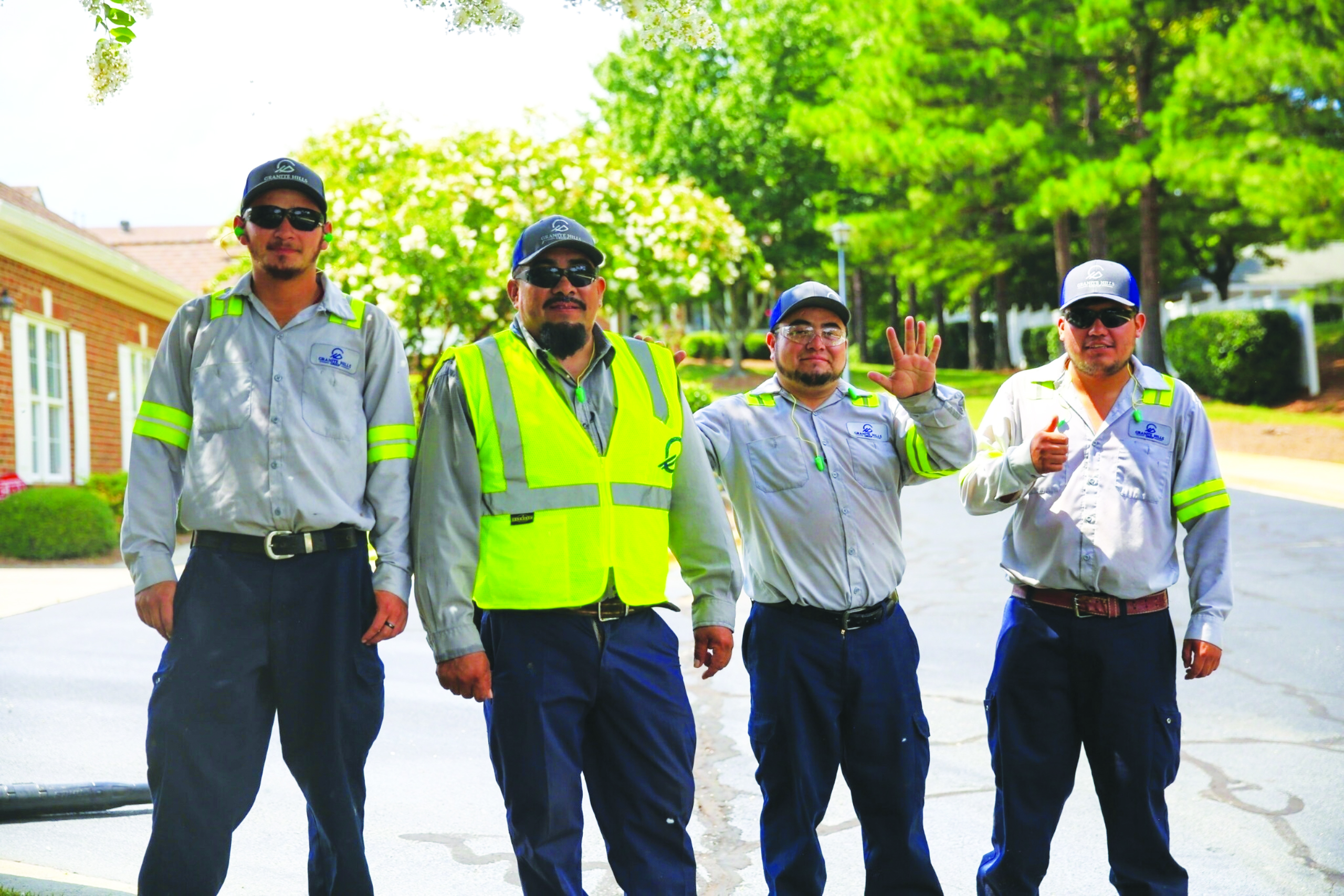
This has led to greater success and growth, as Eleazer points out each former owner can bring in their own knowledge and expertise.
“We’ve created our own internal peer group now,” Eleazer says. “We have owners from every aspect of the business that sit and talk on a weekly basis. We share the good, the bad and the ugly to figure out how we can overcome and make it better for these individuals.”
Martin says he’s just one of the people who’ve come onboard at Granite who truly appreciates the open-book policies.
“It’s giving people an opportunity, if they come out and perform, that there’s career growth and income growth,” he says. “Also, it’s all for the team and not for the individual. For the business owner to open financials to the whole team — you don’t see a lot of that. We’ve just leaned into that and we’re a total open book to our people. Anybody on the team can go on and see how they’re performing, how their peers are performing and how the company as a whole is performing. They can see how their performance drives the overall results of the company.”
And Eleazer adds there’s no rulebook thrown at companies who are acquired.
“We’re not going to come in there and tell them to stop what they’re doing and go by the Granite Hills playbook,” Eleazer says. “We let them run their business as they’re running it and, slowly, we integrate the best processes and best procedures.”
Martin adds that this emphasis on internal promotions helps Granite Hills stay ahead of the industry’s biggest issue — labor.

“Everybody has the labor challenge,” Martin says. “The way we overcome it is by bringing in that QB position of VP of HR and building out a team of recruiters on the frontlines to help recruit and retain talent at all levels. That has been a gamechanger for us.”
But the business is growing so fast that Eleazer mentions his biggest concern is being able to maintain this focus and give all employees the opportunities they deserve.
“Something I take very seriously, and probably lose sleep over at night, is being able to provide those career opportunities and promotions for people who deserve it now fast enough,” he admits. “We can only grow so fast. We have such good talent in our company right now that deserve to be in a better position. My goal is to help make sure that we’re providing for them and giving answers to people who ask, ‘What’s next for me?’”

Explore the May 2025 Issue
Check out more from this issue and find your next story to read.
Latest from Lawn & Landscape
- Autonomous Solutions acquires Scythe Robotics
- Our March issue is now live
- New Holland Construction's E12D mini excavator
- Caterpillar enhances Cat Rentals for modernized experience
- Work Truck Week's kickoff Green Truck Summit event to rebrand as Future Truck Summit in 2027
- Kubota's SVL110-3 compact track loader
- Green Lawn Fertilizing/Green Pest Solutions donates $100K to Children’s Hospital of Philadelphia
- Bartlett Tree Experts adds Lee Gilman & Associates