Editor's Note: This article originally appeared in the September 2025 print edition of Lawn & Landscape under the headline “Everyone needs to own it.”

There are a few evolutions in learning how to grow a landscaping business that will call for a company to bring on more talent.
Taylor Milliken, CEO of Milosi, says there were three major milestones where he added management.
“My first manager was at $1 million when you find yourself running around with your hair on fire and trying to do everything and every position, but things began to slip, so you know you need to add some talent,” he says. “Whenever you go to start hiring out that first person — you have to look at what your God-given talents are, and mine are not operations. So, it made sense to first hire an operations manager.”
Milliken also says that at the $5- to $7 million range, a business owner needs to find more management that will keep them accountable.
“I was breaking all the rules because I was the owner and could make those decisions,” he admits. “Around that $5-$7 million mark, I began to delegate line items on the P&L to where I no longer had ownership…that was a major shift in our company. We became much better stewards of our finances.”
Now, at $16 million in revenue, Milliken says the company is once again making changes in terms of management.
Milliken was just one of four panelists on the Lawn & Landscape Business Builders Summit “New Level of Accountability” panel to help attendees learn how to delegate and how to improve their leadership skills.
Additional panelists included Brad Stephenson, CEO of New Castle Lawn & Landscape; Jess Milligan, president of Strathmore; and Justin O’Connor, owner of Growing Season Landscapes.
It all starts with delegation
Panelists reminded attendees that great leaders are only great if they learn to delegate and not shoulder everything themselves.
“To me delegating is all about, ‘How do I empower somebody else to grow upward in the company?’” Stephenson says. “At New Castle, everybody has started at the bottom, and you give them more and more responsibility and challenge them and then they start growing.”
He adds his leadership style is a bit unusual — but hinges on delegation.
“I’ve always grown people, and I would delegate everything,” he says. “I list out all the things that I don’t like to do, and I delegate it. The surprising thing is some people actually like to do all the things that you don’t like to do.”
Milligan recalls when her and her brother took over the business, they jumped right into their parents’ respective roles.
“I was the worst bookkeeper to ever exist,” she says. “Pretty quickly I learned that somebody else would do the bookkeeping properly and my strengths were more in operations.”
That’s why now Strathmore is focused on fitting employees into roles where they will flourish.
“We made sure that as we grew, everybody was working within their strengths and you’re not trying to combat their weaknesses,” Milligan says.
The company also recently added a few vice president roles to the staff.
“When we crossed the $50 million mark, we knew $100 million was right around the corner,” she says. “We knew we had to get some outside perspective so they could help us clean things up now so the next doubling, and even tripling, of the business was done successfully.”
Milligan says delegating important tasks is not always easy, and business owners are known for not liking to relinquish control. Still, it's an essential skill to master as you learn how to grow a landscaping business.
“The really challenging one to delegate was HR — our teams are the most valuable asset we have, and for the longest time, that was just something that I couldn’t give up,” Milligan says.
For Milligan, adding this executive team of VPs has changed her intrinsically as a leader. “Because now I’m managing the people who are responsible for the next three years and not the next three weeks,” she notes.
And like anything else, delegation is a learned behavior.
O’Connor says his early attempts never went 100% right.
“When I first started delegating, you go off the job description and that ultimately fails,” O’Connor says. “People are going to do the best they can do, but if you don’t have correct scorecards and metrics and KPIs to score each other on, what they think is good and what you think is good may be two different things.”
Be there, be supportive
That’s why O’Connor says the most important part of having any number of direct reports is open, consistent communication and meeting regularly.
“The three things I’ve implemented is empowering them to make the decision, having the correct KPIs and scorecards — because they need to know if they’re winning or losing — and the last thing, which has been huge, is consistent one-on-one meetings,” O’Connor says.
With his direct reports, Milliken says he’d rather they create the game plan than him hand down rules or ultimatums.
“What people create, they will own,” he says. “If I tell my direct reports what to do, they’re less likely to adhere to it because they didn’t create it…but come hell or high (water), they’re going to make their idea works.”
That harkens back to meeting regularly with direct reports and really listening to their successes and struggles. Milliken says a leader shouldn’t be the one talking for the majority of those meetings. These meetings should also be about getting direct reports to open up about their weaknesses and what areas of the job they don’t enjoy.
While reassurance is all well and good, Milliken and O’Connor both note the importance of these meetings in having an actionable goal to work toward before the next one.
“A lot of the times, it’s not about how did the meeting go — but how did the meeting end?” Milliken says.
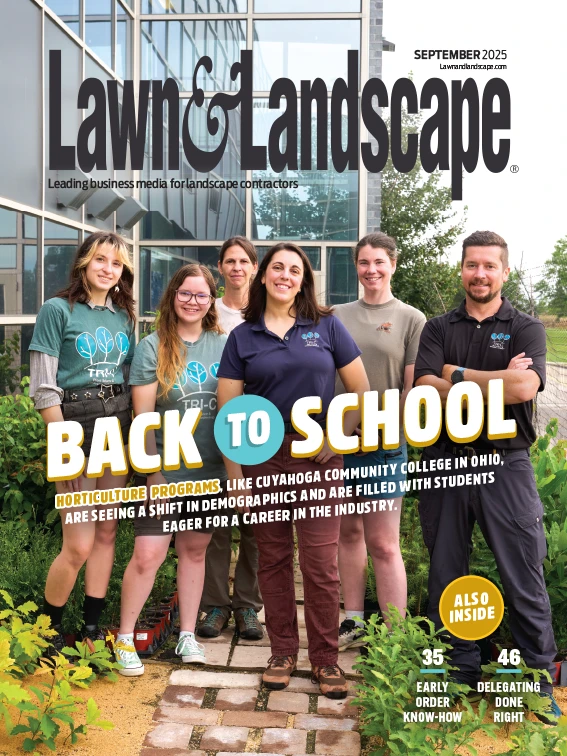
Explore the September 2025 Issue
Check out more from this issue and find your next story to read.
Latest from Lawn & Landscape
- The Harvest Group opens registration for virtual series on compensation strategies
- Granum, Weathermatic enter multi-year strategic partnership
- Rockit Pest adds Green Solutions Lawn & Pest Control in Tampa
- Riverview Landscapes acquires Cleveland Brothers Landscaping in New York
- LandCare promotes Kelly, Majczan to Northeast leadership roles
- Massey Services has acquired Solve Pest Pros of Jacksonville, North Carolina
- Takeuchi-US names Lisitza, Dickerson as regional managers
- New Holland debuts Workmaster 35C and 40C compact tractors