Alpine Gardens
Editor's Note: This article originally appeared in the May 2025 print edition of Lawn & Landscape under the headline “All fired up.”
“We’ve never done the same one twice,” says Kris Nylander, sales manager at Alpine Gardens based in Fort Collins, Colorado.

Nylander estimates that half of his fire feature projects are prebuilt, off-the-shelf and housed in a gathering space designed specifically for this centerpiece. Others opt for a multi-use outdoor living environment — a platform for a fire feature without a complete commitment. Portable units can be tucked away when not in use.
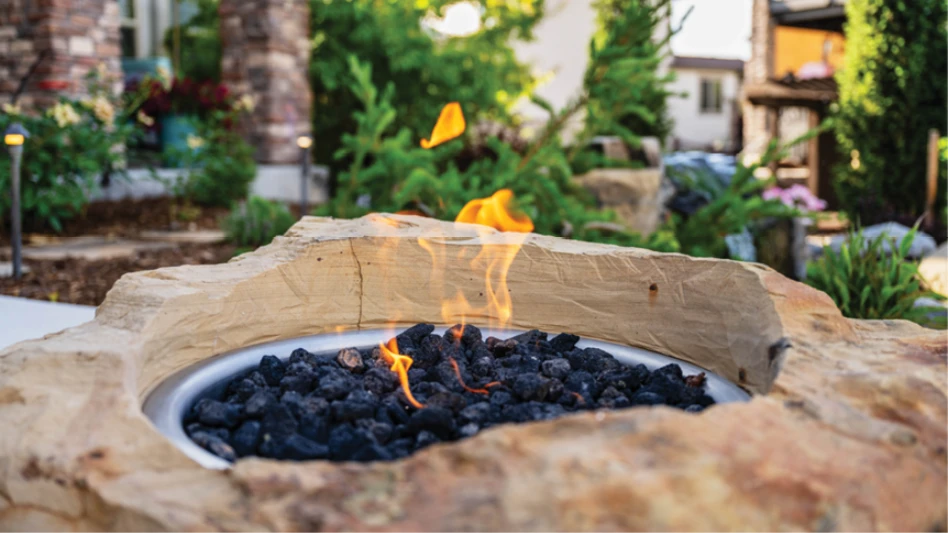
Alpine Gardens creates plenty of hybrid fire pits, too, employing prefabricated pits that are finessed with hardscape, stonework or sleek metal touches.
“We are seeing more modern designs with steel that are more decorative versus the traditional stone fire pit,” Nylander says.
The lure of fire features positions this design/build focal point as an easy sell, whether incorporated into a main design or as a second phase.
Jen Kloter at Bahler Brothers in South Windsor, Connecticut, also reports a “definite increase” in demand for fire features, a move toward sleek designs and interest in portable setups.
“People want flexibility,” she says, adding that fire preferences also span from campfire-style wood-burning features to cast-concrete fire pits that double as art.
“It really depends on the family dynamics,” she says, echoing the variety of options available and nuances of each project.

Form and Function
With any fire feature project, Nylander says conversations with clients begin by addressing location — they must identify municipal regulations and the property’s layout, which informs where a fire feature can be safely, practically placed.
In Nylander’s area, regulations can present permitting challenges for certain fire features.
“There was a period of time when building a custom fire pit in Fort Collins was significantly more expensive and difficult because of the permitting and safety requirements adding thousands to the cost,” Nylander says.
Concealing pilot lights and dealing with auto shut-offs can get complicated and extend beyond some clients’ budgets.
But prebuilt fire pits powered by propane do not need a permit.
Nylander adds, “We always ask clients how willing they are to submit plans and go through an inspection process.”
Some municipalities enforce tight regulations while others are relaxed. But location still factors heavily into design and space planning.
“Some families with teen kids want the fire pit separated off so they can have their own area, and others want the feature closer to the patio as an added attraction of their home,” Kloter says, noting that proximity to an existing natural gas line also matters.
But in Bahler Brothers’ service area, propane is a go-to power source for homes and a primary fire-burning fuel for outdoor living features.
“We are very aware of what type of a fire clients want to build and the size of the fire pit — how big of a fire it can produce,” Kloter adds.
The company recommends placing fire boxes at least 20 feet away from anything combustible. “Standard fire pit kits can’t make a terribly large fire and, if they are built properly, the pit will contain that fire,” Kloter says. “But if someone is installing a 6- to 7-foot fire pit made of boulders and burning wood, they are going to have some rip-roaring flames and it better be 30 to 40 feet away from the house, near a water source and clear of overhead trees.”
Kloter adds, “We definitely tailor the type of fire a burner produces to the design application and how it will function for the client.”
For instance, fire tables have caught on and offer an appealing aesthetic. They should have a valve to adjust the flame height and amble tabletop space around the burner. “You don’t want the heat right in your face,” Kloter points out.
Speaking to tailored burner applications, Kloter describes a project on a lakefront property. The gas fire feature includes a custom-shaped burner that sets into a dry creek bed. When ignited, the flame rises from the boulders. When off, you can walk right over it. “If you’re tight on space, there are options,” she says.
When space constraints are a concern, Tyler Burr might suggest a hardscaped or landscaped setting that can house a fire pit — or not. “You want to be sure the fire pit does not interrupt traffic flow from a design perspective,” says Burr, vice president of D.W. Burr Landscape and Design in Simsbury, Connecticut.
Relatively few clients decide to make a fire feature the No. 1 focal point, but this is certainly the case when designing and building pavilion spaces that include a fireplace. Burr says he notices a “less or more” trend with “people interested in going full-blown with a fireplace or doing more of a mobile fire pit without the commitment.”

Warming Trends
Fire features are making appearances on commercial properties such as private clubs, apartment complexes and high-end retail environments with mixed-use shopping and dining destinations that promote gathering.
Burr describes a golf club project where his company is installing two large natural-gas fired pits with auto ignition systems and emergency shut-offs.
“In a public setting, you need those features because many different people may be using them,” he says.
Nylander adds, “Safety devices are key on commercial sites where you don’t have the consistency of the same person using them all the time. In this application, you usually see restrictions requiring shut-off timers.”
But at home, bells and whistles like remote-control igniters tend to fail.
“On residential projects, I always encourage clients to choose match-lit because we find auto-ignition and shut-off systems to be fickle with regard to gas,” Burr says.
A technology that’s hot and for good reason is the smokeless burner and prefabricated smokeless units and burners that can operate under water. “There are a lot of inserts available that are almost smokeless, and the key to installing those is making sure the fuel load is below the rim,” Kloter says.
The reasons fire smoke is because of lack of heat or oxygen (or both), or the wrong fuel. Smokeless systems generate more airflow and burn hotter.
These systems, fueled by propane or natural gas, can be advantageous in areas that tend to have “ozone days” and air quality warnings that prohibit burning wood, Nylander points out.
What about wildfires’ impact on adding a fire feature to designs? Nylander, Kloter and Burr do not see any cool-off in demand.
Nylander says, “People love to have fire tables and fire pits — it fits with the Colorado vibe.”

Explore the May 2025 Issue
Check out more from this issue and find your next story to read.
Latest from Lawn & Landscape
- Wilson360 names Anderson as featured speaker for Thought Leaders Retreat 2026
- Kubota introduces SVL110-3 compact track loader
- Hittle Landscaping acquires Wesley's Landscape & Lawncare
- Aquatrols Company's Precip Acres
- JCB debuts 250T compact track loader, 25Z mini excavator at ARA Show
- Agri-Fab's weed eliminator
- New Holland Construction expands D-Series range with 5 new diesel mini excavators
- WAC Lighting founder earns Long Island Business News Icon Award