Editor's Note: This article originally appeared in the March 2026 print edition of Lawn & Landscape under the headline “Travel takeaways.”
H-2B and other Capitol Hill happenings
NALP’s Andrew Bray gives an update on the most pressing concerns within the green industry.According to Andrew Bray, NALP’s senior vice president of government relations, 2026 should be a solid season for landscape contractors looking to utilize the H-2B program.
Bray told attendees at NALP’s annual Leaders Forum that once again 64,716 visas will be released this year. That’s four years in a row with the same number of available visas.
About 18,490 will be available immediately until March 30; another 27,736 will be available starting April 1 (plus any rollover from the first release); and 18,490 become available May 1 (plus additional rollover).
“I see a scenario where most people get their visas this year,” Bray says. “Remember it could be a little bit delayed, but I feel pretty confident it’s going to be a good year for everybody.”
Bray says he feels like anyone in sections A and B in the lottery system will have no issue getting their visas on time. He adds he’s fairly confident those in groups C, D and E will also have labor for the year.
Bray notes that the returning workers provision stays in place but the Northern Triangle carveout (for workers from El Salvador, Guatemala and Honduras) has been removed.
In addition to updating attendees on all things H-2B, Bray took the time to address the ongoing ICE incidents happening across the nation.
“The No. 1 thing you need to be is prepared,” he says to attendees.
Though Bray notes it’s not enough for business leaders to have a plan, but for that plan to be crystal clear to everyone in the company from branch manager on down.
He adds that during these difficult times Trust, empathy and listening is of upmost importance.
Bray added that legally, ICE enforcement officers are allowed to stop individuals for the way they look, speak and if they’re working in several industries including landscaping and construction.
“Please take this seriously,” Bray warns.
In addition to giving his H-2B update, Bray ran over some other common concerns facing the green industry that NALP is helping businesses combat.
The first being pesticide use and regulation. Bray says he anticipates the Trump administration, and the Republican Party’s, Make America Healthy Again initiative to include some kind of legislative push to ban or reduce pesticides.
“MAHA has done their vaccine work and now they’re getting ready to go after pesticides,” he says. “It’s slowing things down.”
Bray predicts the pressures from MAHA will last throughout 2026 and into the next election cycle.
“This won’t change until after the midterms,” he adds.
Conversely, Bray says Trumps administration is halting most of the gas-to-electric mandates that had been creeping up in recent years.
When it comes to water though, Bray says to be prepared for regulations to continue. However, he notes that these are typically on a state or municipal level rather than federal.
“You’re getting pressure on turf, and other green spaces, on their use of water,” he says. “We’re trying to do everything we can to combat it. These problems are there and while they might not be in your state right now, we need you to be ready because they could be coming.”
Profitable prophecies
Taylor St. Germain of ITR Economics gives his outlook on the economy and challenges facing the green industry.
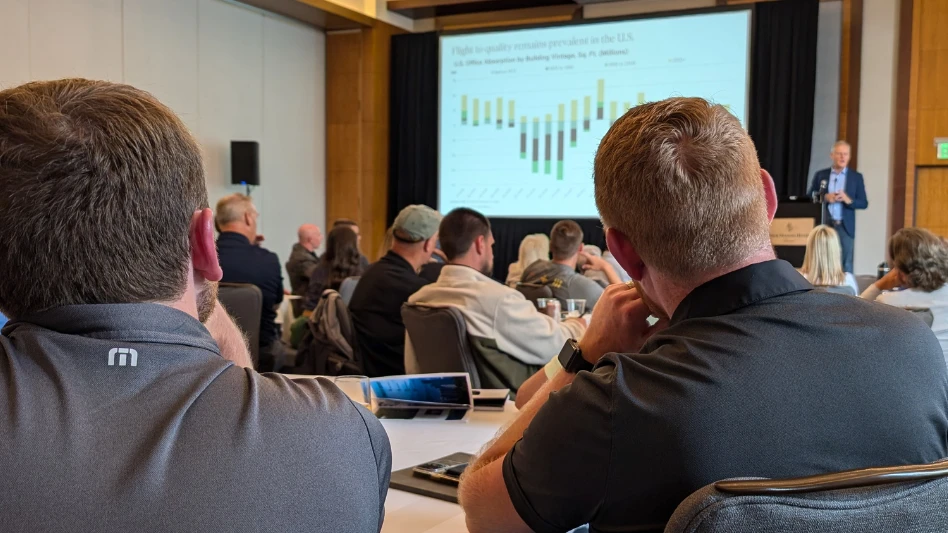
Attendees at the NALP Leaders Forum also got an in-depth look at economic trends on the horizon during a presentation from Taylor St. Germain with ITR Economics.
“I want to cut through the uncertainty you all may be feeling,” St. Germain tells attendees. “We do not have a recession in our forecast for the second half of this decade.”
However, St. Germain says a challenging economic downtown is expected in 2030.
But until then — St. Germain gave his outlook on the global economy, inflation tariffs and everything in between.
TARIFF TAKEAWAYS. After a few years of economic uncertainty. St. Germain says that cloud is starting to fade and there is a bright future ahead.
“Businesses are growing more confident, projects are moving forward,” he says. “It’s good news to see this uncertainty coming down.”

St. Germain says since President Trump took office for his second term, confusion and worry over tariff costs have plagued many industries, including the green industry.
“During the time Trump announced the tariffs, we saw record-breaking numbers of uncertainty,” he says. “We were more uncertain in early 2025 than we were at the height of the COVID-19 pandemic.”
St. Germain says countries like China and Canada have been “losers” in the tariff debacle so far, while countries in the European Union have benefited.
Though he adds it’s still too soon to know the full effect of Trump’s tariffs.
“It is likely we face higher inflation as a result of these tariffs, and it’s our opinion we have not felt the weight of these tariffs in full at this time,” St. Germain says. “These tariffs are something we have to get comfortable with and something we have to get used to.”
But despite the troubling tariffs, St. Germain says the global economy is in good shape.
“The global economy is accelerating in its pace for growth,” he notes. “We’re expecting the global economy to continue to improve.”
For the U.S. economy, St. Germain says his company is also optimistic and expects it to continuing expanding.

“Spending is growing above the rate of inflation,” St. Germain. “2026 is going to be a lot better year than what we saw in 2025.”
INFLATION INFORMATION. While inflation isn’t expected to be as bad as it was during the pandemic in 2021-22, St. Germain still warns of its impact.
He urges business owners to be more productive, more efficient, and keep from falling into what he calls “profitless prosperity.”
“I’m not worried about your sales or revenue — I’m worried about your margins,” he says. “That’s the big concern we have over the next four years.
“Be laser focused on your costs,” St. Germain adds.
In dealing with inflation, St. Germain says Americans are seeing the highest median salary in history of $62,500 per year. This will continue to increase, as labor costs are expected to increase an additional 4- to 5% each year over the next four years St. Germain reports.

“We have more Baby Boomers leaving the workforce than we have Gen Z entering the workforce, which gives us this upside-down labor market,” he adds.
In one more not on inflated prices, St. Germain says electricity costs in numerous states is expected to increase significantly as well in the years to come.
LOWDOWN ON LABOR. But back to labor costs, St. Germain says hire this year if at all possible.
He adds that the green industry especially is seeing more people in its workforce than ever before — a record-breaking 919,000. But he says the growth rate of the industry is starting to slow down so it’s important to focus on recruiting and retention.
“It will continue to be a challenge moving forward,” he says adding that one hurdle facing the industry is current immigration laws.
Another factor in the slowdown is that Gen Z is reluctant to join not only the green industry but the workforce in general.
“We cannot understand how to get Gen Z to join the workforce — it’s almost laughable at this point,” St. Germain notes. “They are the wealthiest 16 to 24-year-olds we’ve ever seen in this country. Gen Z also has the wealthiest parents to ever live in the U.S.”
St. Germain encourages businesses to branch out and form partnerships with not only colleges but high schools and trade schools as well to find their next generation of leaders.
“Partner with schools and colleges because we need to find ways to get these young people excited about the workforce,” he says. “College enrollment is dropping and trades are picking back up. That’s an encouraging sign for Gen Z.”
Explore the March 2026 Issue
Check out more from this issue and find your next story to read.