Austin
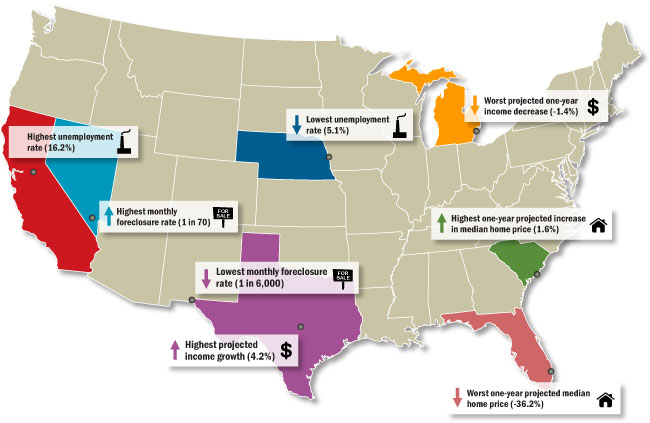
Austin, San Antonio, and the rest of southern Texas have fared well compared to the rest of the nation. Last summer, a report from Wells Fargo showed that the Austin economy had already stopped declining and was perhaps even on the mend. But it’s not out of the woods yet: the housing market has flattened out, making things challenging for many in the landscape industry.
Jonathan Quick, owner of Great Scapes Landscaping in Round Rock, Texas, says that though property values haven’t declined in the Austin area as much as in other parts of the country, homeowners aren’t spending as much as they used to. That’s made competition fierce. “I used to go to bid on projects with one or two guys,” he says. “Now I’m bidding against seven or eight. We’re just not lining up residential work like we used to.” As a result, Quick says he’s started to add more commercial work to his lineup. He’s doing what he can to make up for those lost residential jobs.
Being diversified and adapting to change has also helped South Texas Growers, based in Bulverde, survive the drop off in residential work. “We offer landscaping and irrigation but also have a wholesale and retail nursery and have found that our plant sales have actually gone up,” says Joanne Hall, vice president. “Those new projects on brand new homes aren’t out there anymore, but we’ve found that residential clients want to put money into existing landscapes. One area may not be as lucrative as it used to be, but another area has taken its place.”
Of course the sometimes-extreme weather also has an impact on the state of the industry. Hall says this past winter was colder than average, so come spring, homeowners invested more in replanting.
Drought and water issues also plague the region, which can be good and bad. It’s made drought-resistant and native plants a more popular trend in the area and Hall says she’s certainly seen homeowners more interested in purchasing these. But it also makes certain landscaping efforts virtually impossible when the land is in such poor shape.
Kevin McCormick, president, Botanical Designs in San Antonio says he’s seen a trend toward more people renting in his area than ever before. “Homeowners aren’t necessarily getting foreclosed on, but they’re just saying they don’t want the hassle or the worry of owning anymore and they wind up renting,” he says. “That’s definitely impacted the amount of residential work available.” – Lindsey Getz
El Paso, Texas
While the rest of the country has been hit hard by the economy, El Paso, Texas has fared well – in some regards. The city has the lowest foreclosure rate in the country, one in 6,000 homes, and for a stretch of more than a year, the local unemployment rate has been below the national average. But in September, the city’s 10.2 percent unemployment rate was higher than the rest of Texas and the national average.
That up-and-down news goes along with what most local landscape contractors are saying about the market – for some it’s good, for others, not so much.
“It’s down a bit but it’s not terrible,” says Joel Jones, co-owner of The Growing Concern. “Our company is off about 8 percent from last year. Last year was a better year for us than most I would suppose.”
A big part of the city’s economic boom is thanks to Fort Bliss. The 34,000 families expected to move in by November 2012 means there could be a lot of landscaping work to be had.
But companies still have problems, such as rising healthcare costs and changes to the taxes they’ll pay.
“The fact that we don’t know how much anything is going to cost anymore – we don’t know what our overheads are going to be, we don’t know how the government is going to apply taxes and restrictions, so that’s made it difficult,” Jones says.
Jones says he hasn’t laid-off anyone in his 30 years of business, but he now is looking at the option of letting go of employees during the slow season.
Pattie Fell, owner of Ransom Lawn Services, says she’s looking forward to 2011, but Joe Talamantes, owner of Arbor-tech Tree Experts and Talamantes Door Designs, doesn’t have such a rosy outlook.
“Any other little needle that punctures a hole in this flat tire makes it harder to pump it back up,” Talamantes says. “I’m telling you we have a difficult, difficult time right now. I know guys that come around here and beg me for work.” – Brian Horn
Omaha
Omaha, Nebraska – what’s not to love? The world’s third wealthiest person – Warren Buffett – likes it enough to call it home. Fred Astaire grew up there. So did President Gerald Ford. And plenty of other, less-famous people enjoy its unemployment rate – at 5.1 percent, the lowest in the nation.
Those odds seem great if you have a business in the area, but Bryan Kinghorn, owner of Kinghorn Gardens, doesn’t agree. He believes Omaha has the lowest unemployment rate because there are fewer people in Nebraska than other states, which skews the stats.
“Nebraska isn’t that populated of a state. As you go west, it’s pretty scattered. The state’s economy is more diversified in that way so we don’t go through cycles, so there’s a little more stability,” he says. “But by the same token, people in the Midwest are fairly conservative. Even though the economy is more stable, it’s not like they’re overly eager to be loose with their disposable income. There’s a tendency of us to be more even-keeled.”
While employment may be up, the housing crunch is very much alive, says Dan Mulhall, which complicates things even more.
“There aren’t any new houses going up so a lot of it is the lack of new home construction, the lack of people changing homes, the lack of subdivisions being built. All of that has translated into less landscaping,” says the vice president of Mulhall’s, which offers customers a landscaping service, nursery and garden center.
Because Mulhall’s grows its own plant material, it has tried to incorporate landscaping deals with the nursery and garden center to generate more revenue.
“We have reduced the prices (on plants),” Mulhall says. “We’re trying to encourage people to buy.”
Kinghorn hopes that will change.
“People take great pride in their homes here,” he says. “They’re given a reason to do what needs to be done to have their properties look good and retain their values through our services and products. They’re going to probably invest some dollars in that direction.”
But as of now, Mulhall doesn’t see much changing any time soon.
“From a landscaping perspective it’s going to stay the same,” he says. “We’re not seeing things being dug and steel coming out of the ground. That will tell us if we’re turning the corner on the landscaping side.”
While Kinghorn thinks business will stay consistent for now, he also says competition among landscape businesses in the area will contine to increase thanks to Midwesterners’ conservative and cautious natures.
“(Customers) are going to think twice about (services) and check prices and see where you fall in the competition. It’s going to help us all be better businesses,” he says. – KP
Miami
Big gray clouds clustered high in the sky over Miami late one morning during the first days of September. A hurricane roared just up the coast, its eye over the Atlantic but coming fast for the edges of North Carolina, the residual rain on its way south toward the otherwise beautiful white sands of South Beach.
The rain has been some sort of constant this summer in Miami, almost always around – figuratively, at least, if not literally. The unemployment rate in and around the city checked in at 12.8 percent in June, according to the U.S. Bureau of Labor Statistics, almost 2 percent higher than in January and, in fact, the highest rate for a single month during the last two decades. The projected decrease in median home price is a staggering 36.2 percent. Factor in foreclosures – only two states in the nation have a higher rate of foreclosure than Florida, and only one has a higher rate of foreclosure filings – and the market is as challenging as possible for those in the local lawn and land care industry.
Latest from Lawn & Landscape
- Develon unveils -9 Series heavy excavators
- News you might've missed last week
- Lifescape Colorado's Hupf moves to regional role as Ostheimer becomes president
- Your most reliable predictor of success
- LandCare names McCallon, Miller as branch managers
- Takeuchi-US names Paul Wade, Eric Wenzel as dealer development managers
- CASE continues partnership with country artist Jon Pardi
- Greenlee debuts new battery-powered remote pruner





