From streaming services preferred to the sports you played in high school, our census paints a picture of your personalities and interests.
You use Facebook more than any other social media platform. Landscaping was not your first career choice. Yet, if you had to do it all over again, you would still work in the green industry. That’s just a peek into our 2025 Lawn & Landscape Census. The census data was collected in early September and the results are based on more than 150 respondents. The goal of the survey is to get an idea of what life is like outside of work. We’ve also spoken to a handful of landscapers about their activities in their personal time.
All totals won't equal 100% due to rounding.

Fall seven times, stand up eight
Ed Arens, owner, E&M Outdoor Services
For Ed Arens, there’s nothing more rewarding than watching that fledgling skater finally feel at ease on the ice and take off after the puck. When he’s not running his company, E&M Outdoor Services of Minnesota, Arens is at the ice rink either as a coach or an official.
“I grew up playing hockey in high school,” he says. “In college, I decided not to play college hockey but to go become a ref instead. I’ve been (officiating) since 1994. I did it until about 2001 and then took some time off.”

As a father of four now, Arens says he’s excited to be back on the ice.
“I have an 8-year-old son who started playing hockey when he was five, so I’ve been coaching him for the last three years,” he says. “I coach his team three days a week once the season starts and that’ll run through March.
“I got back into it about seven years ago and I absolutely love it,” Arens adds of officiating. “I referee all ages but mostly I try to pick up games that are ages 16-years-old and lower. High school games, a lot of refs like to ref those games because they’re a little more intense, but I like the slower pace ones.”
In addition to his duties as an official and being the coach of his son’s 8U team — Arens says he also volunteers his time with the youngest of hockey players.
“Right now, I coach a program called Learn to Skate, where we get kids four to six interested in hockey who have never skated before,” he says. “For me as a coach it’s fun to watch them first come onto the ice and not be able to skate at all. We have 11 weeks that we work with them, and over that course of time, you watch them not be able to skate at all to being one of the fastest skaters on the ice. That’s rewarding to watch.”
The Learn to Skate program now has a special place in his heart, Arens says.
“The biggest thing it’s taught me is patience,” he says. “When you work with kids who are four, five and six, you have to have a lot of patience. They’ve never skated before, and they get out there and are frustrated because it takes them a little while. They don’t like falling down. They’re afraid to fall down.”

Arens says he likes to change the narrative when it comes to the kids falling and try to inspire them to persevere.
“One of the things I like to tell them is to sit and watch professional hockey and count how many guys fall down and how many times they fall down,” he says. “People fall down in pro hockey all the time.”
While hockey season has become some great family time for Arens, his son and his wife and other children — Arens admits that the drive to inspire the kids would keep him on the ice even once his own kin outgrow the sport.
“If he decided to get out of it today, I’d still want to referee and coach some of the other levels,” he says. “We have a small town hockey association and we rely heavily on parents coaching and volunteering.
“I’m 51, so my time skating on the ice as a coach has about 10 years left before it’s a little more difficult for me to coach,” Arens adds. “(Officiating) is a little bit simpler because all you have to do is skate up and down the ice — you don’t have to get physical with the stick or skate around cones.”


Putting in the miles
Derek Taussig, CEO, Taussig Landscape LLC
It may seem unthinkable to go out and run 100 miles through the mountains, but that’s just a typical race day for Derek Taussig.
As a business owner, Taussig says he was very familiar with the Wheel of Life assessment but wanted to improve the health & wellness segment.

“It started out because of the life wheel and how one of those segments is health and fitness,” he explains. “I’m a recovered alcoholic, and I was a chain smoker for a bunch of years, so when I quit drinking and quit smoking, I put myself more into my life wheel…I realized I didn’t really work out, and I wasn’t that fit.
“So, I needed a goal with a low barrier of entry. I live out in the country, so I decided to pick up running. I figured I could put on a pair of shoes, leave my driveway and get started — no big deal. I set a goal to win a 5K…and I did. So, after that, I needed a bigger, scarier goal.”
Taussig started running ultra marathons in 2023 and has since run 15 of them — including two 100-mile races.
Most recently, he competed in the Wasatch Front 100-Mile Endurance Run just outside Salt Lake City, Utah.
“It’s 100 miles with 24,000 feet of vertical gain. That took me 32 hours to finish. I got sick and was throwing up for about eight hours — it was kind of a wild ride,” he recalls. “I went out nine days early, because of elevation, and camped in my truck and tried to camp at the highest elevation points for a few days before the race just to acclimate my body.”

Pushing his body to the physical limits has not only been great exercise, but Taussig says it’s opened his mind to so many things as well.
“It has taught me tons and tons and tons,” he says of running ultra marathons. “When a race goes really well, I enjoy it and it’s fun, but it’s when it goes south that I really learn the biggest lessons.”
Taussig recalls during the Black Canyons 100K in Arizona when he started experiencing heat exhaustion, was throwing up and ultimately struggling.
“I hit these really low points. But I just had to put myself in gratitude during those times,” he says. “I didn’t want to get lost in the ‘this sucks’ or the ‘I did this to myself.’ I tried to focus on how I had the freedom to do this, could afford to buy the plane tickets and a family that’s supportive of it. Even in the bad times, when I focus on gratitude while I’m suffering, it made it worth it and helped keep me focused on my goal.”
His running has helped him so much as a leader as well, Taussig says.
“It’s a major outlet for stress,” he says. “If I’m feeling really frustrated or am overwhelmed, if I go for a jog — I organize my thoughts and get some free space in my mind and can come back refocused and reenergized to deal with things one problem at a time.
“I hope I’m a runner for the rest of my life,” Taussig adds. “I still haven’t fulfilled all of my purpose or my ‘why’ in running yet. I’m still testing the mental and physical limits of myself and have not reached the end of that yet. I’m inspiring everyone around me to be the best version of themselves through my fitness, and I feel like I have to keep doing big, crazy things to catch people’s attention.”


Under the sea
Lisa Knapp, horticulturalist, Ohio Green Works
What started out as innocent envy of a friend more than a decade ago has transformed into a beloved hobby for Lisa Knapp.
She became a PADI open water scuba diver in 2011.

“A friend of mines dad was getting certified and didn’t want to go by himself, so he talked my friend into going with him. When he told me that he was going to learn how to scuba, I was so jealous. I had always wanted to but never had the opportunity. It was a year later when I decided it was time,” Knapp says. “It’s so much fun. I’ve only been on four trips. It’s not a cheap hobby.”
Knapp says she’s gotten to experience some exotic destinations through her scuba travels.
“My first trip was in 2012,” she recalls. “The people I dive with go to Cozumel every October… it’s fun and we dive in costume one day because it’s close to Halloween. I’ve done that trip twice.
“I’ve also been to the Great Blue Hole in Belize on a liveaboard,” Knapp adds. “That was a fantastic trip. The deepest we went was 129 feet and you can only stay down about nine minutes because of the pressure and losing so much air.”

In a serendipitous turn of events, Knapp met someone else with green industry experience. He was a medical professional on a research diving trip she won a spot on.
“He was actually going to school to be a landscape designer but changed his mind at the last minute and decided he wanted to be a doctor,” she says. “In 2019, I won a trip through Divers Alert Network. They do testing and different medical research…they were doing research on something to do with the heart. They picked 12 people to go on this trip, and I was one of them.
“This was definitely a bucket list trip to the islands of Socorro,” she adds. “It’s down in Mexico, south of Cabo. We were on the liveaboard for the entire time, which was about 10 days.”
While Knapp wasn’t selected to be tested, she says other participants received ultrasounds on their heart after diving to see if nitrogen crossed through certain valves of the heart.
“They need victims, so they have people sign up for these trips and they pick so many,” she jokes.
What Knapp says she loves most about diving is all the amazing things to be seen underwater.
“There were lots of big animals,” she says. “I got to dive with a giant manta ray that was like 22 feet across. They’re very friendly and are known to interact with people. You’re really not supposed to touch anything down there, but I could’ve touched this one. It was that close!”
And while some might say they’re scared to scuba near sharks, Knapp isn’t one of them. She admits she isn’t the type of person to panic easily.
“There were sharks and if something happens, it happens,” she says. “I mean, you’re in their living room. What would you do if a predator came into your living room?
“It’s just amazing that there is so much life down there,” Knapp adds. “We live on ground, and you take everything up here for granted — the birds, the trees, the bugs. But being out on a boat and seeing how amazing the ocean looks, and the sky, is just amazing.
“To be in the water and see everything is just incredible. There’s so many different things and it’s so diverse and it’s just a whole new world.”
Leaving on a jet plane
Jared Dorsey, founder, Everything Outdoors
Jared Dorsey says when he turned 30, he knew it was time to get serious about his desire to start traveling the world.
“It was always a goal of mine to take some time off to travel around,” he says. “At first, I debated selling the business or putting someone in place to take a year or two straight off. I have a plan right now to work six months and then travel for six months for the next like three years.”
Dorsey says this “work hard, play hard” mindset of his has always been how he does business. “I’ve always been into the ‘all or none’ mentality,” he says. “I work about 80 to 100 hours a week every week. I’d rather work 100 hours a week for six months straight and then take six months off then just work 50 hours a week for a year.”
This year alone, Dorsey went to just shy of 30 countries across multiple continents. The number of miles he traveled was enough to circle the globe almost three times.
“I went to 28 countries — it was about 70,000 miles that I traveled,” he says. “I went to 18 countries in Europe, then Southeast Asia, Australia, New Zealand and Hawaii.
“Everyone always asks me what was my favorite place — and it’s probably Vietnam. That was probably the top. New Zealand and Iceland were favorites, too,” Dorsey adds.
He’s already mapping out the itinerary for his next adventure. He will be gone March through September relying on managers to run the company. He returns in time for the company’s busy holiday lighting season.
“I’m going to visit every country in South and Central America,” he says. “I also want to do a little traveling in the U.S., Canada and the Caribbean. It’ll be a little over five months of traveling. It’s more about the goal to see the entire world rather than going on vacation for five months.”
Dorsey says his travels have taught him a lot about not only landscape design, his specialty, but also about different cultures and ways of life.
“The culture in America prioritizes work,” he says. “Throughout my travels, I realized people in the U.S. don’t travel very much compared to other countries. When I was in Southeast Asia or Australia, mainly everyone I met was either from Europe or the UK… I just didn’t come across very many Americans compared to other nationalities.”
Not yet waving the checkered flag
Pat Kelly, owner, Kelly Landscaping
Growing up in Indianapolis, it seems like destiny that Pat Kelly would find joy in all things IndyCar and the Indianapolis 500.

“I live in Indianapolis, so it’s the IndyCar racing capital of the world,” he says. “As a kid, my parents would sometimes pull me out of school to go to the track. Over the years, I just kept following it. I’d say the past 10 years I’ve really started focusing on it and it’s becoming a bigger hobby in terms of trying to go to the events, watching all the races and all that good stuff.”
But nowadays, Kelly’s passion for IndyCar has upshifted into him starting a podcast with two of his longtime friends on the subject matter.
“We were all just joking around one day and said we should start a podcast,” he says. “It’s more from a fan perspective. We know what we’re talking about, but it comes more from a fan perspective, too…we don’t want it to be an hour-and-a-half-long podcast. We want it to be 20 to 30 minutes that you can listen to on your drive to work or as you’re picking up the kids from soccer practice.
“We call it Checkered Shorts. It’s because one race, we all wore checkered shorts to the track, and everybody thought it was so cool,” Kelly adds.
Kelly says during the season the trio records twice a week, but still to try to have weekly episodes throughout the reminder of the year.
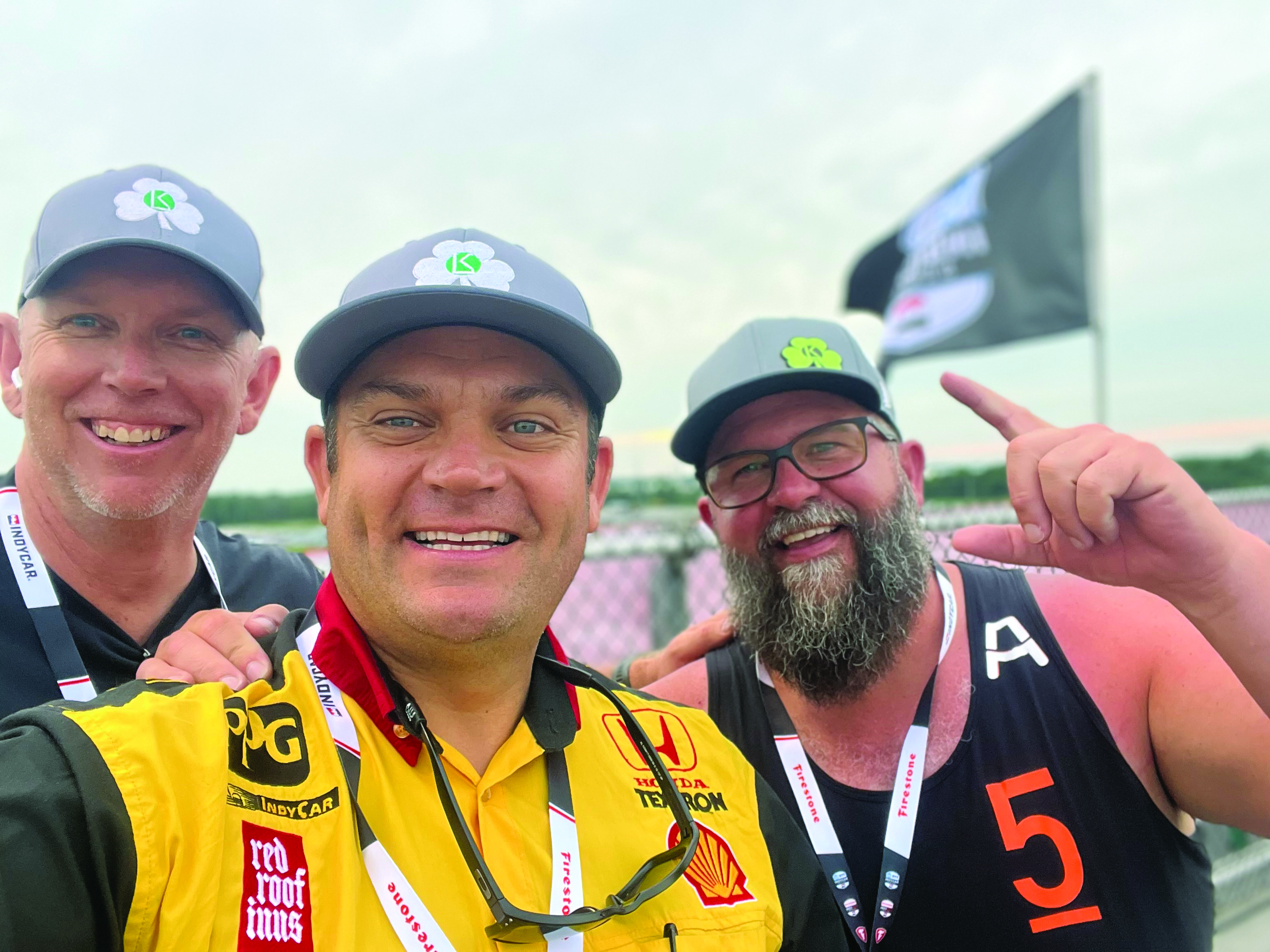
“It keeps us connected. It’s fun and we all live pretty close to each other, but it’s a fun way to just catch up if nothing else…We try to do it every Sunday night because with all of us being dads and husbands and stuff Sunday night at 7 p.m. is usually the easiest time for all of us,” he says.
Between the three hosts, Kelly says at least one of them is at most IndyCar races every weekend.
“If there are 16 races in the season, a couple of us will go to half of them,” he says. “We’ll go to Iowa, Milwaukee, St. Louis — it’s all within a few hours from Indy. The three of us will go to two or three races a year all together.”
At episode 42 of the podcast, Kelly says the group is ready to kick it up a notch.

“We want to make it to 50 episodes,” he says. “We’ve heard that’s when you really become legitimate…We don’t know how many listeners we have and always joke that if there’s anyone really out there listening. Regardless, we like to do it anyway.”
Kelly says he runs his business a lot like an IndyCar team.
“I wake up, take my kids to school and then it’s off to the races,” he says. “I correlate IndyCar and landscaping a lot. It’s really cliché and really corny — but everybody has to have their teams. Everyone has their job on the mowing crew or the landscaping crew. It’s just like the tire changer. It may not seem important — but if you don’t have that tire changer, you’re scrambling. It throws the whole thing off.”

Reveling in the refuge
Sue Cross, office manager, Pro Cut Lawn and Landscape
It’s wild how much Sue Cross has enjoyed being a board member for the Yellowstone Wildlife Sanctuary in Red Lodge, Montana. It’s a move she says she never saw coming.
“I got involved with the sanctuary about three years ago,” she says. “I serve as treasurer. We have about nine members on our board.”
While helping animals in need is incredibly rewarding, Cross adds her fellow board members make her work with the board even more worth it.

“It’s a devoted group of people — they’re just amazing,” she says. “The board members are fantastic. We’re all like a little family. It’s really kind of neat.
“We have board meetings twice a month,” Cross adds. “The last couple of years, I’ve been involved in some habitat planning and have done work on improving habitats. In the next year we’re talking about a new bear habitat, but that’s a huge project. We’re talking about a couple of million dollars to get that accomplished. All of that is funded by donors and we get some grants if we can.”
As treasurer, Cross says the role has opened her eyes to the nonprofit world of business and helped her flourish in her nine-to-five job as an office manager for Pro Cut Lawn and Landscape.
“I’ve learned a ton of non-profit stuff that I never knew before,” she says. “I’m in accounting, and it gives me nonprofit experience I had never even considered before. We do a lot of grant work and I’m the executive director on that and budgeting. It’s been a lot of fun.”
In addition to the learning she’s doing behind the scenes, Cross says the primary goal of the sanctuary is to educate the public on Montana’s wildlife.
“It’s a non-releasable sanctuary,” she says. “We take in rescued wildlife from the greater Yellowstone area that are non-releasable. So, like say a raccoon is missing a foot and we’ve got some hawks who have vision problems and can’t see…It’s a small place — we have about nine acres.
“It gives people the chance to see the animals in the area, but it’s mostly about education,” Cross adds. “Educating them about living with animals and the Montana wildlife. In Montana, you’re living right in the middle of it — it’s been the most incredible experience. I’ve had moose walking through my yard and bears and it’s just the neatest thing ever.”
But while the sanctuary is open to the public, Cross makes it clear it’s not a zoo — in fact some animals are purposely kept out of view from patrons.
“We focus on the animal’s health more than anything,” she says. “We have a bear that gets nervous sometimes around people, so they’ve made sure that bear can get away from people. That’s what’s most important to the sanctuary — that the animal is comfortable with its life than if people can view it.”

Explore the November 2025 Issue
Check out more from this issue and find your next story to read.
Latest from Lawn & Landscape
- Stay Green acquires JH O'Brien in California
- Loftness names McComas as chief operating officer
- Wilson360 names Anderson as featured speaker for Thought Leaders Retreat 2026
- Kubota introduces SVL110-3 compact track loader
- Hittle Landscaping acquires Wesley's Landscape & Lawncare
- Aquatrols Company's Precip Acres
- JCB debuts 250T compact track loader, 25Z mini excavator at ARA Show
- Agri-Fab's weed eliminator