Editor's Note: This article originally appeared in the June 2025 print edition of Lawn & Landscape under the headline “An ever-changing landscape.”
Every year, Lawn & Landscape produces a Technology Report. Every year, there are similar themes and leap-frog advances. Integrating landscape management software is really hard. It requires commitment and an all-in mentality, not to mention engaging key staff. This is a constant. AI can help write job descriptions and muddle through rote tasks like training manuals that you’ve been putting off — tasks you’ve assigned to AI before, perhaps. Now there are new ways.
You might just change your business processes to align with landscape business software that makes your whole operation run smoother with more data gathered and better decision-making. And, speaking of decisions, there are choices to make as you inevitably start with one solution, navigate the next and hopefully find an integrated engine that enables revenue-generating growth.
It’s a lot. Ready to unpack?
Implementation isn’t easy, but the payoff is huge.
Implementing this robust, all-things, industry-relevant business management platform was a cinch! — said no one. But the rewards of fully committing, engaging your team in the process, enlisting in vendor support and going through what can be painful motions of migrating data unveil eye-opening realities for businesses that positively change the way they operate.
The old “no pain, no gain” push is true with tech.
Here’s a look at the gains these landscape leaders have realized.
An Up-Scale Move
When Derek Taussig dug into integrating a landscape business management software platform, his Manhattan, Kansas-based business had already hit seven figures in revenue. The data collected throughout the years on disparate apps, software solutions and even sticky notes felt like a mountain of, “How?”
But there was a sort of “sherpa” to help.
Taussig, owner of an eponymous landscape maintenance business, landed on the all-in software through a consultant who knows it like a second language. So, he knew he’d get on-site support, candid advice and an integration strategy.
“What we were doing before was broken and my team also knew we needed something different,” Taussig says. “With our size, we needed something all-inclusive that everyone could access from their phones.”
Since committing to landscape management software integration, completed in 2020, Taussig Landscape has more than tripled in revenue, grown from 35 to 50 employees and executed an acquisition because the systems table was already set.
Taussig says his goal was always to get ahead of emerging technology, but that’s not so easy.
When he first adopted the new software, operations were about 50% integrated. That wasn’t enough. “You really have to embrace it fully,” he says. “I fought (the landscape business software) the first year, and we didn’t use it for clocking in and clocking out of jobs. Then, those jobs weren’t getting billed properly and we couldn’t cut down on job cost on the back end.”
When a peer from the area came to tour Taussig’s operation, he saw notes stuck to a board in the shop and asked, “Why aren’t you using the app all the way? All these problems will go away.”
Cue the lightbulb.
Then Taussig recognized how full implementation and really sticking to it would solve another common revenue-draining scenario. A crew pulls up to a client’s property, mows and maintains it, then a neighbor pops out and asks, “Would you mind?”
Sometimes they were little jobs like edging. Other times it was a full service.
“In the past, we were not capturing that work in billing,” Taussig says. “But now that we are fully integrated, crews have to clock in and clock out and attach every job to a task.”
If there is no job created in the system, they allocate the time to “no job task” and the office catches that time and can bill the new customer accordingly. This system works for existing customers, too. “We can catch that Jim asked for two yards of mulch that we threw in at the end of the day,” Taussig says.
He can’t exactly figure out how much captured revenue the company is reeling in, “but it more than pays for the software.”
Also, going all in “frees up mind space,” he says. “Once I sell a job, I put it on a wait list and I don’t have to remember. It gets scheduled. This has allowed us to grow in scale and forget a lot less things.”
A Techie Perspective – Retrofitting Operations
Spruce Acres Landscaping is an encore career for Greg Loewen, who started the Manitoba-based business after years in business and IT consulting for Fortune 1,000 companies throughout the United States and Canada.
From the beginning, Loewen’s design/build firm was data-driven. “It all started with collecting lots of information on the customers and tracking leads, though we were capturing all of that information in rudimentary tools,” he says.
But those tools, mainly Google Workspace, worked and Loewen still relies on the productivity/collaboration suite. After some time, Loewen adopted a simplified field management system for proposals, invoices and receipts. As the business evolved and expanded, Loewen knew it would outgrow this software, so he began vetting green-industry specific options.
Last December, he went all in with a full CRM business management solution that includes scheduling, time tracking, job costing and more, bringing all operational pieces onto a one platform. Before selecting this software, Loewen reached out to industry peers in his network and asked for candid feedback on the program and integration pains.
“That process of talking to a couple local people was very enlightening,” he says of an over-arching theme: implementation takes longer and is more challenging than you think. Knowing this prepared Loewen to get support from the vendor.
Soon after he began migrating data and working through the platform’s processes, Loewen recognized that some of the company’s systems and even job responsibilities would not align with the way the software works.
“Don’t expect the software to change to match you — you need to change to match the software,” he says, adding that “change is hard for everyone.”
Sure, there are some customizable features. But the system architecture isn’t built for a complete renovation. The other tools Loewen had been relying on were more flexible, so he customized the tech to suit the way Spruce Acres conducts business.
“It’s a decision-making process where you have to say, ‘This is how we did this task before, but the software doesn’t have configurable aspects for that particular thing, so we have to do it differently,’” Loewen says.
For example, Loewen had to reassess some employees’ roles. “Now, salespeople have a much bigger hand in creating estimates,” he says. “Before, they gathered information to put together a bid and brought it into the office. Then we established a proposal for them to deliver.”
Loewen still reviews proposals before they go out the door, but the landscape business management software’s templates and job costing tools give salespeople turn-key, accurate estimating details. “It’s a huge process improvement for us,” Loewen says. “We can generate more proposals, more accurately, more quickly.”
Loewen expects that at least half of the company’s proposals will be ready to deliver to potential clients within hours or a couple of days rather than a week or longer.
Spruce Acres is intently focused on hospitality, so Loewen wasn’t initially thrilled with the proposal template, he admits. “Anything we would produce that is customer facing was very tailored to individual clients. But with this software, we had to accept the structure for a proposal.”
There’s give and take when adopting a new platform, Loewen says — advice he has given businesses across industries during his IT consultant days.
Overall, he says, “We have found tremendous value in collecting customer information and using that to inform decisions.”
Aligning Sales and Production
After a botch job with onboarding a business management platform some years ago, Ted Ventre approached implementation with Hively Landscapes’ existing solution with a whole different mindset.
“We had to be honest about the shortcomings we were dealing with,” he says. “We hadn’t implemented it correctly, we weren’t fully using the software, and it didn’t work for our smaller, lean business.”
Another misstep: overlooking essential buy-in from the office manager the sales and design consultants. “Rather than saying, ‘We are going to do this, hang on tight,’ we went in eyes wide open in fall of 2018 and worked on it all winter,” Ventre says.
And before getting to work, Ventre explained how the platform would make everyone’s lives easier, detailing tools each team member could leverage to work smarter, collaborate better and connect office and field operations.
“Salespeople would be able to rely on the information and trust the numbers coming out of the system when they build proposals,” he says, emphasizing the importance of helping sales understand how they will benefit from the system.
During the last software chapter, “anyone could manipulate the numbers,” Ventre says. “If they felt pressure from customers and wanted the sale, they could tweak the cost. They’d want to win the business but weren’t thinking of the production side.”

boosting your bottom line as it helps
the sales staff better qualify customers
and bid work.
Now, sales is more connected with how field operations function. “They are not off on their own trying to sell a top-line number to meet commission goals,” Ventre says. “They are invested in budgeting correctly from a money and time perspective, so crews are successful.”
In fact, salespeople are rewarded differently now that this software is in place. “Compensation is based on how jobs perform, not on dollars sold,” Ventre says of the paradigm shift from a previous owner’s structure. “This ties everyone together. We’re all focused on the same results — completing a job with a targeted gross margin.”
As a result, Hively Landscapes has grown its top line without increasing overhead, elevated profitability and established greater accountability across the organization.
“Our salespeople have gotten better at qualifying customers, and they are wasting less time chasing pretend dollars,” Ventre says of focusing on sweet-spot clients that fit the company’s niche, which is estate gardening.
Because Hively Landscapes’ play a dual role of selling and designing, Ventre says some are sensitive toward pricing and “not always great about talking dollars and cents” as they follow a passion for horticulture. “Giving them a tool they can rely on and have confidence in helps because they have years of data telling them what a job will cost,” he says.
Ventre also points to purchasing and how the software enabled Hively Landscapes to stock materials just in time versus holding and caring for an inventory of plants.
Meanwhile, numbers are constantly updated and reviewed, Ventre adds. “We look for trends and where we are successful or missing targets. If every time we build a curved wall out of a certain material, we are missing the budget, what’s going on?”
These reviews steer pricing updates.
Reflecting on how the business management platform has changed operations for the better, Ventre says roles are more defined, from purchasing and sales to operations and admin. Processes are more established, and protocols help every team member understand his or her part in the big picture of serving clients.
There’s No ‘Easy’ Button
At Avalon Landscapes in Meridian, Idaho, employees were still clocking in and out with paper cards. Kristy Clark had to extract cost codes from the hand-written tickets and input the information into a basic, cloud-based accounting program. “When you’re on paper, you’re not even going to see where your jobs sit in the books for a couple of weeks,” Clark says.
The 24-year-old commercial landscape and construction business has a portfolio of large-scale, high-profile projects like Idaho Power, the humane society, hotels and schools. But until a couple years ago, Avalon’s office was automated in an elementary fashion — or not at all. (Pencils and erasers were popular.)
Today, Avalon operates on a fully implemented, large CRM and business management platform and employees track job time on their mobile devices. (The company policy is BYOD, bring your own device.) “Now, our crews can check on their costs, look at estimated versus actual and they’re making adjustments every day and staying ahead of the numbers rather than falling behind,” Clark says.
Getting to this point for the business of 88 employees was a grind.
“There’s no ‘easy’ button,” quips Mike Martin, general manager.
This is especially true when you’re implementing two new platforms at the same time — a CRM system from scratch and going from basic accounting program to a more robust QuickBooks, which “talks” to the business software.
He realized the business needed to adopt a business management platform back in 2012, but Avalon Landscapes got serious in 2020, scoping the software market for contenders. They pulled the trigger on one vendor’s product, then pulled back realizing they needed to suspend the contract to migrate accounting data to QuickBooks. When the request was denied. Martin’s gut reaction: This just isn’t right.
The search for a CRM continued. One of Martin’s key priorities when vetting a half-dozen vendors was how the system would capture real-time costs. Once deciding on a platform, the pandemic hit and in-person implementation support was off the table.
“Kristy was in constant Zoom meetings or webinars, and at the same time she was working with payroll and our CEO to onboard QuickBooks,” Martin says.
All this started with inputting data from timecards, spreadsheets and the old accounting program.
“You have to just dig in — and it’s a long, bumpy road,” Martin says, adding that there was no “sandbox” to create test properties and test clients, and no “back button” if you make a mistake. A service ticket had to be issued.

However, there are benefits to this red tape. “People can’t fraudulently go into the system and make changes,” says Martin.
As for adoption, crewmembers were mostly accepting of the technology, says Alex German, director of operations. “We do have guys who don’t like touching their phones, which can be a good quality to have because they are focused on their work. We do have some workarounds for those employees because we want to make sure everyone’s comfortable and they are not feeling so much pressure that they don’t want to be on the team.”
Year 1, in-field usage of the app for clocking time on jobs was about 50-50, German says. Now, most have adopted the system and are comfortable using it.
Microsoft Teams is another platform employees are embracing as a collaborative conduit for connecting the office and field, and crews with one another. “With having so many employees and so many accounts and services, we utilize Teams to make sure our communications are always transparent,” German says, noting that employees can post pictures of what they see and complete on sites.

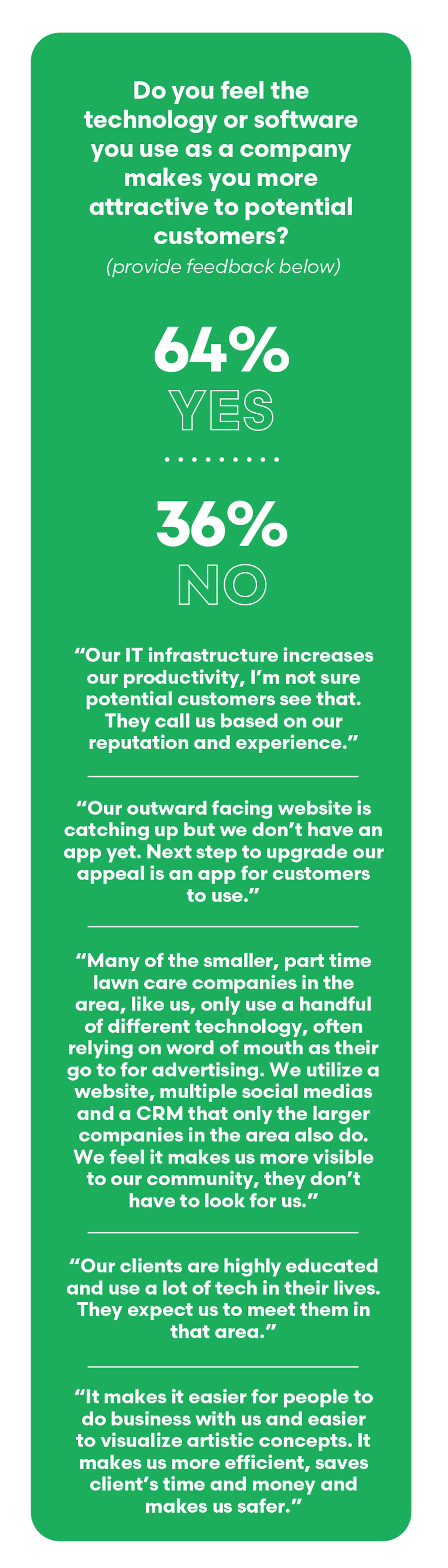
“Don’t expect the software to change to match you — you need to change to match the software. Change is hard for everyone.”
— Greg Loewen, Founder, Spruce Acres Landscaping
Avalon Landscapes organizes Teams groups in various ways — by a foreman and team, department, and even scope of who’s responsible for what on a project, such as hardscape, plant installation, irrigation and so on. German says, “There are checks and balances for everything.”
And there are high-fives.
“We send notifications to say, ‘happy birthday,’ or, ‘happy anniversary,’” German says. “We can also make sure everyone is notified to fill out documents for benefits.”
All a ‘Bot’ It: How AI is giving us shortcuts and timesavers
Artificial Intelligence is pretty much backstage wherever we go digitally. When you start a new email and begin typing a sentence, stop for a second and there’s a suggestion on how you might finish the statement. The list of AI on the radar goes on. But some specific AI tools have proven especially helpful for marketing, business proposals and even sending a gentle reminder to tough clients.

Here’s how AI is working for some industry leaders.
Training Programs, No More Procrastination
“I used AI to build a state-certified chemical application training program I’ve been putting off for years. I copied, pasted and built a beautiful program in 10 minutes and it is state-approved. I input the rules and attached training manuals, using ChatGPT,” says, Derek Taussig, Taussig Landscape, Manhattan, Kan.
Know Your Role
When Avalon Landscapes shifted job positions to better align with its business management platform, AI was helpful for writing new descriptions for roles. It’s also a time-saver for updating policies and procedures, says General Manager Michael Martin.
Additionally, Google’s Gemini (formerly Bard) helps employees who speak English as a second language or who want a professional AI eye to smooth out language to write emails to clients when need be. But the design/build company does not use AI tools for creating proposals since every project is different and not exactly measurable like mowing 1,000 square feet for X dollars per hour, says Director of Operations Alex German.
How to market with technology
Greg Loewen from Spruce Acres Landscaping wanted to run a marketing campaign on the double. He knew his budget (small) and the ask (big). He went to his marketing firm and they admitted, the ask was a challenge. But, rather than quoting long lead time, the alternative was to glean data from multiple tools, feed it into AI and give the ‘bot license to generate copy.
“Not so much the visuals,” he says.
It’s all about how you construct questions for AI. As in, how would you describe a service offering for this target customer in this location with these qualifying factors. “It was their first time doing this, and they triangulated the results,” Loewen says.
Bottom line: success.

Explore the June 2025 Issue
Check out more from this issue and find your next story to read.
Latest from Lawn & Landscape
- Stay Green acquires JH O'Brien in California
- Loftness names McComas as chief operating officer
- Wilson360 names Anderson as featured speaker for Thought Leaders Retreat 2026
- Kubota introduces SVL110-3 compact track loader
- Hittle Landscaping acquires Wesley's Landscape & Lawncare
- Aquatrols Company's Precip Acres
- JCB debuts 250T compact track loader, 25Z mini excavator at ARA Show
- Agri-Fab's weed eliminator