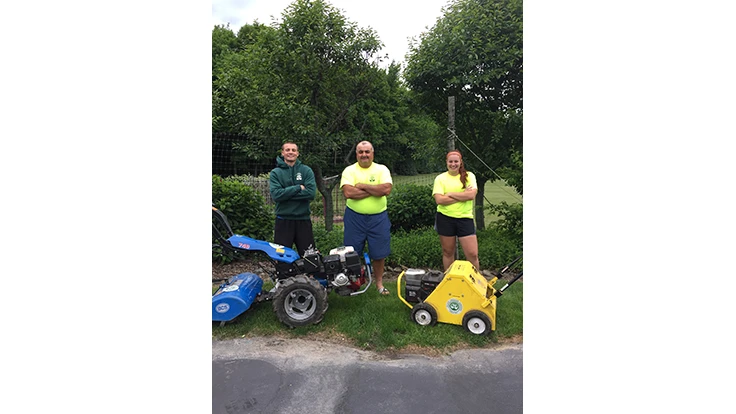
Rich Palazzi, left, Louis Palazzi Jr. and Danielle Palazzi on the job
Photo courtesy of Palazzi Landscape Gardening
There are vanilla landscapes with typical plants, poor placement and blah design. Those are rice pudding, says Lou Palazzi, Jr., third-generation owner of Dunmore, Pennsylvania’s Palazzi Landscape Gardening, founded 100 years ago by his great-grandfather.
Clients call Palazzi to rescue their rice pudding properties. “We make them into zabaglione,” he says, explaining that the Italian dessert trumps tiramisu, with its amaretto, lemon and orange zest, and fresh fruit.
“Most clients call us and say, ‘We have a problem,’ and that could be related to the lawn, a tree or even a bug problem, and they don’t know how to handle it,” Palazzi explains. “We go in and take care of it.”
Following tradition
Experience and a legacy of gardening, landscape renovation and lawn care are the foundation of Palazzi Landscape. Palazzi believes it is the third oldest landscape firm in the United States, founded in 1917 and now celebrating 100 years. “I don’t remember a time when I was not working outdoors,” he says of growing up in the family business started by grandfather, Augusto, who emigrated to the United States from Fano, Northern Italy, in 1908. He worked as an iron molder and part-time gardener, then eventually started his own gardening outfit.
The business flourished and gradually expanded, with an initial motto of “Creator of Beauty.” By 1962 when the second generation was involved, Palazzi’s opened a garden center. By the 1970s, the business included two more garden centers, a seasonal stand and more than 35 employees. Lou was working alongside his dad by then – the third generation.
“My father and I backed away in 1976,” he says, relating that they wanted to focus on their niche: landscape restoration. By 1992, they had closed the garden centers and had returned to the original business model.
“We were getting too big and my father and I got tired of supervising crews and not doing the actual work,” Palazzi says, relating that he runs business operations today but spends days in the field. “I don’t sit in an office. I’m not young, but I’m not dead. So, what’s the work?”
Old world work ethic and attention to detail and craftsmanship differentiate Palazzi Landscaping from the lot. For example, Palazzi’s pruning technique aligns with practices from the International Society of Arborists. “I went to Italy eight years ago and my wife said, ‘Boy, they prune just like you do over here,’” he says, laughing. “I learned from my father and grandfather.”
Palazzi has published articles on the topic of pruning, and it’s another niche service of the business, he says.
Essentially, Palazzi enjoys focusing on landscape projects that present a great challenge so he can apply his expertise to deliver a solution for clients. And he draws on a few key lessons passed down from his grandfather to guide his successful business today.
Lesson #1: Know your strengths
What are you good at? What makes you different? “You can’t just be a guy that goes out and cuts grass. Do something different than everyone else,” Palazzi’s grandfather told him.
“Our difference has always been that we solve problems,” Palazzi says. So, rather than being full-service for all customers, Palazzi Landscape focuses on three key areas: landscape renovation, pruning and lawn care.
Palazzi refers back to the time when the business was much larger. (Now, company consistently earns revenues of $300,000, a comfortable size for Palazzi.) By right-sizing the company and homing in on what he loves and performs with great expertise, the company earns all of its business from word of mouth. “I haven’t advertised since 1992,” he says. Word passes that Palazzi can fix it. And he does.
Lesson #2: Grow a niche
Palazzi’s grandfather had a special way of growing grass and even positioned a sign in front of the business that said, “Watch this grass grow.” The difference was, he paid close attention to the soil.
This speaks to one of Palazzi Landscape’s business niche, lawn renovation and lawn care.
Palazzi Landscape’s four-step lawn care program is 70 percent organic, drawing on cultural practices like core aeration and adding back organics that soil needs to thrive in order to create a healthy foundation for grass to grow. The program involves no “weed and feed.” “We spot spray if we see weeds,” Palazzi says. “And, if we see a fungal problem – we know most fungal problems are because the soil pH is off, so we add lime in the fall and aerate again.
“Our process is unique and based on experience, and now research is bearing that out.” It includes using Milorganite to feed the soil.
Virginia Tech recently conducted a study using a program like Palazzi’s, he says. “They said, in the long run, the mostly organic approach is much more long-lasting than using synthetics,” he says.
The second niche is pruning, which is essential for plant health and longevity, Palazzi explains. “We prune for specific reasons, not just to make a plant look good,” he says of the process. That includes renovation pruning that calls for expertise – removing a third of a Bradford pear tree’s canopy every decade, for example. “Otherwise, the will snap and crack in high winds.”
Palazzi’s third specialty is landscape renovation, which is mostly on residential properties. However, Palazzi describes a large project at the French Manor restaurant, an exclusive dining venue and hotel. “The entire place needed to be pruned heavily and the bed needed to be redone,” he says. “We planted a rose garden where people can take pictures for weddings.”
Lesson #3: Keep learning
“Education level is the biggest gap in the industry today,” Palazzi says. He’s referring to horticultural knowledge and best practices – landscape art and science. Palazzi took his father’s advice to read whatever he can and continue learning. And, Palazzi serves as an educator, speaking and writing for landscape industry trade organizations. His recent article, Guide to Prunus virginiana, was published in American Nurseryman.
Aside from reading and learning the horticultural aspects of landscape, training has always been hands-on at Palazzi Landscape. Palazzi learned in the field, working next to his dad and grandfather. Now, his children, Rich, 27, and Danielle, 21, are involved in the business.
“I’m looking forward to the future for my son and daughter to continue something that was started by their great-grandfather – a unique gardening enterprise,” Palazzi says.
“We are not your average landscaping company,” he says, relating that the Palazzi family gardening story speaks to U.S. history. “It’s the American Dream.”
Latest from Lawn & Landscape
- Develon unveils -9 Series heavy excavators
- News you might've missed last week
- Lifescape Colorado's Hupf moves to regional role as Ostheimer becomes president
- Your most reliable predictor of success
- LandCare names McCallon, Miller as branch managers
- Takeuchi-US names Paul Wade, Eric Wenzel as dealer development managers
- CASE continues partnership with country artist Jon Pardi
- Greenlee debuts new battery-powered remote pruner





