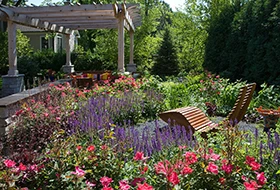
Landscape architecture for David Van Zelst is the perfect blend of design and nature. He can stretch his creativity by forming plans for a high-end client in Chicago’s northern suburbs and he can dip into the field and establish beds of billowing, ever-changing color – one of his favorite design treatments.
Van Zelst found this calling when he was in high school working in a nursery. “I was just looking for a summer job, and I was originally thinking about a couple different career paths,” he says. He thought he wanted to be an architect or a chef. “I fell in love with being outside and basically took my interest in design and turned that into a landscape architecture degree.”
The young entrepreneur, who comes from a family where all of the men as far back as Van Zelst knows ran their own businesses, launched his own landscaping outfit and grew it during college at Purdue University. He had 30 employees at the time. “I just loved working for myself and the idea of building a business,” he says.
The service mix in the beginning was “a little bit of everything and anything we could get,” including maintenance and some smaller design/build projects that were mostly plantings. But in 1984, when Van Zelst was a junior in college, he landed a significant design/build project that took until graduation to complete. The business “carried on from there,” he says.
By the mid-1980s and early 1990s, Van Zelst had grown Van Zelst Landscape Development & Management to a 150-employee firm serving large Chicago builders during a housing development boom, and the company had won portfolios of 300- to 500-acre multi-family home projects and some commercial developments. “That was great for us at the time and it allowed the company to grow,” Van Zelst says.
But Van Zelst was managing a corporate business. The creativity had dissipated because most of the projects the firm took involved volume planting. “We were doing a truckloads of trees and sod,” he says. “It was a great business model, but it wasn’t fulfilling in terms of the creative process.”
From the outside, it might have seemed that Van Zelst had a crystal ball and executed a strategic move out of risky developer-based business just in time. But actually, he just recognized a need to scale back the business and focus more on the type of work he loved to do: high-end residential design/build projects for quality-minded clients who are looking for more than a cookie-cutter landscape.
So in the mid- to late-90s, Van Zelst pulled back from multi-family and commercial accounts. “We maintained several clients that were looking for not just a low-bid situation, but quality work, and we still maintain a few of those clients to this day,” he says.
Van Zelst basically stopped bidding. Through referrals, he grew the residential side of the company and within a few years, virtually flip-flopped the customer mix. “We looked really smart because about two years later, that whole [multi-family and commercial] market turned south and we already were positioned really well in the residential space,” he says.
A right-sized culture.
Today, Van Zelst runs leaner than it did in its “big” days, with 80 employees and a 90-percent residential customer base of clients who are willing to pay for quality. “Commercial work became bidding wars, and it just wasn’t a good business model that we wanted to participate in,” Van Zelst says. “We were unable to come up with the same numbers as some of the companies we were competing against so we basically said, ‘Thanks, but we can’t do it,’ and those companies went their way and we went our way.”
That brand of attrition is how Van Zelst shifted the customer mix. Now, Van Zelst says the company is the perfect size. “I want to be involved with projects and with our clients,” he says. “This size allows us to be mobile and very personal. We are more boutique than box store, and that has been the key to our success.”
Delivering boutique services requires a team that is every bit as committed as the owner. A good majority of the employees at the Van Zelst company have been part of the team for 20 years or longer. Developing the people is a focus at the firm, which Van Zelst calls “family based,” not because his own four children are involved (they aren’t at this stage, and “that’s perfectly fine,” says Van Zelst, a firm believer in following one’s passion); but because the loyal employees tend to “recruit” their own to work for the company. There are families with three generations working at Van Zelst.
“For field operations positions, we turn to our team in the field, whether a foreman or groundsman, and ask if they have relatives or friends that might be unhappy with what they are doing and looking for a change,” Van Zelst says of finding good people. He emphasizes that a quick fix is never an employment solution. “We want people to be happy here for a long period of time,” he says.
Of course, being “just the right size” means that those people who do stick with the firm grow in ways that are different than at a more corporate environment, where a supervisor could move up to run a branch office, or an expansion in divisions could open up opportunities. “We don’t have lots of different departments and satellite offices, and our people know that and they like that,” Van Zelst says. “They have a very comfortable position within the team and ever-growing responsibility levels, and that is how we grow. Strictly from a financial standpoint, everyone grows as the company grows.”
Van Zelst doesn’t want to grow for the sake of giving someone a promotion or adding more work to the business. It has to be the right expansion (such as winning a significant job, not adding a department to the company). “I don’t want to be just feeding the large dog,” he says. “We want to create beautiful landscapes, work with quality clients and have a fun experience doing it.
“When we were much bigger, it was a whole different approach – we were more of a corporate than a personal experience, and our success has come because of the quality of our people here and working with clients who value that personal experience.”
Different by design.
Every landscape design Van Zelst creates is a unique expression of the client’s desires and tastes. There’s no template or signature style that the team leans toward when laying out designs. And, it is a team approach, involving landscape architects, engineers, horticulturalists and other specialists.
Perhaps what’s most important is the “editing” process that takes place. “No plan has ever been installed as ‘per plan,’” Van Zelst says. “There are so many changes and ideas realized along the way, and we pride ourselves on paying attention to every detail, whether it’s a stone project or a planting project–it’s the detail and balance and color…”
Also, there is no “typical” job that Van Zelst goes after in terms of scope. “You can never judge a book by its cover,” he says, noting that one of his largest projects ever started off as a request to install nine ewe trees in front of a foundation. “That project continues to this day.” Clients often return for additions to their landscape – an initial project grows over time.
The reason clients hire Van Zelst is the care in delivery. It’s the simple stuff, really, but it’s difficult to execute unless the team is committed. It’s listening, showing up on time, calling when there is a problem and taking a straightforward, honest approach to projects. “I trust our people 110 percent to take care of any client we have,” says Van Zelst, who calls his landscape projects children. “Your garden is my garden.”
Photos courtesy of Van Zelst Landscape Development & Management