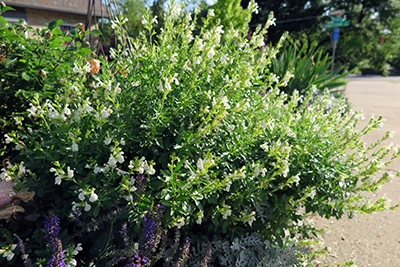
For residents who want to swap out their thirstier plants during drought conditions, there are lots of options beyond cacti. Here are some options for dry landscapes.
Autumn Sage
Salvia greggii is one of the most reliable and easy-to-grow drought-tolerant perennials. There are many varieties of the species available and bloom colors range from pure white to pink, to coral, to deep red. As plants become semi-woody, they are often used as small shrubs in warm climates. Plants can grow approximately 3 feet tall and spread to 5 feet wide. Autumn sage begins blooming in early spring and continues until a hard frost. There are also many S. greggii hybrids with S. microphylla and other species, which are referred to as “Salvia greggii types.” Plant in a sunny location with well-draining soil. Hardiness zone varies by varieties and typically ranges from Zone 5-10.

Sedum
As a group, Sedums can be relied upon to be sturdy performers in hot and dry landscapes. These hardy succulents are available in assorted sizes, shapes and foliage colors. ‘Blue Spruce’ is a variety particularly good for use as a low-maintenance groundcover along sidewalks, driveways, retaining walls and containers. This variety offers up a unique silvery-blue foliage color. Plants require a full sun location with well-draining soil. Once established, plants require little supplemental water and are highly tolerant of reflected heat. There are sedum varieties available for just about every hardiness zone.

Mexican Feather Grass
Nassella tenuissima, commonly referred to as Mexican feather grass, is a species of grass native in the U.S. only to West Texas and New Mexico. Unlike many other ornamental grasses, this species is compact in size, growing to only 30 inches tall in bloom, in clumps 1 to 2 feet wide. Foliage is threadlike and adds a soft texture to the landscape. The spring and summer inflorescence have a feathery appearance. Plants require a sunny location and well-draining soil, and do not tolerate any excess soil moisture. They are also excellent in containers and cold hardy to USDA Zone 6.

Rosemary
Known as one of the most popular culinary herbs, rosemary also performs as a lush, evergreen landscape shrub or cascading trailer. Plants are drought-hardy once established and very tolerant of intense reflected heat. Can be used in very low-maintenance plantings without supplemental irrigation. Plants bloom sporadically throughout the growing season, but timing will depend on climate. There are many varieties of rosemary available; some grow upright to 6 feet tall, while prostrate varieties will trail over retaining walls and containers. Some varieties are cold hardy to USDA Zone 6, while others are more suited to Zone 8 or higher. Provide a sunny location with well-draining soil.
Latest from Lawn & Landscape
- Develon unveils -9 Series heavy excavators
- News you might've missed last week
- Lifescape Colorado's Hupf moves to regional role as Ostheimer becomes president
- Your most reliable predictor of success
- LandCare names McCallon, Miller as branch managers
- Takeuchi-US names Paul Wade, Eric Wenzel as dealer development managers
- CASE continues partnership with country artist Jon Pardi
- Greenlee debuts new battery-powered remote pruner





