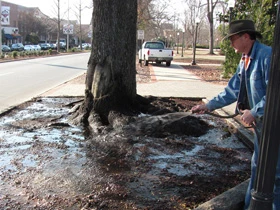
A man has been arrested in connection with the poisoning of trees at Toomer's Corner at Auburn University.
WTVM-TV in Columbus, GA, said Harvey Almorn Updyke, 62, of Dadeville, had been charged with criminal mischief. WTVM-TV attributed the news of the arrest to a source at the Lee County Justice Center.
Bond for Updyke was set at $50,000.
A University of Alabama fan admitted to using an heribicide applied in lethal amounts to kill the Toomer's Corner oaks at Auburn University in an escalation of the schools' football rivalry.
The City of Auburn Police Division is investigating the situation, and the application of this herbicide, known as Spike 80DF, or tebuthiuron, is also governed by state agricultural laws and the Environmental Protection Agency. The university does not use Spike herbicide. There is no reason to suspect any human danger from the herbicide, which manufacturer Dow Chemical says should be applied with proper clothing protection; a typical use of the herbicide is to kill trees along fence lines.
The lowest amount detected was 0.78 parts per million, described by horticulture experts as a "very lethal dose." The highest amount detected was 51 parts per million, or 65 times the lowest dose. Experts believe a normal application by itself would have been enough to kill the trees, which are estimated to be more than 130 years old.
The soil was checked after a Jan. 27 caller to The Paul Finebaum Show, a nationally syndicated radio show based in Birmingham claimed he had applied the herbicide.
The caller expressed anger at a Cam Newton jersey appearing on Paul “Bear” Bryant’s statue during Iron Bowl weekend last year.
“Let me tell you what I did,” the caller said. “The weekend after the Iron Bowl, I went to Auburn, Alabama and I poisoned the two Toomer’s trees…they’re not dead yet but they definitely will die…roll damn tide.”
As a precaution, soil samples were taken the next day and sent to the Alabama State Pesticide Residue Laboratory on campus for analysis. Due to a small fire that occurred in the Alabama lab in December, the tests were sent to the lab at Mississippi State University in Starkville, Miss., to expedite results.
The lowest amount detected was 0.78 parts per million, described by horticulture experts as a "very lethal dose." The highest amount detected was 51 parts per million, or 65 times the lowest dose. Experts believe a normal application by itself would have been enough to kill the trees, which are estimated to be more than 130 years old.
"We are assessing the extent of the damage and proceeding as if we have a chance to save the trees," said Gary Keever, an Auburn University professor of horticulture and a member of Auburn's Tree Preservation Committee. "We are also focused on protecting the other trees and shrubs in Samford Park. At this level the impact could be much greater than just the oaks on the corner, as Spike moves through the soil to a wide area." Additional tests are being completed to determine the movement and extent of the area affected, Keever said.
The removal process involves digging trenches and applying activated charcoal to absorb the herbicide from the soil and block its progress. A representative from Dow Chemical, which manufactures the herbicide, is advising the university on removal procedures, and expert horticulturalists are also being consulted.
"We will take every step we can to save the Toomer's oaks, which have been the home of countless celebrations and a symbol of the Auburn spirit for generations of Auburn students, fans, alumni and the community," said University President Jay Gogue.
Gogue asked members of the Auburn Family to "continue to be 'All In' in upholding its reputation for class" and not allow anger to be expressed inappropriately or undeservedly.
"It is understandable to feel outrage in reaction to a malicious act of vandalism," Gogue said. "However, we should live up to the example we set in becoming national champions and the beliefs expressed in our Auburn Creed. Individuals act alone, not on behalf of anyone or any place, and all universities are vulnerable to and condemn such reprehensible acts."
Because the application of the herbicide is being investigated, no details about the investigation can be released. Anyone with information can contact the Auburn Police Division at (334) 501-3110 or anonymously by voice or text on the tip line at (334) 246-1391.
Latest from Lawn & Landscape
- Develon unveils -9 Series heavy excavators
- News you might've missed this week
- Lifescape Colorado's Hupf moves to regional role as Ostheimer becomes president
- Your most reliable predictor of success
- LandCare names McCallon, Miller as branch managers
- Takeuchi-US names Paul Wade, Eric Wenzel as dealer development managers
- CASE continues partnership with country artist Jon Pardi
- Greenlee debuts new battery-powered remote pruner





