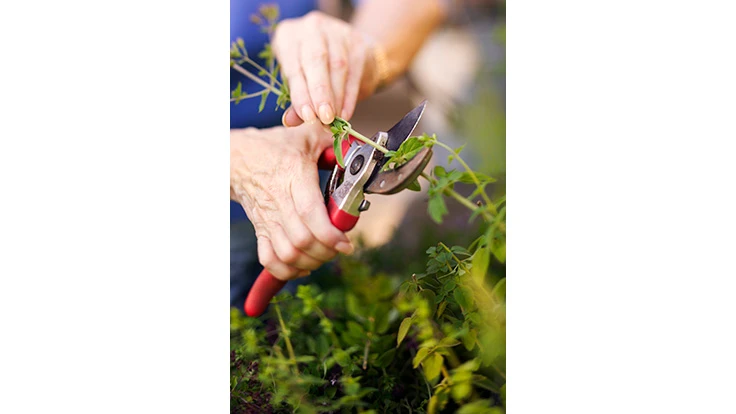
If you don’t want your clients to miss out on blooms from their trees and shrubs, it’s crucial to know where the flowers are located before starting a pruning project.
Pruning plants that bloom during growing season, like azaleas, too late in the summer or in the fall will mean fewer flowers. Instead, prune them right after they bloom so that the plant has time to regenerate for the next year.
Knowing bud placement can help determine the placement and extend of the cuts. A peach tree will have blooms on the previous year’s growth, whereas an apple tree will flower on wood that is two to three years old. “So the position of the fruit in the trees or the flowers in the shrubs would determine how you would prune that tree,” says Elden LeBrun, certified arborist with Bartlett Tree Experts.
When it comes to coniferous plants, pruning is safe any time of the year as long as it isn’t too severe. However, extensive cuts should be done earlier in the year, not be done at the end of summer or in the fall since it may stimulate new growth which is susceptible to cold or freeze damage.
If you find dead limbs any time of the year, go ahead and get rid of them. “Make a proper cutback to the branch collar because a lot of that bloom closure will begin in the later summer, early fall,” LeBrun says.
Start early.
An overgrown plant is much harder to fix than a young one, so you want to start maintaining and training while they're small. When you’re talking trees, there can be real structural issues as the they get larger like poorly attached branches.
So don’t wait until a shrub gets out of control to start pruning and training. Most will become too large for the landscape without a little care. “Most people wait too long to begin pruning,” LeBrun says. “They wait until the plant is well out of bounds before they begin the process of training that plant and then their options are considerably less aesthetically appealing.”
Start with a plan for the shrub, and start training and maintenance early on. That way, you won’t shrubs blocking out home windows. Otherwise, there may not be enough interior branches and foliage to keep the plant looking its best when you trim it down.
You can prevent a lot of work by simply choosing a plant that fits the landscape. Check out your local arboretum or a good garden center to see what a potential planting will look like after it matures, LeBrun suggests.
“Start early,” he says. “Don’t wait until it’s critical. People will plant the wrong plant. It’s too big; they wait until it’s already a problem before they begin the process. We like to see folks anticipate that and take care of it before the plant reaches that point.”