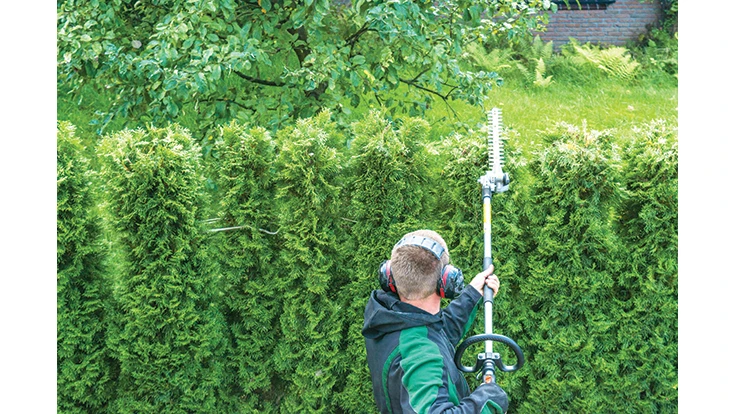
Spring pruning can be tricky because trees and shrubs are putting out new leaves, and pruning can weaken plants that are putting forth energy to grow, says Kent Honl, arborologist at Rainbow Treecare in eastern Minnesota.
Honl says his company in mid-April, but he doesn’t get bogged down in the minutiae of timing too much. He cites a saying from his time studying horticulture at University of California Santa Cruz. “They told me the best time to prune is when your blade is sharp,” he says.
And if you need to remove dead wood, any time is a good time, Honl says.
Without the proper pruning, trees can become unruly and unstable. A few small cuts early on in the tree’s life can ensure that it has a good structure without large, unstable limbs that can break off. “If you just have the right formative pruning in the early years of the tree, you can save very damaging things from happening later on,” Honl says.
Depending on the size and species of the tree, an annual or biennial pruning is necessary for the first 10 to 15 years.
Shaping shrubs.
Honl says you can divide shrubs into roughly two types: those that grow like trees and cane-growing ones that constantly grow new shoots from the base. And they need to be treated differently.
In order to keep cane-growing shrubs healthy, you want to thin out the oldest canes or stems on a regular basis rather than shearing. “It keeps the plant healthier and allows it to rejuvenate naturally, and it just looks better so for health and for its appearance, good pruning just helps prolong the life of the plant,” Honl says. “But most of the time shrub pruning is done incorrectly where it’s just sheared off on the outside and that shortens the lifetime of the plant ultimately.”
If you need to shape a cane-growing tree, it’s best to combine shearing with thinning to open the plant up to new growth and allow new stems to grow from the bottom of the plant to the desired height.
Evergreen shrubs are a little different and Honl recommends pruning them after they finish their first flush of new growth around late May or early June. If you prune before that, you’ll have to return to shape the shrub after it puts out new growth. “If you prune evergreens right away, that new growth starts to get it out of shape right away and then you have to go and do it again,” Honl says.
Pick the right tool.
The first step in picking the right tool is to gauge the size of the plant you’re working with. Then all you have to do is choose the right rate and don’t be afraid to use a larger tool. “If you try something bigger than what’s rated for the tool that you’re working with, you might break the tool or you might even injure yourself if something breaks and there’s an uncontrolled snap reaction,” Honl says.
Also consider the species of tree you’re working with. The effort it takes to cut a softer tree like a Linden, is going to be much less than something hard like an oak.
“Don’t be afraid to have an array of saws. It’s OK to have a variety of gear to suit the situation,” he says, adding that it’s better to err on the side of using a larger tool, as long as you can fit into the tight spots you need to. “If you use a saw that’s too small, it can pinch the blade and you snap the blade off if you’re cutting.”
Protect yourself.
Whenever you’re working with hand tools like pruners or loppers, you should be wearing eye protection and gloves, Honl says. “If you’re working with shrubs, some of them have thorns or even if they don’t have thorns, it’s very easy to get poked in the eye if you’re pulling on a stem trying to get it free.”
Honl always wears Kevlar chaps when he’s using a chainsaw, but says it’s easy to turn of the chainsaw and decide to do some hand pruning to finish the job without putting on the proper gear. He says he’s been guilty of that and lost a thumbnail while using a hand saw. “It took me six months to regrow the thumbnail on my left hand,” he says. “It was a wake-up. I could have just had leather gloves on and it would have been a near miss but it wouldn’t have taken my thumbnail off.”
If you’re doing ground work, kneepads are a good option too, but eye protection and gloves are necessary no matter what, Honl says.