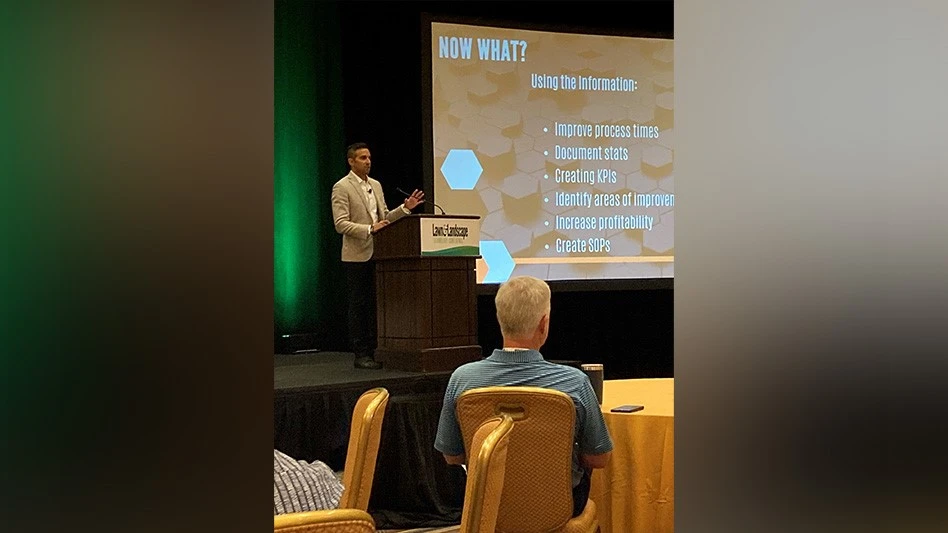
* Editor's note: James Manske gave his presentation "Utilizing Technology to Increase Profitability" at the Lawn & Landscape Technology Conference in August.
With more than 18 years in the green industry, James Manske, owner of Elkhorn Lawn Care, knows how to generate more profit.
“For the first 15 years I thought I knew everything,” Manske says. “But I was wrong. And I didn’t know I was wrong.”
With anything, but especially technology, Manske says it’s about first changing yourself before attempting to change your team.
Manske advised company on how to use tech to improve processes while understanding the data and building your team concurrently.
“With every process in business you can reduce cost, increase output and define new sales all of these things you need to think about as you build your process documentation,” he says.
Having a new client process cycle can be useful. Manske says it starts with identification before moving into estimating, routing, completing the job and then billing and follow-up.
“You can take this and run with it and create sub processes for all of these things,” Manske says.
Using follow-up as an example, a sub process might include making lists, establishing email/phone scripts, scheduling time to reach out and then converting these follow-ups into more sales.
“You need to have all this worked out so that a five-year old could do it,” he says. “It has to be as easy as possible.”
And once you have that overview it’s easier to improve process times and document stats. This can lead to creating key performance indicators and identifying areas of improvement.
“I ask why for every single thing in every one of my meetings,” Manske says. “Think about what areas have high cost. What takes the most time? And what’s overcomplicated?”
Utilizing any and all technology from CRM, to estimating programs, GPS tracking and routing software, companies can truly understand it’s data and use it to grow.
“There’s so much tech you can put into any portion of your business,” Manske says. “You might only need one right now and that’s great. But you will need more when you grow. The first thing you should look for is what you need the most help with.”
Storing data, or intellectual property, is the next portion of utilizing technology. Manske compares it as a vault so you can keep everything together. He adds that this even allows for more efficient training.
“Without having a system to show you what your data is you can’t analyze to make accurate decisions as a business owner… and you can’t create a pricing structure without knowing what your costs are,” Manske says.
And the more knowledge the better. Manske says he took the business from a simple one-page P&L to an elaborate 11 page one that broke out by every division and how it relates to profitability.
“This might be a good thing to do in the off season,” Manske recommended. “The more detailed you get, the more effective you can get in order to take you to the next level.”
Manske says with the detailed P&L you can see what shifts in the company need made. A service might need cut, or prices may need increased. It can also be used to identify top performers and double down on marketing in certain areas.
“All this comes from having a great CRM for great financial software,” Manske says.
The 10% rule is another thing that can be analyzed from this detailed reporting. Manske explains the rule states no customer should allot for more than 10% of your revenue.
“I’m the devil’s advocate, I want to make sure I’m protected,” he says. “If it’s less than 10% of total sales we can easily pivot, and it won’t create a big impact.”
Leading into that is identifying your top personas or ideal clients. Manske says use the data you’re collecting to identify key characteristics in these customers to market for more of these clients.
It’s also useful in building your team.
Manske breaks it down into three elements — attract, reward and retain.
Attracting is using online employment sites and social media to boost recruiting. Manske adds that referrals are another great way to attract new staff. Elkhorn has brought in over 18 new employees this season with a robust referral program.
“I’d much rather pay out people,” Manske says.
Using the data if staff are meeting KPIs, then it’s time to reward them. You can also utilize progression charts to entice staff to want to move up the ladder.
“If you show them that in the beginning, they won’t want to just be a laborer all their lives,” he says. “If they don’t know where they’re going they’re going to feel stuck. You need to motivate them.
Adding commissions at all levels of the business is another way to reward staff and can be easily tracked through proper software.
“I want people to make money beyond just clocking in and clocking out,” Manske says.
Retention is a huge component of success. Manske says clear mission and vision statements and a good culture help with this. Along with regular team meetings where the staff can review all the data being collected.
“All this can happen once you start looking at the big picture,” Manske says. “There is always a lifetime of opportunities at your fingertips.”
Latest from Lawn & Landscape
- Develon unveils -9 Series heavy excavators
- News you might've missed last week
- Lifescape Colorado's Hupf moves to regional role as Ostheimer becomes president
- Your most reliable predictor of success
- LandCare names McCallon, Miller as branch managers
- Takeuchi-US names Paul Wade, Eric Wenzel as dealer development managers
- CASE continues partnership with country artist Jon Pardi
- Greenlee debuts new battery-powered remote pruner





