What can landscapers do to lower their carbon footprint and prioritize the environment? Husqvarna’s 2020 Living City Digital Event focused on educating the industry on several sustainable measures.
Dan Mabe, founder and CEO of the American Green Zone Alliance, gave a presentation on sustainable grounds maintenance.
AGZA oversees Green Zone Certifications, for industrial and residential properties, along with crew certification courses.
“Our mission is to prudently transition the grounds maintenance industry to quieter, more sustainable practices,” Mabe says.
Mabe acknowledges that the industry’s impact on the environment first became a topic of discussion after multiple gas-powered leaf blower bans across the country. He notes there are at least 200 cities now with active bans.
“Coming from the industry myself, I worked in the gas industry as a child and had my own gas business as a young adult, and I know full well the impact of working with internal combustion,” Mabe says.
Mabe says the leading problems with gas include emissions, health risks, noise, vibration, toxic waste and the expense.
Mabe says the solution to combatting these problems are certified Green Zones.
“A Green Zone is a property that is certified to do all routine maintenance with people-powered, low-impact and primary battery-powered operations,” Mabe explains.
South Pasadena in California was AGZA’s first Green Zone certified city, which has gone all electric for routine maintenance. The city also established that any company which would like to do grounds maintenance business within the city needs to go to AGZA training or the equivalent and must adhere to AGZA standards.
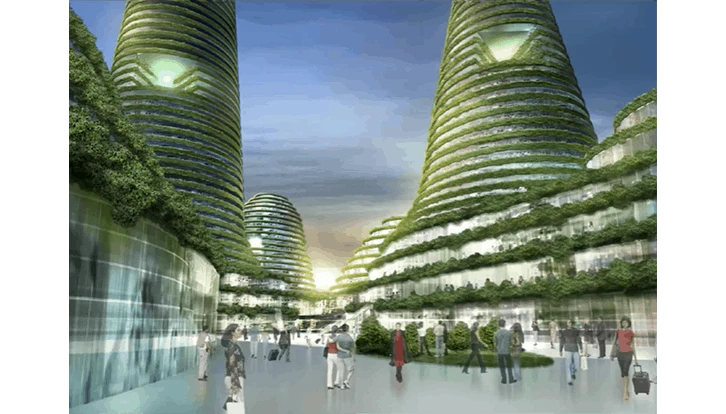
According to Winy Maas, an award-winning architect and co-founder of MVRDV, 56% of the world’s population lives in urban areas. So, the need for integrating more green spaces into them, and protecting the planet, has become increasingly more important. Maas’ presentation focused on what he called The Green Dip.
The Green Dip refers to the architectural strategies used to incorporate plants into buildings.
“Much like we dip our ice cream cones into chocolate, in our case we need to dip our cities into green,” Maas said.
Maas said that countries across Europe and parts of Asia are starting to add plants to the design of buildings. Not only do the plants provide oxygen, but they also contribute to biodiversity.
Seoul, South Korea, has been leading the charge on this. Maas says that as a “gray city,” Seoul has been adding green viaducts to heavily populated areas. Now people are using the viaducts as a more sustainable mode of transportation.
Erik Swan, a digital ecosystem strategist with the Husqvarna Urban Green Space Index (HUGSI), shared data on just how green cities are and talked about quantifying the “greenness” of global cities using satellite images and other technologies.
Swan says the average city is about 39% green. European cities are greener than average at about 45% and North American cities are 36% green.
HUGSI also looks to see if cities are getting green over time.
“This is something that we strive for,” Swan says. “And sadly, we can’t say they are all getting greener.”
However, he says there has still been a lot of growth and the amount of new vegetation has increased exponentially in some areas.
Swan added that municipalities and landscape professionals can increase their “greenness” in just a few steps. The first is city planning to assess green space and its distribution within a city. Benchmarking your performance is also important.
“As a green space professional you get a lot of marketing insights from this,” Swan says of benchmarking.
Swan says that HUGSI will be launching a new version of its site next week on Wednesday, Dec. 9, and announced a new partnership between HUGSI and NL Greenlabel, a Dutch platform for green initiatives.
“We make a great match with our different perspectives,” Swan says.
To wrap up the event, Olle Markusson, director of product management, unveiled Husqvarna’s latest autonomous mower – the CEORA.
The CEORA is designed to mow a larger area, up to 12.5 acres. Markusson says the new mower targets sports complexes, golf courses and large facilities such as hotels and housing complexes.
“We have sold around 2.5 million robotic lawn mowers,” Markusson says. “We sit with the insights and know how to help our customers needs’ when it comes to sustainability.”
The next Husqvarna Living City digital event will take place in March 2021.