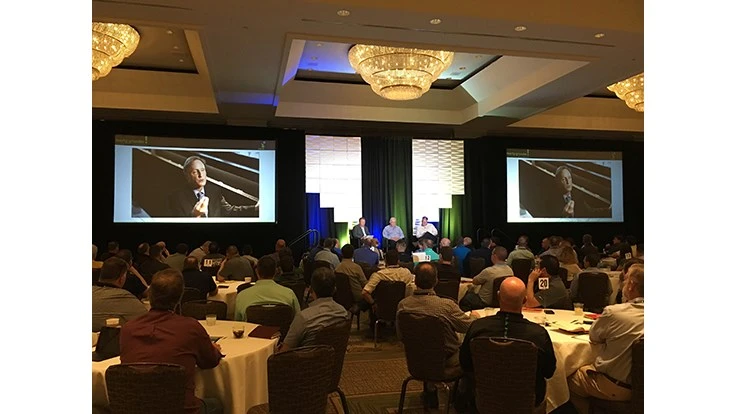
Clay Mathile, who lead the Iams Company to become a $1 billion company, and his son Mike, an entrepreneur, shared their advice from years of experience growing, failing and balancing family life with work at GROW! 2018. Clay and Mike are also chairmen of Aileron, a nonprofit organization founded by Clay that helps private business owners find better success.
Involving the family.
Clay involved his children in the company from an early age, having them in the factory on the weekends and teaching them how the business ran.
There’s a stigma around hiring friends and family, Mike said, but that shouldn’t necessarily be the case. “I think if you step back and look at your business as a platform, what are you really trying to do with this business that you have?” he asked. “What’s the real meaning behind it?”
He sees business as a vehicle for your values and beliefs, and a way to share that with others, including family.
“I think it completely opens the door,” he said. “What better way for one of your children to understand your values than to work in your business? There’s something powerful about a family business and looking at your business as a platform.”
And it’s important to get your family on board, Clay said, giving the analogy that you want your business to be “our baby not your mistress.”
“Your spouse looks at the business as either our baby or your mistress, so to have a happy family life, it would be good if it became a baby rather than a mistress,” he said.
Learning leadership.
When Clay first took over Iams, one of the things he had to learn was how to manage, and part of that was learning to let go.
“You don’t have to be the one-man band doing it all yourself, he said. “In fact, if you want to grow, you will need to enlist some other musicians.”
Making that transition from one-man band to professional organization is extremely difficult, though, and that process is where Clay has seen a lot of managers fail.
“It’s so easy to get consumed by business. When you run out of days in a week and hours in a day, and you can’t work any harder and do any more and it’s not enough, you’re going to have to recruit people to come into your organization and help you grow,” he said. “Then you become a professional manager.”
Mike said that transition is so tough because it’s not natural for an entrepreneur to give up control but if you fight that paradigm and empower your people, you’ll get the most out of them.
After taking over Iams, Clay attended a management course and decided to bring in a board of directors. Once they learned how to trust each other, he was able to get the company growing. “You’ve got to protect your business from yourself too,” he said. “You need outside people to challenge you to achieve your mission.”
Clay said he’s run businesses with boards and without, and the ones with boards have always been successful. “The ones without have been hit or miss but the ones with boards have always been successful,” he said.
Over the years, Mike said he learned a lot about management from his father. Clay’s management style was to really give his people the opportunity to show what they can do. “That’s really what I learned was how to manage people, but you have to trust people and you’re going to get burned every once in a while,” Mike said.
He said he learned from watching him step back from his ego to get done what needs to be done.
Another thing he learned is that you need to know what you can do and what you can’t do, but never be afraid to fail. “Go for your dreams, don’t be afraid to fail, but do it with humility and know who you are,” he said.
Creating culture.
In order to change your company culture, you need to understand the culture you already have, Clay said. Think about what you want to retain and what you want to change if you want to grow or achieve your objectives.
“It keeps people in line,” he said. “It’s kind of the silent supervisor.”
Then, once you have the culture identified, you have to get rid of destructive people. Clay said there is at least one somewhere in every operation.
You need to have disciples of professional management instead of believers, Mike said. “Otherwise, when times get tough, they’ll go back to the old way,” Clay added.