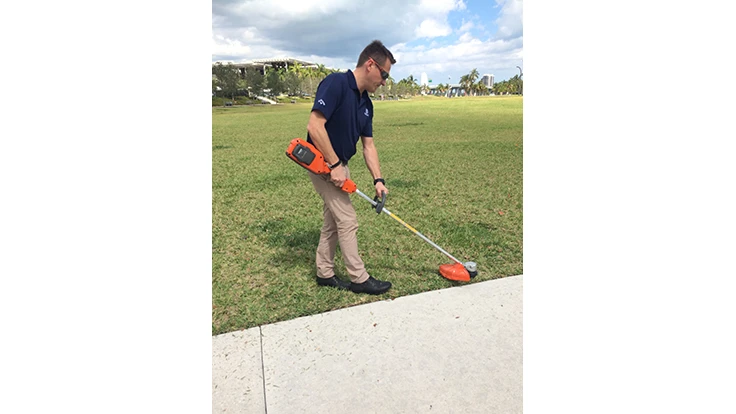
Gas-powered equipment has its downsides from noise to fumes to simply the hefty weight of some pieces. Husqvarna is hoping to alleviate some of those problems with its lines of electronic outdoor equipment.
The company held a panel discussion and demonstration in Miami, Florida, on Feb. 23 to explain the benefits and future uses of the equipment. Their collection of trimmers, chainsaws, blowers and even mowers run on lithium ion batteries and while they’re quiet and eco-friendly, they’re still catching on in the landscape industry.
“We truly believe that the future of our industry is in battery-powered equipment,” said Jeff Sebert, president and founder of Sebert Landscaping in the Chicago area, during a panel discussion.
Sebert has started installing solar panels on their trailers to fuel their battery-powered equipment. Fifteen of their 72 trailers have solar capabilities and they’re in the process of finishing six more.
Sebert has been working with battery power for five to six years, and Sebert said the company had to overcome the gas culture to get staff on board. Now, many crewmembers prefer the battery-powered tools to the traditional gas-powered options, said Steve Price with Sebert Landscaping. “it’s been pretty seamless,” he said.
Price said the reduction in noise, fumes and carbon emissions are all part of the motivation behind the switch. There’s also no need to worry about noise regulations, he said.

Going green.
Some of Sebert’s customers like healthcare facilities, ask for battery-powered equipment specifically because they want to be associated with the eco-friendly service. And there are cities in the Chicago area that have completely banned blowers, so electric options are ideal there.
Price said he sees equipment like battery-powered blowers and chainsaws as a good opportunity to talk to customers about the environmental advantages of having a lawn and the benefits of getting kids outside to play.
“If we don’t do it, somebody else is going to go out and do It for us,” he said.
Egues echoed the sentiment, saying that It opens up the opportunity to highlight the importance of green spaces of a residential lawn and landscape.
“When people thank a landscaper for taking care of their own personal oxygen factory, then we’ll know we’ve succeeded,” Egues said.
Husqvarna surveyed 1,579 U.S. consumers last August about green spaces and landscape care. More than half of consumers with lawns said they would prefer an eco-friendly outdoor power equipment over one who doesn’t. And 72 percent said they would support companies who use eco-friendly equipment over those that don’t.
“When the consumer starts demanding and asking for this stuff, that’s when it will change,” said Scott Lindley, vice president of sales and marketing for the National Association of Landscape Professionals.
And 57 percent of consumers said they would pay more for a landscaper who uses quieter outdoor equipment.
Sebert said there are a lot of misconceptions about this technology because not a lot of people have adopted it yet.
“I think there’s a financial tipping point where it’s, ‘Are they going to pay their bills or their workforce or are they going to invest in new equipment?’ They need to see this work,” Lindley said.
Ralph Egues, executive director of the National Hispanic Landscape Association, said that since most landscape companies are small, they’re going to be later adopters of new technology. Plus, a lot of dealers don’t have the technology in stores yet, he added.
It’s going to take some work to change people’s minds, said Pierre Lanquist, Husqvarna’s global battery product manager.

A new way to mow.
While many see robotic mowers as a consumer product, Husqvarna highlighted the benefits for contractors, which include:
- Operator cost savings
- Ability to work all hours
- No emissions
- Natural fertilizer from clippings
- Fairway cut quality
Contractors can control multiple mowers from a mobile app that shows the location, status and mowing paths of the robots. In spring, the company will be doing a pilot project in Europe to see what kind of productivity and sustainability gains are possible.
Egues also highlighted the safety benefits of the robotic mower, noting that a lot of crewmembers don’t wear ear protection, which is unnecessary around quiet machine.
“Our members work really hard,” he said. “We want to help them work smarter.”
The units are $2,000 to $3,500 plus the cost of installation.
Latest from Lawn & Landscape
- Develon unveils -9 Series heavy excavators
- News you might've missed last week
- Lifescape Colorado's Hupf moves to regional role as Ostheimer becomes president
- Your most reliable predictor of success
- LandCare names McCallon, Miller as branch managers
- Takeuchi-US names Paul Wade, Eric Wenzel as dealer development managers
- CASE continues partnership with country artist Jon Pardi
- Greenlee debuts new battery-powered remote pruner





