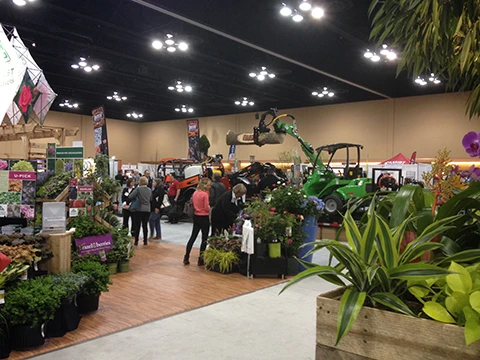
SCHAUMBURG, Ill. – Native plants are not only great for the environment; the life they support attracts a lot of attention and that can be a great selling point for landscapers. Janine Catchpole, president of the Illinois Native Plant Society, discussed the benefits and challenges of native landscaping at iLandscape, the Illinois and Wisconsin Landscape Show, taking place Feb. 25-27.
“You’re not going to get someone excited about a plant maybe, but you’ll get them excited about the wildlife it supports,” Catchpole said. “It creates life and when it creates life, we’re drawn to it.”
Catchpole defined a native plant as one that was growing naturally in the state prior to settlement by Europeans. But native plants can vary region by region within a state, especially one as large as Illinois.
“We have to know not only the species but where they come from to make good choices,” she said.
With less than 1/10th of 1 percent of prairie left in Illinois, certain genotypes are in danger of disappearing. That’s why the Illinois Native Plant Society is working with growers to promote authentic native plants. Noting that invasive species are expensive for property owners to clear, Catchpole said fire is often the easiest way to get rid of non-natives.
That means landscapers are going to need to learn some new skills like prescription burning. Other skills and services include:
- How to specify and source native plants responsibly
- Early spring cleanup to give pollinators a place to overwinter
- Crews trained in plant identification to locate which plants to eliminate and which to include in a landscape
- Customizing the diversity of the landscape to the property owner’s preferences, removing what they don’t like and adding more of what they do
- Environmental education services for customers to explain the benefits of native plants. “We’re never going to get by unless we start teaching people what’s out there,” Catchpole said.
- And, of course, landscaping companies will also need to find or train the right employees
- Educating the customer on the environmental benefits is crucial, but so is teaching them what they’ll gain: lower costs
“Native plants are adapted to amount of water we’ve got here,” Catchpole said, which means lower irrigation maintenance and water costs.
And since native plants are adapted to the soil, fertilizer costs can be reduced. In fact, Catchpole said over-fertilizing is a common problem for native plants, making them grow lanky. She suggested using raw wood chips rather than composted to help absorb extra nitrogen in the system when dealing with native plants.
While native landscaping is a far cry from traditional lawns, with a little education for both a landscaper and the customer, Catchpole said it can be a success, as long as companies make education a priority.
“Don’t be afraid to get on the wild side a little bit,” she said. “There’s life there; there’s color there.”
Look in the mirror. Know who you are and don’t try to be someone you’re not. It’s good advice for relationships, and life in general, but it’s also the way to drive sustainable growth in your business, according to Joe Abraham.
The founder of BOSI Global and author of “Entrepreneurial DNA: The Breakthrough Discovery that Aligns Your Business to Your Unique Strengths” shared the four personality types with iLandscape show attendees, explaining the value of knowing your own personality as well as that of your employees and your customers.
“A lot of the business decisions we make are based on who we are,” he said.
Builder: A Builder tends to grow a business, acquire companies and spread to multiple locations very quickly. They tend to push employees to the next level and always want to be expanding. “They can get people to do things they wouldn’t normally do,” Abraham said.
Their weakness tends to be relationships because their ambition tends to make them think they are more competent than their employees.
Opportunist: These are the people that can’t make money enough and they’re always after the next big thing. When opportunity comes knocking, they always answer the door. “There’s always a new, shiny object and they have to go pick it up,” Abraham said.
They always want to be reaching for the stars so they need unlimited opportunity. “If you give them a good base income, you’ve completely deactivated them,” he said.
Every business needs some opportunists, Abraham said, noting that the best sales teams have a lot of this kind of person. Their biggest drive is financial independence, but their biggest weakness is their up and down income
Specialist: This is the most common type of person. They tend to look for reliability and consistency, and most of their business comes from referrals and networking. Their businesses tend to grow well and then plateau, “and that’s not necessarily a bad thing,” he said. “That’s because they want stability.”
For these people, reputation is the most important factor, making them analytical and risk-adverse. “They’d rather lose money than lose their reputation,” Abraham said.
Innovator: Only about 12-15 percent of people fall into this group, who would rather spend time creating than anything.
They measure their success by their mission, so they’re most concerned with whether or not the client likes their landscape. “Every decision an innovator makes is seen through the mission lens,” Abraham said.
While these types are great for marketing or design, their greatest weakness is management.
Once you realize your own strengths and weaknesses, you can see the gaps in your business and hire the right people for the right positions, Abraham said. For example, if you’re a Specialist who looks for stability, you’ll need a partner or staff who can generate new leads, like an Opportunist.
And it’s important to look at your sales team, and your entire company to see where your strengths and weaknesses are.
To take the free personality test, visit BOSIdna.com.