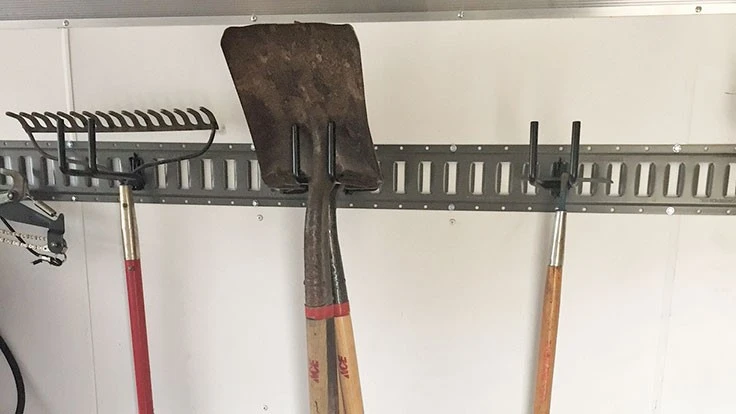
Photo courtesy E.A. Quinn Landscape
It can be easy to forget about logistical details like trailer organization when focusing on big picture tasks. But one quick way to stall progress is to get to a project site and not have the equipment needed to get the job done. For many contractors, keeping a routine inventory of trailer equipment is a necessity to prevent those kinds of slip-ups.
“It’s one of those ‘inspect what you expect’ things,” says Travis Jinright, general manager for Russell Landscape in Sugar Hill, Georgia. “As a management team, if you’re not keeping your eyes on the crews on a daily and weekly basis, that’s when things start to slip.”
Keeping tabs.
E.A. Quinn Landscape in Glastonbury, Connecticut, utilizes a numbering system to keep tabs on its 12 trailers and equipment. Each truck or trailer has a unit number, and each piece of equipment has the truck or trailer number printed on it or etched into the plastic. Periodically, the management team checks in with the foreman to make sure all of the tools are in their possession, says Scott Pinney, landscape maintenance manager.
“It’s important to stay organized with even the smallest of tools,” Pinney says. “If you have a v-nose trailer, make sure there is shelving to keep the small stuff like mix oils, oils for mowers and spill kits in case of hydraulic leak on a mower.”
Similarly, Complete Landsculpture in Dallas has been tracking inventory with numbers for more than 10 years. A manager manually inputs data into Excel spreadsheets, and a fleet management software system tracks and analyzes the details, Vice President Gene Freeman says.
“The fleet management system sum totals it, so we know that we have 48 push mowers and 32 weed eaters and 70 shovels, etc. If we need to transfer a piece of equipment over, it is easy to do and still know where we’re at when we have the same quantity of equipment at all times,” Freeman says.
The fleet management system also allows Freeman to track how much the company is spending on repairs for each piece of equipment, as well as to isolate which crew members used that equipment to identify any potential equipment abuse.
Later this year, the company plans to implement a digital barcode system to further expedite and simplify inventory management for its 20 trailers and the equipment inside them, Freeman says.
“Each piece of equipment would get its own barcode, and you would take your phone and scan it to know exactly where the equipment is at all times. The trailer will also have a barcode on it that you can scan, and it will give you an inventory of everything that should be in that truck. You can quickly look and see your machines and your sprayers, blowers and weed eaters,” he says.
The barcode system will cost about $10,000 for both the software and the implementation, which Freeman expects to take a few days. There is also a monthly fee that varies based on the amount of equipment and selected features, Freeman says.
The author is a freelance writer based in Kentucky.
Latest from Lawn & Landscape
- Develon unveils -9 Series heavy excavators
- News you might've missed last week
- Lifescape Colorado's Hupf moves to regional role as Ostheimer becomes president
- Your most reliable predictor of success
- LandCare names McCallon, Miller as branch managers
- Takeuchi-US names Paul Wade, Eric Wenzel as dealer development managers
- CASE continues partnership with country artist Jon Pardi
- Greenlee debuts new battery-powered remote pruner





