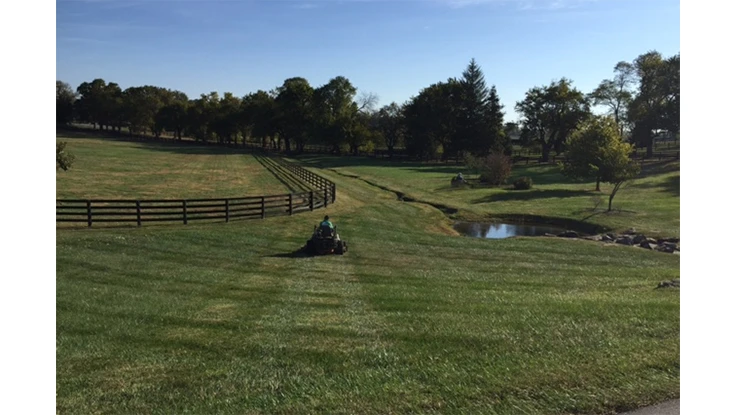
“At the end of the day, it’s just a bigger account, but there’s a lot more intricacies that the equine require, not just in the maintenance but just within the care of the facility.”
 That’s how Allen Sweeney, president of Al's Complete Lawn Care describes the thoroughbred facilities his crews maintain in Lexington, Kentucky.
Al’s started in 2004, and Sweeney immediately knew the residential route wasn’t the best fit. “When you start, you have a lot of residential business, but we got to a point that our residential business was 80 percent of our customers and less than 20 percent of our revenue,” Sweeney says.
At the time, the company was doing maintenance for a few smaller farms and decided to try their hand at that.
“When we looked at it, there wasn’t really in our area one big equine provider; it didn’t have any competition,” he says.
So Al’s sold the residential side of the business and chose to focus more on equine landscaping.
 The setup.
“We bid them just how you would any commercial site,” Sweeney says. “We measure all the turf and go out on it; we do site measurements on everything and site maps for the customers.”
He says it’s also similar to a commercial contract in how they assign crews, but some farms require more equipment and larger crews, meaning they need to spend multiple days on a job.
Some of the farms are direct report, meaning the crews are there weekly. Those range in size from a four-man crew to an 18-man crew. The company also has mobile crews for certain farms – they refer to them as an equine mobile route – in six-man crews that provide only mowing or limited services for a farm a day or two.
“We measure a farm; we know what our efficiency rates are, our production rates, giving us an amount of hours,” he says. “We build the crews based on that.”
The major difference between a commercial property and an equine facility? The timing.
“We have to develop schedules with each farm – when we can be in certain areas at certain times,” Sweeney says. “A retail commercial customer has customers in and out, so you structure your mowing around that, but for the most part in commercial retail you can maintain almost anytime during the normal workday. With the equine, we’re dealing with horses that are anywhere from a couple hundred thousand dollars a horse to one farm I know has a $56-million horse on it.”
Working around the schedules of the trainers and farm staff can sometimes cause a scheduling hassle for the crews, but it’s important for them to be respectful of those needs.
 “The communication level is extremely important on the farms,” Sweeney says.
One of the farms his crews maintains has 12 tenants who board their horses there, meaning the crews have to coordinate with each tenant to make sure the equipment and crews on site won’t get in the way of the training schedules.
“Not each portion of the farm has the same time requirement, so they don’t say ‘hey we let all the horses out at 8 a.m., bring them in at 10, you can mow from that time until 4 and we turn them back out at 5,’” he says. “Each area has its own turn out times and bring in times.”
Because the farms have very valuable assets on them, and need those horses to make money, it’s important for the crews to be respectful of that as well. Sometimes that even means being aware of your surroundings so you don’t risk startling a horse.
“The rule of thumb is, if a horse is being moved from one field to another, or in and out of a barn, all the equipment has to be shut off,” Sweeney says. “You could be mowing a big area and the instant they take a horse out of a barn or out of field, you stop where you are and wait.”
Sweeney says in the beginning, there’s a lot of coordination and communication to try and cut down on these situations, but sometimes overlaps can’t be helped.
“A couple times a day everybody has to stop,” he says. “You turn the mower off for 30 seconds, then fire it back up.”
 Up on the knowledge.
While crew members don’t need any type of specific knowledge to work on the farms, an understanding of how the industry works is important.
“Just learning about what to expect around the horses, what they do with the horses, when they do certain things certain times of the year, learning when is the sale time of the year in the spring, when is derby and the races,” he says. “It’s more learning their industry from a standpoint of when do we need to make sure we’re always careful and that certain areas look better than others and change our schedule.”
It’s also important for crews to know a little about plants that could potentially harm the horses. Recently, a crew had a situation where a plant on the facility was poisonous to horses and needed to be maintained. It wasn’t in a field where horses would have access to it, however the crew had to make sure everything was cleaned up so there was no risk of cuttings getting into the barn.
“The crew had to give special attention that everything got cleaned up and taken care of and the details of that to make sure nothing was blown,” he says. “I mean they border right to that part where the horses come out of the barn so nothing could be blown out of that area or potentially cross the entrance of the barn.”
At the end of the day, Sweeney says his crews take extra pride in the farms they take care of because there’s a sense of teamwork and pride.
“It’s a partnership,” he says. “That’s our work being portrayed to the world. It’s not just local; a lot of the publications and pictures taken on this farm are worldwide publications. … It’s humbling.”
Latest from Lawn & Landscape
- Develon unveils -9 Series heavy excavators
- News you might've missed last week
- Lifescape Colorado's Hupf moves to regional role as Ostheimer becomes president
- Your most reliable predictor of success
- LandCare names McCallon, Miller as branch managers
- Takeuchi-US names Paul Wade, Eric Wenzel as dealer development managers
- CASE continues partnership with country artist Jon Pardi
- Greenlee debuts new battery-powered remote pruner





