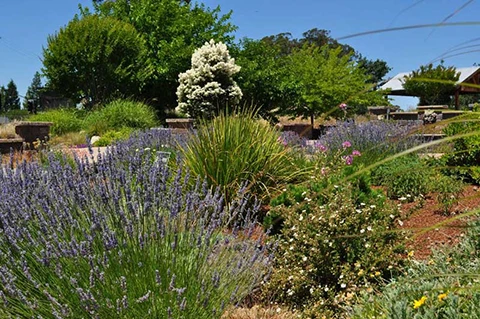
Peter Estournes doesn’t do landscape maintenance; he does landscape management. The co-owner of Gardenworks in Healdsburg, Calif., is working with the city, the state and local residents to manage water in their landscapes as the drought continues.
“We’re not anti-turf; we’re not anti-green; we’re more just look, low impact development is the wave of the future,” he says.
He and his partner Jay Tripathi have been using their contacts in the city to educate residents, putting on workshops and assisting with the development of a water conservation program. The city of Healdsburg even offers $75-vouchers to residents who hire Gardenworks to do irrigation inspections.
Local restrictions limit residents to watering only from 8 p.m. to 7 a.m. Tuesdays and Fridays. And no potable water is allowed. To help residents handle the drought, Gardenworks has a drought resource center on its website with all kinds of information, positioning itself as a water expert. “It’s kind of our mantra no matter what we do,” Estournes says. “We do a lot of public speaking on the subject and work with a lot of local municipalities and the state with drought issues so our company is extremely involved in the water issue in California.”
Gardenworks set down the road to be water management experts back in 2005, and has since worked with the California Landscape Contractors Association on its water management certification program and helped build the qualified water efficient landscape certification program with the Sonoma County Water Agency with the CLCA and the municipal water district. “Initially we were just picking out anomalies to be able to respond and say, ‘We used 2,000 extra gallons in this last week. We’d better figure out why that’s happening so we would go out and look for the issue,” Estournes says.
In order to get the water efficient certification, companies must meet the water budget on at least one site for a year, so instead of looking at the health of the plants, landscapers are looking at how much water they should be using. “So we were able to start programming our controllers to meet a water budget as opposed to intuitively thinking Oh wow we should have about five minutes on this one and three start times or whatever it was,” Estournes says.
At the end of each year, Gardenworks sends out a report to each client on the program to show how they did. And while the company sometimes needs to manage water by extrapolating nearby projects, most customers seem to be willing to pay the extra money for the monitoring.
“We’re kind of a high-end company so most people look at a $500 or $600 installation for flow sensing and/or sub metering as a cost that’s required to provide them the best service we can and they’re perfectly willing to do it,” Estournes says.
Latest from Lawn & Landscape
- Develon unveils -9 Series heavy excavators
- News you might've missed last week
- Lifescape Colorado's Hupf moves to regional role as Ostheimer becomes president
- Your most reliable predictor of success
- LandCare names McCallon, Miller as branch managers
- Takeuchi-US names Paul Wade, Eric Wenzel as dealer development managers
- CASE continues partnership with country artist Jon Pardi
- Greenlee debuts new battery-powered remote pruner





