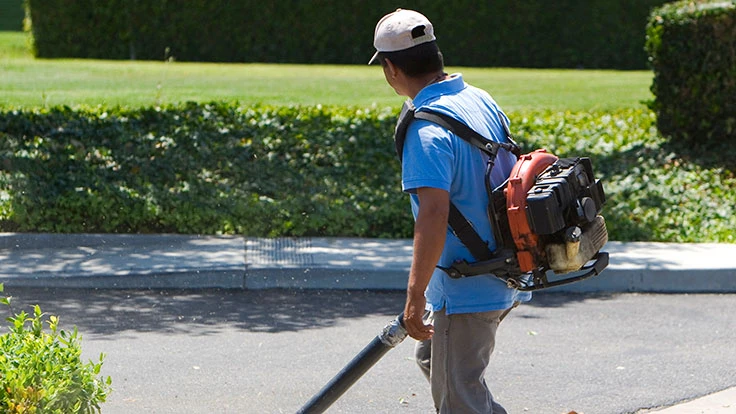
Above: Photo courtesy of © MCCAIG | iStockphoto
October marks prime time for fall cleanup jobs for landscapers that focus on maintenance services in cooler climates.
For some landscapers, fall cleanup season came a little early this year, as leaves in some areas changed color and fell as early as mid-September. Barney Naylor, president and CEO at Naylor Landscape Management in Kalamazoo, Michigan, says fall cleanup started a little early for him this fall.
“A lot of our trees were stressed in the summer and our colors are coming a little early,” Naylor says. “Typically, our first (fall) cleanups start the third week of October and get all cleanups done (by) Thanksgiving. This year, it will probably start a week earlier the way things are going.”
Getting an early start on fall cleanup should help in case of any detriment weather as the season gets cooler, he adds.
“I don’t think starting early will have a negative impact,” Naylor says. “The weather gets too crummy at a point in time (since) we get lake effect snow on the west side of Michigan usually by November, which shuts us down.”
However, other landscapers experienced a late start to fall cleanup because of hot summer temperatures and conditions extending well into fall.
“Summer flowers are still in bloom,” says Jason Pawlowski, owner of Precision Landscape Services in Milwaukee. “The perennials are still going like mad (as of late September).”
Pawlowski says his area experienced a slight drought at the end of summer and most leaves have yet to change colors. With the delay, he says the fall cleanup work may begin one or two weeks later than usual.
Cleanup checklist.
Before starting fall cleanup, it’s wise to meet with crew members to ensure the company has the right equipment for the jobs. Precision Landscape likes to have this meeting a few weeks before the fall cleanup jobs start to make sure it has all its blowers, rakes, tarps, vacuum systems and other equipment in good working condition. Pawlowski also changes out blades on the mowers to be more of a mulching blade.
The start of the fall cleanup season means making sure equipment is up to par. Pawlowski says he’s updated equipment in the last couple of years for fall cleanup, and he says the technologies for working in this segment have come a long way in recent years.
“The old days of raking have gone by the wayside, as blowers nowadays are so powerful,” he says. “The power and efficiency of the equipment is better. It used to be heavier and now things are only a couple of pounds and have two to three times the power they had back then.”
While his company has been around for about nine years, Pawlowski says it wasn’t until a few years back that he invested in backpack blowers to help with fall cleanup jobs. He notes that blowers can be pricey, but it’s worth the investment after only one or two seasons.
Once the checklist items are done, it’s time to move on to tackling jobs. To be the most efficient at a fall cleanup job, it’s good to map out goals and plans before the season starts. Also, with each day, Pawlowski says it’s a good idea to have a game plan for tackling each site.
“Have a game plan put in place prior to arriving at the site,” he says. “Or if you arrive to the site with a crew, gauge wind factors and anything that might affect you while you’re trying to clean things up.”
With larger properties, he recommends dividing the property into sections to help start and finish tasks in a “single swoop” instead of having to redo sections for various tasks.
Benefits.
Both Naylor’s and Pawlowski’s companies have always offered fall cleanup services. Naylor sees this as a simple way to extend the maintenance season. From a revenue standpoint, his fall cleanup jobs also do slightly better than his mowing jobs.
“We try to make more on (fall cleanup) than on mowing,” he says. “We charge all our cleanups by the job.”
Naylor says he typically charges fall cleanups the same as 10-hours of labor. If his crews accomplish the job in less time than that, it provides him with better revenue. However, if the weather conditions are bad, it can hurt the business. Fortunately, he says weather this fall has been good to help him get ahead on fall cleanup jobs.
“When we do cleanups in good weather conditions, we make good money,” he says.