 |
Most people are already currently aware that the state of California is experiencing the worst drought in history, and our savvy followers also know that this has significant implications on both landscaping practices and the health and vigor of landscapes throughout the state. However, did you know that the drought can actually lead to an increase in fungal infections present in the trees in your landscape? Surprised? Keep reading to discover why.
Drought stress is more than just emotional…
Most trees are quite hardy and can be resilient to intervals of drought (even if they are not drought-tolerant), but all trees need some water to survive.
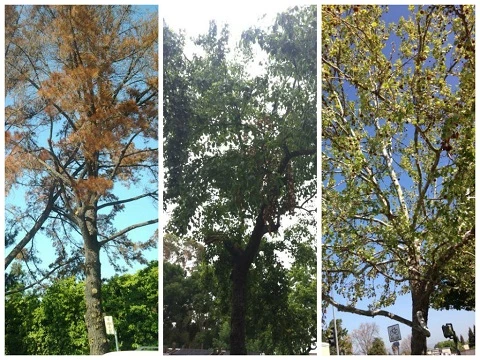
Drought stress manifests in trees a few different ways. Direct damage includes drying of leaves, buds, shoots, bark and roots, starting from the tips of the leaves and working inward, and if too prolonged, the tree will stop the uptake of water altogether and will eventually die. Indirect damage includes slowing or complete shut down of the photosynthesis process, which slows plant growth, as well as the inability of the tree to produce defensive chemicals to protect itself from pests and diseases.
Drought stress is more than just emotional…
Trees weakened by drought stress are at a greater risk of becoming infected, just as a person with a suppressed immune system is more likely to become sick. The tree’s tissues may be more easily invaded than if the tree were in a healthier condition, the tree may not be able to produce its usual defense mechanisms or put on additional growth in order to fight the infection, and some pests that carry infections may be more attracted to the trees when drought stressed. Some examples are Armillaria root rot, Dutch elm disease, Verticillium wilt, and many different cankers.
April showers bring…infection!
Some fungal infections have spread rapidly this year due to the late rains. Anthracnose [affects Sycamores (Platanus Spp.), Modesto Ash (Fraxinus velutina ‘Glabra’), Dogwood (Cornus Spp.), Privet (Ligustrum Spp.) and Chinese Elm (Ulmus parvifolia)] and Fireblight [affects Callery and Evergreen Pears (Pyrus calleryana and kawakamii) as well as other select trees in the Rosaceae family] are common throughout the Bay Area, and are worse this year than in past years. Fungal infections thrive in warm and wet conditions, and late season rains were the “perfect storm” to promote fungal development.
Well, what can I do about it?
Different treatment methods exist for different infections. Some infections can be treated with well-timed fungicide sprays or injections, others require selective pruning, and unfortunately, some cannot be treated and require tree removal.