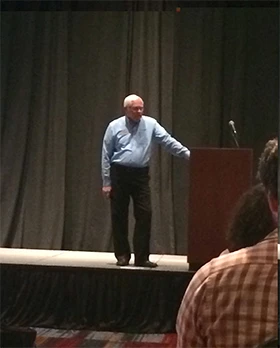
Looking back on the year can be an enjoyable experience, but that was not the case during speeches at the Tree Care Industry EXPO. Instead, it was a lesson on what arborists should and shouldn’t do to stay safe.
Thursday’s first safety session was “Arborist safety update: What happened in 2014?” presented by Dr. John Ball, CTSP, South Dakota State University. The session discussed injuries on the jobsite in the last year, and looked what incidents caused the most injuries and fatalities.
“One of these days I’m going to have a session and just have an hour of bad pictures,” he told the audience. His presentation included images of injuries as a result of improper use of equipment.
“The most common medical condition is a heart attack. This is the most common medical fatality,” he said.
However, he pointed out that a vast majority of arborist incidents involve trauma, kinetic energy, potential energy, thermal energy and electric energy.
Ball discussed fatal injuries, non-fatal serious injuries and non-fatal non-serious injuries, explaining what kinds of incidents resulted in each. He then broke down those three categories into national companies, regional companies, large local companies and small local companies. Small local companies had the largest number of injuries, and he said this was because they don’t have the resources to train their employees as much as the bigger or national companies do.
“Make sure all your people are properly trained,” he said. “Make sure you do proper evaluations, and have proper communication.”
Following the first round of sessions was the keynote address. The keynote was presented by Gary A. Higbee, of SafeStart. Higbee’s presentation was “Inside out: Rethinking traditional safety management paradigms.
The first thing Higbee pointed out was that safety is a personal thing. To explain this, he told a story of when he taught his daughter how to drive, and one day she and some friends went to the mall. It was her first time driving on her own, and as she pulled out of the driveway, Higbee realized he had no control over how safe she was. He just had to hope that she listened and remembered everything he’d taught her.
“You have no control over your employees when it comes to safety,” he said. “The only thing you have on the jobsite is your influence. When you’re gone, that’s all you’ve got.”
Higbee also explained that 97 percent of injuries are caused by human error; from something you didn’t mean to do. Things he said were huge critical errors were not having your eyes on the task, not having your mind on the task, being in the line-of-fire and poor balance, traction or grip. He also explained that you can focus your reticular activation system.
“If you live near an airport, you never hear the noise,” he said. “Our reticular activation system prevents us from hearing because that takes up too much time and energy. Nothing bad ever happens because of the noise, so why bother thinking about it?”
He said the brain wants you to do things automatically and not have to think about it.
“Habits don’t limit complacency, they compensate for it,” he said.
Following the keynote, the show floor opened at 9:57 a.m. Attendees were able to walk the floor, and the rest of the day featured free forums and networking sessions. The day ended with a welcome reception in Ballroom B/C at the convention center. The event runs until Nov 15.