When every drop of water counts, evapotranspiration is a key calculation in the equation. By monitoring the amount of water lost from soil or plant surfaces and the amount of water used by plants (transpiration), irrigation contractors can make important adjustments to their systems.
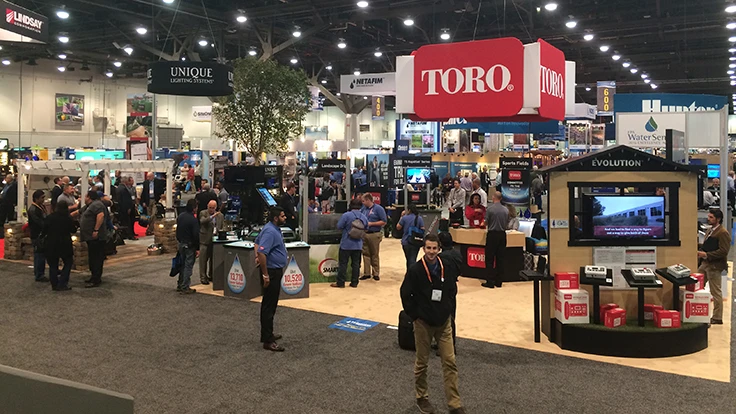
At the ET & Irrigation Management seminar during the Irrigation Show in Las Vegas, Brent Mecham, industry development director for the Irrigation Association, explained what contractors need to know to make the right decisions.
Components.
Most ET data comes from weather stations that provide information on sunlight, wind, air temperature and humidity. Its basic components are:
Pyranometer: Measures intensity and duration of sunshine
Anemometer: Measures speed of wind
Radiation shield: Measures humidity and temperature.
“If you own a weather station and you haven’t calibrated it, I can guarantee the information you’re getting is not useful,” Mecham said, adding that it’s best to calibrate in the winter when the data isn’t as crucial to system adjustments.
To measure rainfall, most use a tipping bucket that counts each hundredth of an inch of rainfall. You can also use a rain gauge, but that can only be read in person.
To measure ET, an atmometer tube will tell you where the water level of the soil is, and if you read it and compare it day by day, you’ll know how much water was lost.
Mecham said an atmometer can tell you the ET in a microclimate such as a shady area on a property. An evaporative pan is another option, but they often require maintenance due to scum growth. By reading the weather station and looking at the atmometer, you can get a more accurate idea of which areas need more or less water.
“We all know watering plants in the shade is about half of plants in full sun,” he said.
Placement.
Most weather stations are located somewhere out of the way, like a rooftop, but that doesn’t give the most accurate reading due to nearby buildings or asphalt. Ideally, the station would be surrounded by green areas.
Look at your weather station and how close it is to the site that you’re managing, Mecham said. “I just need to take that into account when I take that data and try to use it.”
That means you’ll need to modify your ET. “If you don’t take that reference and fit it down to what you’re managing, you’re overwatering.”
Considerations.
The two main things to think about are the types of plants you’re dealing with and the required appearance. For example, an industrial park won’t need the same appearance as a residential yard.
“That required appearance is a big fudge factor we have working for us,” Mecham said.
Maintenance practices like slow release vs. quick release fertilizer also determines the amount of water necessary.
A cool season grass will require more water than a warm season grass, no matter what the maintenance practices.
When looking at mowing practices, it’s important to note that shorter grass will actually use less water than longer grass since its roots are smaller. However, you can go longer in between irrigation with longer grass so it’s a tradeoff.
“The bigger mystery for our industry is – OK, what about all the other plants?” Mecham said.
It seems counterintuitive, but plants in wet climates actually use more water than those in dry climates. Plants will close their stomates and stop evaporating when the climate is dry. To find how to calculate this, visit https://www.irrigation.org/Resources/ET_Resources.aspx
Managing drought.
When dealing with water restrictions, managed plant stress is an option for short periods of time.
Depletion, when you decrease or reduce irrigation without detrimental effects, occurs when 50 percent of water is coming out of roots. This doesn’t cause any real damage to the plants. When levels reach 70 to 80 percent below what the plant requires, you begin to see stress.
“As you begin to stress a plant, it starts to slow down its transpiration so those plant factors start to go out the window when you practice depletion,” Mecham said. “It’s a management thing. You cannot go on vacation when you’re doing this. You can’t rely just on instruments telling you the whole story.”
This is not a management technique you can use for high-maintenance areas like sports fields. However, it’s a good alternative to changing the landscape by taking out plants or replacing them with other options for short periods of time. “You cannot do this year after year,” Mecham said.
This is ideal for periods of higher drought resistance followed by ready recovery. “At some point in time you need to get the plant back healthy so that it has the energy to go through it again,” Mecham said.
But used for short periods, this technique can develop deeper roots with greater density, making plants more drought-resistant. It lowers water losses to evaporation and makes rainfall more effective as water is stored in the root zone. You can reduce water need by half by this practice, according to Mecham.
For our coverage of new products from the IA Show, click here.
Latest from Lawn & Landscape
- Develon unveils -9 Series heavy excavators
- News you might've missed last week
- Lifescape Colorado's Hupf moves to regional role as Ostheimer becomes president
- Your most reliable predictor of success
- LandCare names McCallon, Miller as branch managers
- Takeuchi-US names Paul Wade, Eric Wenzel as dealer development managers
- CASE continues partnership with country artist Jon Pardi
- Greenlee debuts new battery-powered remote pruner





