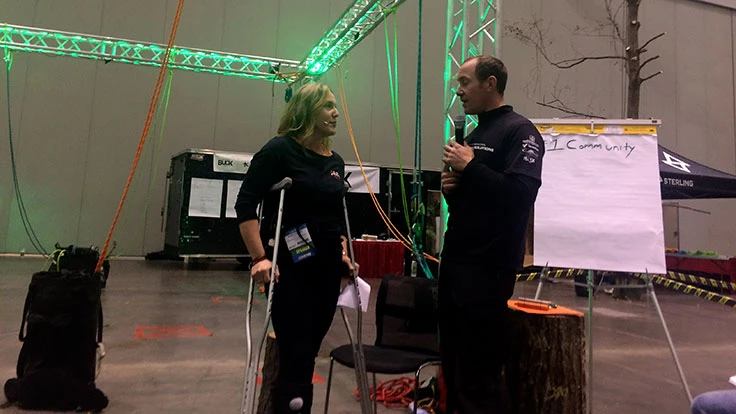
Landscape industry jobs tend to be arduous, requiring more physical labor than most jobs. During New England Grows, Dr. Mandy Carpenter of C.O.R. Ergonomic Solutions discussed why green industry professionals should always be taking time to consider their health. Back in 2009, Carpenter fell ill toward the end of the year and had continued to get sicker into 2010. As her symptoms worsened, she sought help from a doctor.
“This time taught me the value of health,” she said. “I learned when I was sick, and I have since restored my health to the point where it’s better than where I was before I fell ill. I’ve been enjoying life much more since 2014.”
Carpenter discussed a few pillars for health and wellness, and she mentioned five for landscape contractors to consider:
- Community engagement: Outside of work, people need some type of interaction or engagement. She said all humans need interaction and relationship with others. She advised getting involved in clubs, church, volunteering and other activities after work to boost mental health.
- Appropriate diet: Proper nutrition is necessary to provide the body with energy and allow for tissue to repair to improve strength or recover from injury. The body uses carbohydrates and fats for energy during activity or exercise, and it uses proteins for tissue repair after activity. She also said people often neglect watching their blood sugar levels. She shared a story of how her father would skip lunch sometimes while at work. Yet one of the times he failed to eat lunch, he grew fatigued by 4 p.m. and ended up falling on the job, fracturing his ankle and shoulder. “Consider what it takes to manage your blood sugar levels,” Carpenter said.
- Hydration: This is essential for normal physical and cognitive function, as well as to maintain normal body temperature. Proper hydration allows for optimal cardiovascular and muscle performance. Carpenter said contractors can lose up to three liters of water per hour during physical activity and sweating, but they can only absorb up to one liter of water per hour safely. So, hydration should start the day before. To calculate how much water each person needs in a day in ounces, she gave this formula: 50 percent of a person’s body weight / 2.
- Rest, sleep, recover: The body repairs itself when it’s resting or sleeping, allowing it to get stronger and heal. To get adequate sleep, she recommended seven to nine hours of sleep each night. Also, people tend to need more sleep in the winter seasons than summer. To aid in recovery and relaxation, Carpenter suggested taking an Epsom salt bath to serve as a muscle relaxer. She said athletes do this before a game or a race to restore strength. To take an Epsom salt bath, use two cups of Epsom salt in a bathtub full of water at any temperature preferred and soak for 15 to 20 minutes.
- Stress deflection: While stressors will happen, Carpenter said these can be managed. For example, if a person gets a flat tire while on the way to work, the person can choose to either be stressed about it or calm and collected. Work is often a stressor, so it’s also important to relax when off the job. Some simple ways to relax include deep breathing practices or taking a walk in a forest with good friends or alone.
Latest from Lawn & Landscape
- Develon unveils -9 Series heavy excavators
- News you might've missed last week
- Lifescape Colorado's Hupf moves to regional role as Ostheimer becomes president
- Your most reliable predictor of success
- LandCare names McCallon, Miller as branch managers
- Takeuchi-US names Paul Wade, Eric Wenzel as dealer development managers
- CASE continues partnership with country artist Jon Pardi
- Greenlee debuts new battery-powered remote pruner





