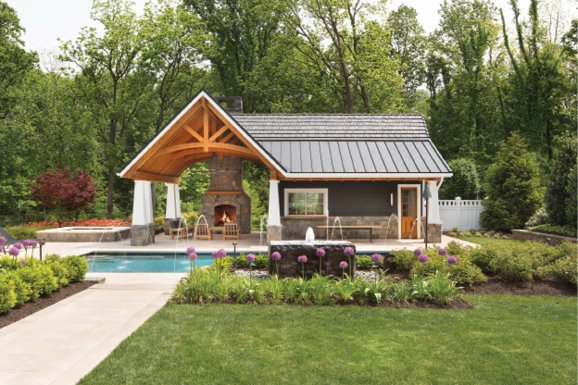
According to the most recent American Society of Landscape Architects trends survey, about 80 percent of landscape projects are expected to include low-maintenance plantings, per client request. Low-maintenance gardens always have been popular, but there’s a distinct movement toward a more relaxed feel to the landscape. “We’re selling a lot more sweeping beds of grasses, even in traditional gardens,” says Barry Schneider, president of Surrounds Landscape Architecture and Construction, based in the greater Washington, D.C., area. “They’re more natural in appearance and you get three-seasons of interest. They’re often placed alongside a meandering gravel path and a mixed border of perennials.”
“Almost every project has at least six to 12 pots and they’re planted with 90 percent annuals for color.” Chris Vedrani, Planted Earth Landscaping
The other benefit is that grasses fill in quickly. You can plant hundreds of them in April and within three months, you’ve got a nearly full-grown plant. “They don’t cost as much as boxwoods or evergreens,” Schneider says.
Another growing design development is the use of pots grouped throughout the property. “Almost every project has at least six to 12 pots and they’re planted with 90 percent annuals for color,” says Chris Vedrani, owner of Planted Earth Landscaping. Limestone or concrete urns or large (3’x 3’) metal planters, set on the front porch or on and around the pool deck, are most popular. They’re usually filled with annuals that are swapped out for three turns (spring, summer
One of the challenges for designers in recent years has been
The author is a freelance writer based in the Northeast.