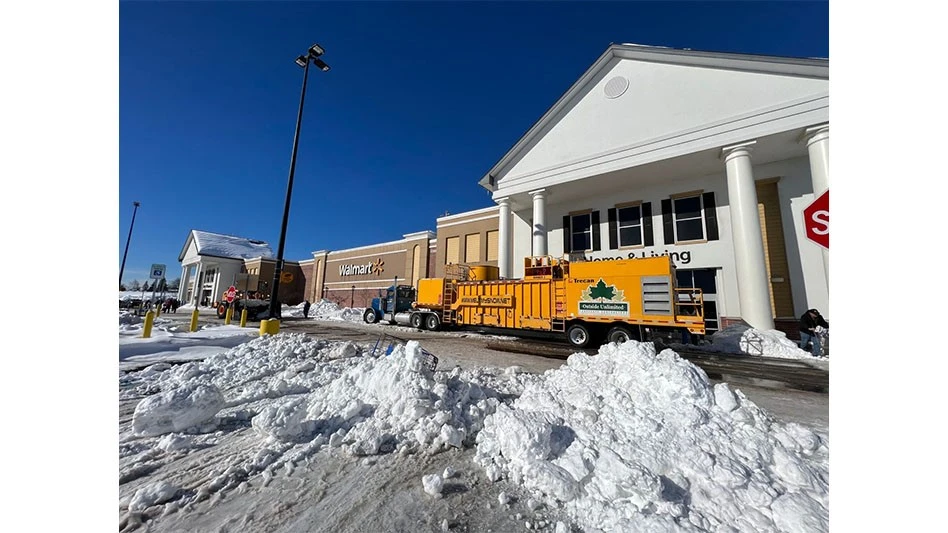
When nearly seven feet of snow falls, everything grinds to a halt. That’s what happened in Buffalo, N.Y., in November when the city and surrounding areas received nearly 80 inches of snow in three days.
Jonah Daigle, president and CEO of Outside Unlimited, says the problem then becomes what to do with all that snow. That’s why his company got to work utilizing snow melters to assist their commercial clients.
Outside Unlimited, headquartered in New Hampshire, operates in 11 Northeastern states from Virginia to Maine.
“Basically, we’re a snow removal company that does landscaping in the off season and sweeping when we have to,” Daigle says.
He adds that snow melters are an extremely effective, and innovative, way of dealing with major snow events.
“We have the snow melters for what I would call extremely large events,” Daigle says. “Sort of like the nearly 80 inches Buffalo just received. I had three snow melters in the market for that. And at that time, we were the only ones up there melting snow. Everybody else was using the conventional means of trucking.”
Daigle says not only was it important to clear the snow quickly for emergency services, but also for keeping customers happy.
“A lot of people don’t understand what seven feet of snow looks like,” he says. “Especially in three days. That’s just an incredible amount of snow.”
But despite rising fuel costs, Daigle says using a snow melter is still more profitable.
“When push comes to shove, the melters use a lot of fuel but we can melt 25 or 30 dump trucks an hour,” he says. “Melting is more economical. The melters do burn a lot of fuel…but even though a melter uses 150 gallons an hour, the three dump trucks would burn between 200-300 gallons. Plus, you’ve got wear and tear on the trucks, the tires, the roads and all that.”
Daigle adds that no matter the method used for snow removal, everyone is being compelled to charge more just to keep up with fuel increases.
“Fuel is an issue in the green industry and really (for) every person in this country,” he says. “Diesel fuel is what stocks the shelves at the stores and what plows the parking lots. It’s all tied together. At the end of the day, melting is still cheaper with the inflated diesel fuel prices.”
Another benefit of utilizing the melters, or really any heavy equipment, is it saves on labor, something Daigle says is a constant struggle no matter the market.
“With the dump trucks you need all those drives and employees are getting harder and harder to find,” he says. “It takes two people to run the melter plus the people operating the loaders…it just makes a lot more sense.”
Latest from Lawn & Landscape
- Develon unveils -9 Series heavy excavators
- News you might've missed last week
- Lifescape Colorado's Hupf moves to regional role as Ostheimer becomes president
- Your most reliable predictor of success
- LandCare names McCallon, Miller as branch managers
- Takeuchi-US names Paul Wade, Eric Wenzel as dealer development managers
- CASE continues partnership with country artist Jon Pardi
- Greenlee debuts new battery-powered remote pruner





