The number of challenges green industry companies face has continued to increase in recent years.
From more states introducing legislation to limit gas-powered equipment and pesticide usage, to the ongoing labor shortage, few businesses go unscathed.
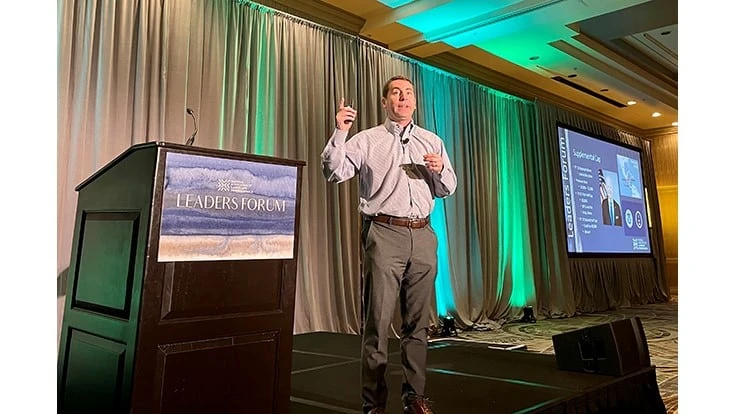
So, NALP’s Vice President of Government Relations, Andrew Bray, gave a quick update on how the organization is helping its members navigate these struggles during NALP’s Leaders Forum in January.
“Some of the news I have to deliver is sometimes frustrating to say the least,” he said.
Bray touched on three main issues — H-2B visas, gas-powered equipment bans and pesticide regulations.
VISA WOES. “We were in a workforce crisis before COVID,” Bray said, noting that the current labor market only adds to the needs for additional H-2B visas.
Bray explained that the visas are capped at 66,000.
“The landscape industry is the largest user of the program by a significant margin,” he said. “Fifty percent of the H-2B visas coming into the country are from our industry.”
A lottery is done in January to determine which applicants are permitted their visas. Currently there are seven lottery bins, labeled A-G.
“You have a one in four chance of getting your visas,” Bray said. “They added another lottery bin this year...Our understanding is if you’re in A you will get your visas. If you’re in B you will likely get your visas, but it’s no guarantee… If you’re C through G I’m sorry to tell you, you are likely capped out.”
However, Bray said all hope is not lost.
Bray explained that a supplement cap is instituted, which is the administration’s ability to release additional visas. Up to 65,000 additional visas can be issued each year.
“We’ve gotten anywhere from 15,000 to 30,000 additional visas each year,” Bray said. “We got to fight for everything we can get.”
Bray said that he’s optimistic that this year’s supplement cap will help some of the pressure and encourages those in lottery bins C through G to stick with the process.
“This year, for the first time ever, the first half cap additional visas are being released,” he said. “Of that 22,000, there’s a carve out for those northern triangle countries — El Salvador, Guatemala and Honduras. This is part of the Biden Administration’s commitment to try and do some nation building. I tell people if you try and get your visas from a Northern Triangle Country instead of Mexico, I would bet you, that under the Biden administration, you will probably get your visas.”
Bray did note that through this option, the individual must be a returning worker.
He went on to explain the Returning Worker Exception, and how getting that passed through Congress could even further increase the number of available H-2B visas.
“The Returning Worker Exception means that if you were in the country as a worker under an H-2B visa in one of the three previous years, you are cap exempt. This would thus triple the cap and have a cap number of close to 200,000.”
Not only did Bray encourage attendees to contact their representatives and ask them to support this initiative, but he also told them all help to spread the message, as the more calls and emails the better.
“I always tell people to pass it on to five people,” Bray said. “This is a numbers game.”
CHANGE IS COMING. California’s recent ban on gas-powered equipment sparked even further discussion on the electrification of the industry.
Bray broke down the recent legislation, explaining that the ban is on the sale of new gas-powered equipment in 2024.
He also noted that California is the only state that can regulate based on emissions. Other states promoting similar bans can do so on the basis that the equipment is noisy or a nuisance, but technically not that it is polluting.
Bray said he expects more and more states to enact similar regulations.
This transition is inevitable and coming quickly,” he said.
Bray said NALP supports the transition to electric equipment, but in due time.
“We are stewards of the environment, and we are proud of that,” he said. “We do want to encourage a responsible transition to this equipment. But trying to do so in one to three years is impossible.”
Bray said there are three big hinderances companies face when making the switch.
“First is cost, and the cost is significant,” he said.
According to Bray, research shows a standard three-person crew would need about 35 batteries to operate their normal route in a day.
Because the battery-powered equipment is still relatively new, Bray added performance is another barrier.
“We know that they’re getting close…but it’s not quite there yet,” he said. “We’re already in a national labor crisis so we shouldn’t be using less efficient equipment.”
And finally, Bray said infrastructure on a micro and macro level makes a substantial impact.
“We know from talking with some companies already making the transition, that you need new electric lines for the different voltage, you have to retrofit the trucks to charge on the go, you’ll whole company has to change its entire infrastructure,” he said.
Additionally, some communities might not have the wherewithal for the additional electricity usage.
“On the macro level, is your community ready for that?” he asked. “Are there charging stations out in the community you could use?”
While the transition is inevitable, Bray said he and NALP are working with the government to make sure the process happens fairly and doesn’t stifle landscaping companies.
MORE RULES FOR LAWN CARE. Similarly, to gas-powered bans, pesticide bans are continuing to increase nationwide.
“All pesticides need to be registered with the EPA,” Bray explained.
He added that when the EPA investigates how certain ones are being used, they talk with the agricultural companies, who use them on a much larger scale than the green industry does.
“We spend a lot of time talking with them about this,” he said. “It’s important to communicate with them and tell them how we’re using products.”
Bray adds that most of NALP’s work in helping pass fair legislation on the issue is done at the state level.
“States are where we’re fighting most of the pesticide stuff,” he said. “Every state in the Northeast, most of the states in the Great Lakes and every state west of Colorado has a bill introduced right now that would ban neonicotinoids or another type of pesticide.”
Because of this Voices for Healthy Green Spaces has been established.
Bray encouraged attendees to join the grassroots organization aimed at promoting the industry and its sustainable initiatives.
“We need you to be engaged as much as you can,” he said. “We’re trying to build that community feel.”