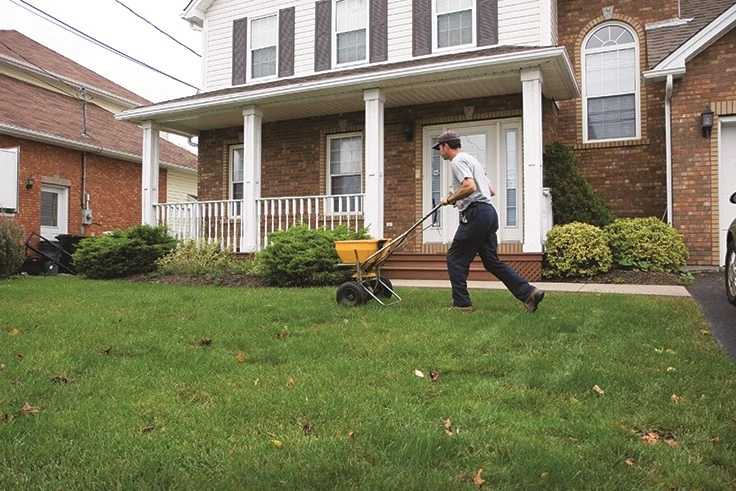
There’s no one-size-fits-all approach when it comes to enhanced efficiency fertilizers. Depending on the needs of the lawn, the application method and the price range, there are lots of options to choose from to keep nitrogen available to turf longer.
The idea is to use less fertilizer either by increasing its solubility to use less and get more to the plant or prevent dissolution of the fertilizer until the plant is ready for it to reduce massive releases of nitrogen at the same time and reduce the volatility.
It can also prevent fertilizer burn since technicians are using a much smaller rate. While most operators don’t apply fertilizer during hot summer months, it’s hard to predict what Mother Nature has in store.
“We’ve had years here where the temperature’s shot up into the 90s and if you’re going out and trying to treat lawns in a short period of time, you don’t have the flexibility of waiting for three days before you put another application down or watering material in,” says Peter Landschoot, professor of turgrass science at Penn State University.
There are two basic types of enhanced efficiency fertilizers to choose from, and most lawn care operators apply a mix of standard and enhanced efficiency fertilizers in their programs.
Slow-release: Sometimes called controlled-release, these fertilizers use various mechanisms to keep nutrients available to plants after application such as sulfur-coated urea or polymer coated urea.
Stabilized: These fertilizers have a nitrogen stabilizer added to them to extend the time the nitrogen remains in the soil and reduce volatilization.
“Bottom line is that they all can work if you get a high-quality product from a reputable company and use the product properly,” says Bryan Hopkins, professor of plant and wildlife studies at Brighan Young University.
Applications
Hopkins says he prefers a liquid application for enhanced efficiency fertilizers, if possible, because it gives better uniformity, but that drives costs up. If your operation has a smaller budget, he recommends dry since it requires fewer applications.
Hopkins prefers to use controlled release fertilizers when applying dry products. “I feel like I get longer release times and a steadier supply,” he says.
But when using a liquid product, he prefers a stabilizer or a slow-release such as urease or nitrification inhibitors and/or urea formaldehyde.
Landschoot says granulars make the most sense for a typical lawn care operation. “It’s easier to apply,” he says. “You don’t need a big, huge tank on the back of your truck, although some companies do that.”
Those rates will change depending on the age of the lawn, since less established lawns require more fertilizer than older ones.
Both Hopkins and Landschoot see companies using mostly a combination of enhanced efficiency and quick release fertilizers. Many are using a half and half combination of urea and sulfur-coated urea or polymer-coated urea to get a quick release for greening up grass and then nutrients to keep lawns looking healthy.
“That lessens the price and they can still get a quick response and a little more color and density until the next application and that seems to work out really well for them,” Landschoot says.
Rates.
Landschoot prescribes a certain amount of nitrogen per year based on the species of grass, the location and the age of the turf. The kind of soil also comes into play since “poorer soil usually require a little more nitrogen than soils with good tills and inherent fertility,” he says.
But since lawn care operators can’t have a program for every property, Landschoot says most businesses offer one or two programs to accommodate differing needs.
Hopkins recommends 1 pound of a 44 percent nitrogen controlled-release fertilizer and 2.5 pounds of ammonium sulfate per 1,000 square feet in the spring and double those rates in the fall. For warm season grasses, he recommends the same rate in the spring with an application of controlled release fertilizer every three months while the grass is actively growing.
For high-end customers, he suggests liquid, for a medium-cost program, he suggests two applications of dry enhanced efficiency fertilizer and in low-budget situations, he recommends one last fall application of dry product.
“We’re kind of trying to find that holy grail of it would be nice if we could go out there and only do it once because there’s a lot of labor involved when you go out and apply fertilizer,” Hopkins says, but so far there’s no one-application solution for a consistently green lawn.
Although the price of enhanced efficiency fertilizers is higher, you’re using less and applying less frequently, so Hopkins says the cost pretty much evens out, as long as you aren’t using a “ridiculously expensive” product.
Popularity.
“We’re finding that here in the Northeast, most lawn care operators are putting down enhanced efficiency fertilizers in their program of some sort,” Landschoot says. “It may not be every application but most people are using them somewhere in their programs.”
Landschoot says that in certain states like Maryland, there are laws regarding how much soluble nitrogen technicians can put down at a time. So if a crew needs to put down 1 pound of nitrogen in an application, they can only use .7 pounds of soluble nitrogen and will make up the rest in slow-release or stabilized forms.
Hopkins says the pressure is on and some communities are trying to ban fertilizers and others that have already done so. And as costs go down, he thinks popularity will spread.
“In turf, we have so many options,” Landschoot says. “It’s really great because you can really pick a product to fit your program very easily but you’ve got to know the product. That’s the thing. There’s so much out there. It’s confusing so you’ve really got to know what your objectives are so you can pick the right product and reach those objectives.”
Latest from Lawn & Landscape
- Develon unveils -9 Series heavy excavators
- News you might've missed last week
- Lifescape Colorado's Hupf moves to regional role as Ostheimer becomes president
- Your most reliable predictor of success
- LandCare names McCallon, Miller as branch managers
- Takeuchi-US names Paul Wade, Eric Wenzel as dealer development managers
- CASE continues partnership with country artist Jon Pardi
- Greenlee debuts new battery-powered remote pruner





