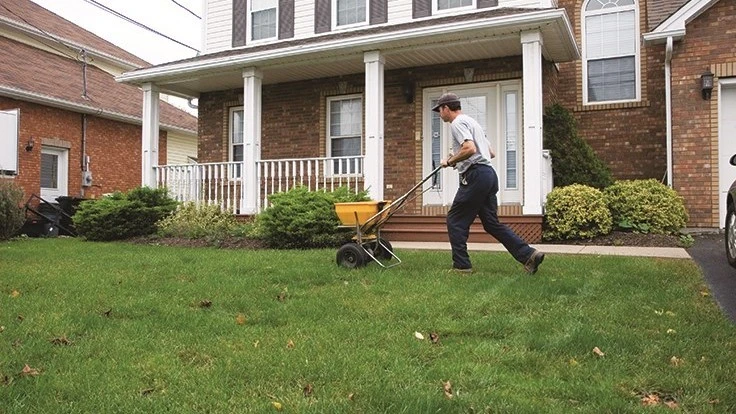
Lawn care operators have a number of items to consider when choosing the right fertilizer program. From application methods to product options, there’s a lot to consider to give your customers healthy lawns.
Enhanced efficiency options.
Scientific Plant Services made the move to enhanced efficiency fertilizers about 10 years ago and President Brian Haga says the change has resulted in significant labor savings.
The Maryland-based company offers plant health care, commercial and residential fertilization and insect, weed and disease control, among other services.
Scientific Plant Services used to apply fertilizers twice in the fall – once in September and then again in mid-October. Switching to an enhanced efficiency fertilizer has freed up four to five weeks of work for 75 percent of the staff.
“It eliminated a lot – a lot of bag handling, a lot of wear and tear on the trucks and hours on the spreaders,” Haga says. “We’re putting down less because of the efficiency so everything kind of worked out.”
Jack Harrell III says enhanced efficiency fertilizers don’t reduce the rounds LCOs do in a year, but cut down on the rounds they need to put out fertilizer so that they can offer other services and increase their value to customers.
“So instead of him fertilizing six times, he can do two or three, depending on what fertilizer program we come up with and then he can do weed treatments or insect treatments and it just makes him more efficient on labor,” says Harrell, senior vice president of R&D, sales and marketing at Harrell’s, a producer and distributor of fertilizing products and programs.
Enhanced efficiency fertilizers can also keep lawns greener longer and avoid jumps in growth, especially in areas with high rainfall.
“A lot of times, if you put a quick release product down, it’s washed through the soils and gets down into the groundwater whereas EEFs take a little bit longer to break down and they stay in the soil where the plant can take it up over time,” Harrell says.
But before any applications go down, Haga and his team recommend soil testing to ensure that the grass has everything it needs to succeed.
"We recommend soil testing for all new clients and I’d say at least 80 percent sign off to have a soil test," he says. "Once that’s done, if there’s a pH issue or a potassium issue or a phosphorus issue, we address that."
The company then recommends re-testing every three to four years on an ongoing basis.
Liquid or granular?
The math is a little less complicated with granular products says Rodney St. John, an agronomist and a former professor at Kansas State University, now holds the title of vice president, director of agronomy and environmental stewardship at Ryan Lawn & Tree.
“It’s easy to do the math with granular,” St. John says. “You know so many pounds cover so many square feet – with liquid the math is a little more complicated.” St. John says one of his jobs is to prepare the recommended amount of fertilizer for the crews who will be doing the actual applications.
“The main benefit is the release time; liquid only lasts for a few weeks, where granular will last up to 16 weeks, depending on the type of poly-coated fertilizer we use,” he says.
One drawback St. John sees in granular fertilizer is with the mechanized equipment they use. He says the operator can get going pretty fast or cut corners, which reduces the amount of product that is applied.
Another drawback of granular fertilizers, according to St. John, is the cleanup that is often required after application. Pelleted fertilizer often inadvertently lands on sidewalks, driveways and streets.
One of the biggest advantages of using a liquid application is you can mix products like fungicides and herbicides with fertilizer into a tank, and take care of everything at once.
“Some herbicides that are available as a liquid aren’t available in a granular,” says St. John.
Ryan Lawn & Tree finds occasions where it is more practical to use a liquid fertilizer over a granular. St. John says it’s easier to pull a hose up a steep hill and fertilize with a liquid than it is to drive equipment up a sloping property.
Some companies also use liquid applications in the spring for a quick green up and then follow up with granular applications.
Latest from Lawn & Landscape
- Develon unveils -9 Series heavy excavators
- News you might've missed last week
- Lifescape Colorado's Hupf moves to regional role as Ostheimer becomes president
- Your most reliable predictor of success
- LandCare names McCallon, Miller as branch managers
- Takeuchi-US names Paul Wade, Eric Wenzel as dealer development managers
- CASE continues partnership with country artist Jon Pardi
- Greenlee debuts new battery-powered remote pruner





