 |
As summer turns to fall, grubs are hatching and fattening up for the winter, while chinch bugs are cycling through several generations. To mitigate damage and prevent spring problems, don’t be afraid to dig down in lawns.
Grubs.
Before grubs dig in for the winter, they’re chowing down on your customers’ lawns. As soil temperatures drop, the pests will disappear anywhere between 4 and 8 inches underground and won’t re-emerge until the spring. To prevent spring damage when eggs emerge, and to minimize harm to your customers’ lawns, take care of them before they go underground.
While experienced technicians may be able to detect a spongey feeling in the lawn as the result of grub feeding, you really have to get down and look for them, says Chris Lemcke, technical director for Weed Man USA.
Grubs are fairly easy to identify once they start doing damage. “Once they start feeding, they basically sever the roots, so if you pull on the grass, it will tend to lift up just like fresh-laid sod and you’ll find the grubs underneath, feeding,” Lemcke says.
If you’re seeing a lot of adult beetles in the summer, it’s a good indication of high grub activity. And since damage from grubs looks a lot like drought, yellow or brown patches could be something more than what it seems.
“Once the damage occurs, it’s done, so it’s hard to repair it without it being costly, so if you end up finding grubs in late fall and the damage has been done, then you’re looking at repairing,” Lemcke says. That’s why he recommends preventative treatments. The longer grubs feed on the lawn, the larger and harder to control they become.
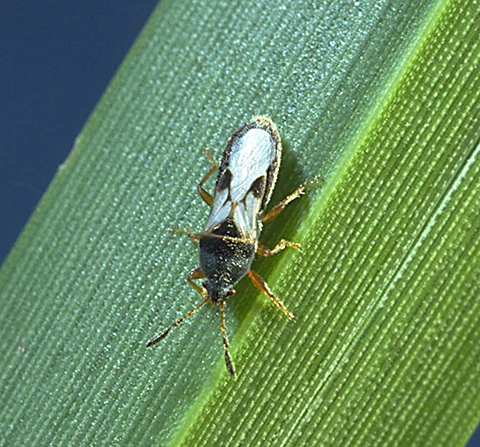
Chinch bugs.
Preventative treatments are ideal for chinch bugs as well, but if you spot them, treat them. “If you don’t treat it, your lawn is done. They will completely devastate your lawn in a very short amount of time and then it won’t grow back,” Lemcke says, adding that repairing turf after chinch bug damage is a serious reinvestment.
Weed Man even has a 48-hour service guarantee so that if customers see spots or problems in the lawn, they can report it and a technician will respond within two days to prevent damage. And whenever they get a report, they’re on the lookout for chinch bugs.
Chinch bugs like warm season grasses in the South, like St. Augustine, and cool season grasses in the North, like bluegrass.
When there’s a fairly large infestation, technicians look where the brown meets the green area of the grass. “They tend to be not where they have created the damage already but where the damage is just starting to occur,” Lemcke says.
He says to look at the base of the lawn in the crown of the plants to spot them. They’re small, but visible. “It’s basically head down, butt in the air and pulling apart the grass looking for them,” Lemcke says.
An alternative is to poke holes in the bottom of a metal can and fill it with water to see if the pests float.
Latest from Lawn & Landscape
- Develon unveils -9 Series heavy excavators
- News you might've missed last week
- Lifescape Colorado's Hupf moves to regional role as Ostheimer becomes president
- Your most reliable predictor of success
- LandCare names McCallon, Miller as branch managers
- Takeuchi-US names Paul Wade, Eric Wenzel as dealer development managers
- CASE continues partnership with country artist Jon Pardi
- Greenlee debuts new battery-powered remote pruner





