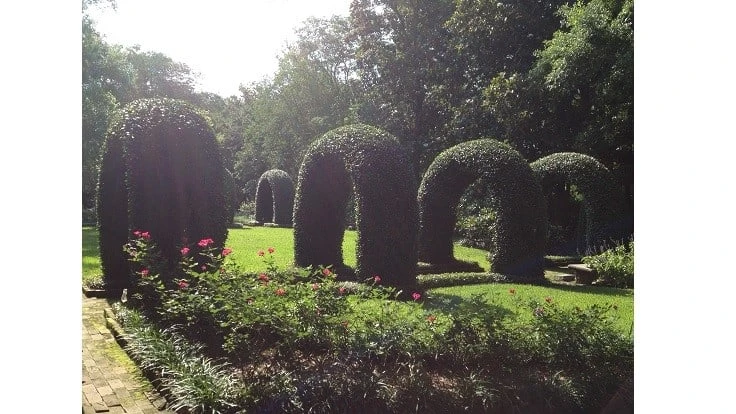
Editor's note: The above photograph depicts a project that Tellepsen Landscaping Services completed for a client.
Benjamin Brown always knew that Marc Tellepsen and Mark Scioneaux demanded excellence. He had no idea how far they’d take that to please clients.
While working at Tellepsen Landscaping Services in Houston, Brown says there was a client who wanted major changes to her landscape design at last minute. She wanted to replace the native soil in her flower beds after the crew had already started planting, and Brown told her it wouldn’t be possible. The next day, she called Brown’s bosses, who ultimately sided with her. Brown says now that it was an inconvenience and it wasn’t in their contract to do that extra work.
But that’s what Brown loved about that company: Tellepsen, 45, and Scioneaux, 58, had pure commitment to the client. It was first and foremost, he says.
“They would bend over backwards no matter what. There was nobody small,” Brown says. “Just to meet the expectations of the homeowner, they went above and beyond what was necessary.”
This is just part of the legacy “Marc and Mark” left behind. Tellepsen and Scioneaux were both killed in a Kerrville, Texas, plane crash last year. The crash also took the lives of four others: architect Reagan Miller, their clients Stuart and Angela Kensinger; and pilot Jeffrey Weiss, according to the Houston Chronicle. They had been surveying some property they’d be working on for a client when the plane went down just around 9 a.m. on April 22.
“It was such a shock, such a surprise,” Brown says. “You don’t realize you’re going to be saying these things about people who should still be alive.”
REMEMBERING GIANTS. Houston irrigation contractor John Taylor had already heard about the accident itself by watching the news – he just didn’t know his personal friends and colleagues were aboard. “I just thought, ‘Those poor people,’” Taylor says. “The following morning during a team meeting, one of my managers came in and said, ‘Hey, I’m sorry for your loss’ and I had no idea what he was talking about.”
It was a fairly high-profile crash, and many stations picked up coverage of the accident. One of Taylor’s friends in Alaska even heard about it on the local news affiliate in Alaska. Since the names of those killed in the crash were revealed, Taylor says colleagues and Houston in general has come together to remember the industry giants. Tellepsen and Scioneaux often gave to charity, so much so that even some of those organizations reached out to Taylor to express condolences.
“At first, you think about what these people have meant, that they died and their families, but then you think of the sort of vacuum or hole that’s created with them being gone,” Taylor says. “The way we’ve come together… both as Houstonians as well as people in the green industry, has been pretty profound.”
Tellepsen’s name is renowned in Houston: His family owns the construction company that has built several prominent skyscrapers in the city. Brown speculates that Tellepsen wisely leaned into his name to start the landscaping company in 2007, but both Brown and Taylor say that Tellepsen wanted to create his own legacy and step out from behind the shadow of his family’s name.
They believe he and Scioneaux succeeded.
“There’s nobody I know that, if they don’t consider Tellepsen one of the best landscaping companies in town, then certainly in the top three,” Taylor says.
In the immediate days following the crash, Tellepsen Landscaping’s Vice President Kristi Axel says she went into autopilot mode. She and Lead Designer Michael Hernandez called all of the clients and reassured some employees that the company wouldn’t fold in the wake of the tragedy. There were seven major installation projects going on at once.
It wasn’t until three or four months later, Axel estimates, that the gravity of the situation hit her. She pulled into the parking lot and wondered aloud where Tellepsen’s truck was parked, though it hadn’t been there since his death.
“There was no time for us to even sit down and grieve…because we had to go. People were depending on us who have been working here for years,” Axel says. “That’s when the realization came, that we’re doing this without them but we’re doing this for them. Our goal is that we want to make sure that this place stays, that we make them happy, we make them proud.”
The whole company has bought into this mantra as they remember two men who shaped what the 35-person team is today. It’s helped to hear from countless Houstonians who are now realizing just how many landscapes the Tellepsen company has designed. The company has not relied much on advertising, instead opting to lean into word-of-mouth and letting their work speak for itself.
“Marc and Mark would move in silence,” Axel says. “They just wanted to have things looking beautiful and go on about their business.”
Tellepsen’s wife, Jennifer, was a co-owner in the company and has since made her presence around the company quite visible. Axel says she told employees to take the next day off after the crash, but they wanted to show up anyway because it’s what Tellepsen would’ve wanted.
“It makes you feel good to know everybody wants you to keep going,” Axel says. “Marc started this from scratch and we want to keep it going.”
FROM CLASSROOM TO FIELD. Marc Tellepsen never stopped teaching.
Sure, he left the classroom to join the landscaping industry when he teamed up with Scioneaux, but his meticulous approach with crews meant constant education. Brown says that industry norms meant nothing to Tellepsen in large part because of his background in education – he wasn’t always a trained landscaper – which was, to some crews, a blessing and a curse.
Brown self-describes himself as a former “boots-on-the-ground architect” at the company, while Scioneaux was the lead designer and Tellepsen focused on maintenance. Brown admires Tellepsen’s thoroughness, which he speculates he got from persistent research. Because Tellepsen wasn’t trained traditionally like most other landscapers, he slowed things down to take the long but right route. He says Tellepsen was never demeaning, though he would make sure crews would do things like ensure none of their shallow-rooted azaleas would die off during transportation.
It would often triple the time it took to complete a job, but Brown says Tellepsen did everything he could to do it the right way.
“Everything he did, he did to full maximum effort,” Brown says. “There were never any shortcuts. Tried-and-true methods didn’t mean a thing to Marc Tellepsen, and I don’t mean that in a negative way. No matter how much time it took, he did it correctly.”
Taylor admires Tellepsen’s humility over anything else. He says Tellepsen could’ve coasted on his family’s prominence – after all, everyone recognized the name. The local YMCA is even named after the Tellepsens.
Still, Taylor says Tellepsen built something for his own, not anybody else. And despite his celebrity in the area, he never lived excessively lavish.
“This is a guy who would go home, take a 30-minute lunch, and eat a Hot Pocket,” Taylor says. “Meanwhile, I’m eating a lunch that costs 15 bucks. I love that lesson of not just the humility…but also that frugality.”
SEEING THE SPACE. Plenty of professional athletes have their signature moves, like a Kareem Abdul-Jabbar skyhook shot or a Derek Jeter jump throw. Likewise, Taylor says most landscape architects have elements in their designs they incorporate into everything they do. He can drive around Houston and recognize which companies did what jobs based on repeated, recognizable designs.
“That’s great, but where Scioneaux was brilliant was he looked at the space and he wanted that space to tell a story,” Taylor says. “Every space ended up looking completely different. They’re going out there and getting the most out of every site.”
Taylor says Scioneaux was the rare exception to landscape architects in that he often spent time on site with his clients. He’d visualize a new idea for the space based on what he saw once there, though Taylor says Scioneaux wanted to draw people into his designs, not just create a pretty landscape for passerby.
Brown says he and his crews always wanted to make Scioneaux happy. He was a perfectionist, Brown says, to the point where it wasn’t a negative detriment but where employees wanted to rise up to the challenge. He was also a family friend to most he encountered (he had Brown over for annual Christmas parties), which added to the desire to make sure Scioneaux was pleased with how his designs were implemented.
“He just had a way, if he was unhappy, you wanted to make him happy,” Brown says. “Not in a buddy-buddy way, but in a respect way, like, ‘Hey, we’re not living up to Mark Scioneaux’s standards. We have to.’”
It wasn’t intimidating so much as it was inspiring, but Scioneaux often liked to watch over crews while they worked on his designs, Taylor says. Scioneaux was on the site because he had a vision and wanted to make sure the crews didn’t incorrectly display it. He didn’t want to leave it up to chance whether what he drew up was successful or not.
“I’ve worked with a great many landscape architects in my life all over the country: I can tell you that Mark Scioneaux was hands down the best landscape architect I ever worked with,” Taylor says. “He brought a passion to the job every day. This was a selfless guy who wasn’t as interested in building a name as much as he was in building something beautiful.”
A BRIGHT FUTURE. Axel and Hernandez say they’ve been working tirelessly with their team to ensure the company not only continues but also honors the culture they believe Tellepsen and Scioneaux established. They point to the first Tellepsen hire still being employed with the company, and the fact several foremen have worked there for over six years. They don’t want that spirit to disappear.
At times since the tragedy, Hernandez says he and Axel have worked seven days a week, 60 or more hours and well into the evenings. They’ve visited with almost all of their clients to walk the properties with their crews, just to familiarize themselves with the maintenance foremen.
Hernandez says they had to give every piece of themselves for a bit of time after the accident.
“It was chaotic. Just over time, things are finally starting to settle,” Hernandez says. “We’re working to get the right people in the correct positions. Overall, we have a really good grasp on everything.”
But it’s a culture worth keeping. Hernandez recalls the company going out for a nice dinner to celebrate his engagement, and he invited several of the employees to his wedding. Axel remembers Scioneaux’s home-cooked meals and Tellepsen’s decision to occasionally do “Fajita Friday.”
Axel says she and Tellepsen had a three-year plan that started in 2016. The company is seeing the growth and results come to fruition from that plan now, even if Tellepsen himself isn’t around to see it all. But she knows that he’d love to see the direction they’re steering the company now.
“This was our family basically. Tellepsen Landscaping, everyone here is considered family,” Axel says. “We are just a close, tight-knit group.”
Latest from Lawn & Landscape
- Develon unveils -9 Series heavy excavators
- News you might've missed last week
- Lifescape Colorado's Hupf moves to regional role as Ostheimer becomes president
- Your most reliable predictor of success
- LandCare names McCallon, Miller as branch managers
- Takeuchi-US names Paul Wade, Eric Wenzel as dealer development managers
- CASE continues partnership with country artist Jon Pardi
- Greenlee debuts new battery-powered remote pruner





