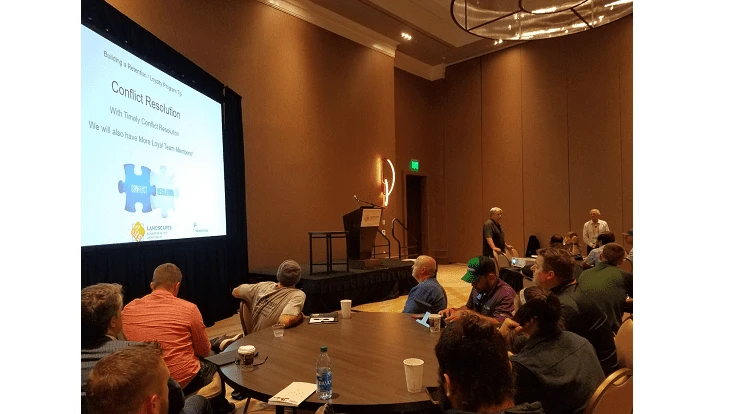
When Jenn Myers from NALP introduced the Harvest Group’s Bill Arman and Ed LaFlamme, she first told LANDSCAPES attendees that the pair has amassed 200 years of landscape industry experience.
Sure, it was an exaggeration – just to make sure everyone was paying attention, Myers joked. But during the session, titled “How to Build a Recruiting Machine that Works,” the tandem that’s combined for over 100 years of experience outlined a bleak hiring and retention reality.
“It’s pretty harsh out there. I’ve been in the industry for 55 years,” Arman said. “This, without a doubt, is the biggest challenge I’ve seen in my career.”
The answers are not easy; Arman acknowledged as much. But the Harvesters spent their hourlong session detailing ways to improve in three key areas: building a quality retention/loyalty program; building/shaping a culture; and going to the sources.
BUILDING A QUALITY RETENTION PROGRAM. Arman recommended having “stay on” interviews with employees rather than just having “exit” interviews when they leave. He offered a suggestion on ways to maintain a consistent schedule to garner feedback from employees.
- In an employee’s first 90 days, touch base with them for 10-15 minutes weekly.
- In an employee’s first year, touch base with them monthly.
- After an employee’s first year, touch base with them quarterly.
Arman also suggested creating a buddy system for recently hired employees so they have a peer they can talk with if they’re experiencing any issues or have questions on a jobsite.
Other advice the Harvesters offered in this area:
- Pay a fair wage: Arman said he’s seen very few places offering less than $15 an hour now.
- Build a career ladder: “Inspire them to aspire them to perspire.”
- Offer a stay-on bonus after they keep coming back to work for a designated period of time.
BUILD AND SHAPE YOUR CULTURE. Arman told attendees that every company has a culture – and it can be your best or worst recruiting tool. For a clearer picture of what your company’s culture actually is, examine what happens closely when there’s an issue or problem.
“I kind of like adversity,” Arman said. “I like a hiccup or two. Champions really come to the surface.”
The Harvesters suggested reinforcing a positive work environment, and deal with people fairly. Say “thank you” often and sincerely mean it. Celebrate their successes publicly and have fun often. Keep a clean workplace with company plaques, trophies and ribbons prominently displayed around the facility. Spend 90% of your time fixing problems and 10% talking about them, not the other way around.
LaFlamme also mentioned that outlining a clear company vision is important. For a great resource on how to outline your company’s vision, they suggested reading the book, “The Advantage” by Patrick Lencioni.
“A company with no vision is like a jigsaw with no picture,” LaFlamme said. “Where are you going?”
When new employees come through the door, LaFlamme also said it’s important to talk with them frequently. After their first day of onboarding, end their day by asking them, “How did the day go?” Ask them if they have any questions or if they’ve seen your career ladder.
“They’re going to go back and say, ‘Man, it was a really hard day but I’ve got potential to grow in this company,’” LaFlamme said.
LaFlamme added that a good company culture is all about building one-on-one relationships with employees.
“At least once a week, 30 minutes, sit there and have lunch with them. Just sit and get to know them,” LaFlamme said. “That is so powerful, you can’t imagine what that means to them. The boss is coming to
GOING TO THE SOURCES. Of course, examining where you find new employees is also important, too. Consider the following places to find your next employees:
- Seek internal candidates first for leadership positions
- Enlist the best to find the best: Pay your employees handsomely to find peers to come work at your company.
- Get involved in your community through charities and events
- Go recruit at high schools and colleges
- Job fairs/open house
- Advertising
- Sponsor sports teams
- Geofence ads after finding out where your targets go shop, eat, get gas, etc.
Above all, the Harvesters mentioned that landscapers should avoid just tossing their job descriptions or company names on ads or social media posts.
“Stop making it so transactional,” LaFlamme said. “We need this, we need that; instead, make it warm and fuzzy. We have an opportunity for you. We have a family operation. Make a story out of it.”
Latest from Lawn & Landscape
- Develon unveils -9 Series heavy excavators
- News you might've missed last week
- Lifescape Colorado's Hupf moves to regional role as Ostheimer becomes president
- Your most reliable predictor of success
- LandCare names McCallon, Miller as branch managers
- Takeuchi-US names Paul Wade, Eric Wenzel as dealer development managers
- CASE continues partnership with country artist Jon Pardi
- Greenlee debuts new battery-powered remote pruner





