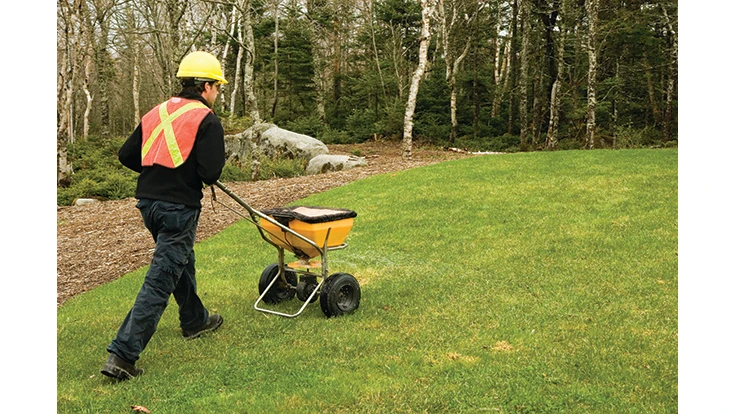
Gearing up for the lawn care season means making sure that blades, and minds, haven’t gotten rusty. Besides a thorough inventory and safety check on equipment, here’s how you can make sure crews are really ready for the busy season.
Crews at Arlington Lawn Care in Erie, Pa., make sure all of the equipment is ready to go before leaving for any job, any time. That means tight blades, belts and gas caps.
"I tell all my guys, make sure your tools are sharp because another one of the big accidents that happens out on the field is when you’re using a dull set of pruners,” says owner Rich Arlington. With a dull blade, technicians are working extra hard to prune branches, which can result in cut fingers or hands.
"It's just easier if you always make sure your tools are sharp," he says. That’s why each Monday, Wednesday and Friday the in-house mechanic sharpens every single piece of equipment.
Besides sharp tools, sharp minds are important, too. Chuck Miller, founder of Mirrorscapes in Lancaster, Ohio, says it can be easy to get stuck in a rut, so he does mental warm-ups by holding regular, short meetings about equipment use with his crews. “Because it can become monotonous, if you’re a mower, you’re riding a mower all day, you can get a little lax in your operation sometimes and so we try to remind them of that,” he says.
And it’s not just tools. Crews need to be outfitted with the proper safety gear to start the year off. Spring work can be cold and wet, so crews are Arlington don’t leave the shop until they have the proper attire like leather boots, long pants, work gloves and, in the case of wet snow, an extra jacket. “I cannot tell you how many stories I hear of blades coming loose and cutting people’s toes off,” he says. “If you have a pair of leather boots, that doesn’t happen.”
Senske Services branches in Washington have safety committees of seven to nine people including technicians, management and mechanics. “It’s not just all driven by management because safety and the culture of safety, really happens at the ground floor,” says Tony Fisher, safety administrator. “You have to have your technicians in a safety culture, or as a manager you can push it all you want and it’s just pushing and pushing and pushing. But if you breed that culture in the organization, where safety is just kind of second nature, it just comes naturally.”
That’s the way to get employees to look out for each other and report problems like broken guards or improper use of safety gear before an accident happens. “It’s important to let technicians know that management doesn’t want to reprimand or punish anyone; they want to find ways to prevent accidents,” Fisher says. “It’s all about making sure the employees know that safety is really about them. Once they really see that you care about them and it’s about them, that’s when they really start to come on board with you.”
Latest from Lawn & Landscape
- Develon unveils -9 Series heavy excavators
- News you might've missed last week
- Lifescape Colorado's Hupf moves to regional role as Ostheimer becomes president
- Your most reliable predictor of success
- LandCare names McCallon, Miller as branch managers
- Takeuchi-US names Paul Wade, Eric Wenzel as dealer development managers
- CASE continues partnership with country artist Jon Pardi
- Greenlee debuts new battery-powered remote pruner





