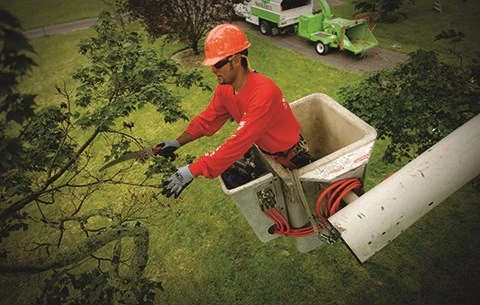
The word “easy” is not something Andy Ross wants to hear around his shop.
“(It) is a little bit of one of those trigger words because I had a fellow who used to work for us and he’d come in and say, ‘Hey, we made you a lot of money today.’ And as a new business, you love to hear that,” says Ross, owner of RTEC Treecare in Washington, D.C.
“But what he was really saying was, ‘I rushed through the day; I got a lot of work done; we can bill it.’ But what I found is in the following week is when I got all the calls, ‘Hey, this was damaged. That was damaged. This was damaged.’”
Aside from the shoddy work, a rushed job is also a huge safety risk. Safety is Ross’s first priority as a tree company owner, and something he wants on the minds of his employees. That can be harder to get across to more experienced employees. In Ross’ case, he’s had some very skilled climbers on staff, but they weren’t willing to adhere with evolving standards, and had to be let go.
“If you look at the statistics, there is a significant surge in fatalities and serious injuries in people over 40 and that usually means they started in their teens or in their 20s and they’ve gotten too comfortable with the industry. They’ve gotten too lax in their precautions and they pay the ultimate price.”
Assesing jobs.
Ross is careful not to stress deadlines on jobs. He can't send the message to be safe at all costs and then tell someone he has to get the job done in four hours. That's when arborists start to cut corners instead of completing the job in the safest way possible, he says.
It is a sales responsibility to accurately predict how many man hours it will take to do work safely and properly with the crews and equipment of the company,” he says.
That can mean losing money on some jobs if you bill a flat fee, but the goal is to do the job the right way and win long-term customers. “Your goal should be to be their arborist for the next 20 years. They’ll call you again if it’s done right.”
The right tools.
When Eli Pintilie first started providing tree care more than 10 years ago, he says there wasn’t as much competition as there is now. That increase in competition has meant he has had to separate himself from the other companies by the type of equipment he has.
“You always have to find a niche,” says Pintilie, president of Laurel, Maryland-based Green Future Construction. “Not just to show more professionalism, but more to be able to compete with these people. We came in with heavy equipment to show them that we can do a job safely.”
Five years ago he bought his first crane, and last year he bought his second. The first crane is paid off, but he is still making payments on the second one. He says a 17-ton crane costs about $110,000.
“Some investments will take years until you pay it off,” he says. “But there is no other way I could still be in business without cranes or heavy equipment. It’s not easy, but we’re doing it. It’s not impossible.”
Pintile says the investment is most painful when you don’t have any use for the equipment.
To offset the equipment’s down time, he rents out his crane to companies who need it, but always has one of his employees operate it.
“You have to be diversified and find ways to use the equipment,” he says.
Make friends.
Having a built-in network of trusted tree companies that you can refer work to, or get referrals from in the not-so-busy times, can help you when you’re in a pinch.
“You are going to have downtimes, then you have to fire the people or let them go,” Pintilie says. “So, rather than doing that, you establish your company to a point where you can face an average season. But if you do get into a hurricane, you should be ready to have some satellite companies ready to assist you. Always have a backup.”
In Pintile’s case, he has a friend who is also a competitor and the two refer work to each other. Pintile will even call up his friend who has a bigger crane when Pintile needs it for a job.
“One of my best friends is in the same industry, we are competing against each other every day but we managed to stay friends for the past 10 years and we still make a lot of money together,” he says.
For Brian Brunsch, an arborist at SavaTree’s Wyckoff, New Jersey branch, having subs on speed dial is the key to him having a great relationship with those he works with outside of SavaTree.
“That’s where technology helps it,” Brunsch says. “You can take a picture of anything and send it to me and if I can’t get out there that day, maybe I can give you a preliminary diagnostic to smooth that relationship with your customer.”
While sub-contracting can be a useful tool for a company, having tree care services in house allows direct knowledge of how your workers are trained to operate on a site.
“One of the main advantages is having control over our own people,” Pintile says.“This is a very dangerous industry. So, we are confident and comfortable that they are trained properly. We know them and we depend on them and they are very reliable.”
Latest from Lawn & Landscape
- Develon unveils -9 Series heavy excavators
- News you might've missed last week
- Lifescape Colorado's Hupf moves to regional role as Ostheimer becomes president
- Your most reliable predictor of success
- LandCare names McCallon, Miller as branch managers
- Takeuchi-US names Paul Wade, Eric Wenzel as dealer development managers
- CASE continues partnership with country artist Jon Pardi
- Greenlee debuts new battery-powered remote pruner





