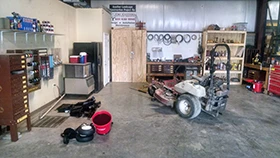
The main purpose for properly stocking and maintaining an orderly shop is to keep equipment and vehicles up and running, and to support the mechanics working in-house. It all comes down to maximizing downtime. When parts are readily available (and easy to access), machines can be serviced efficiently and return to the field where they generate revenue.
Chris Cook, president of Cru Cutters in Florence, Ky., found that a well-stocked, orderly shop has fringe benefits. It shows clients you walk the productivity walk and can make or break your efficiency.
Stocking the shop.
“Organization and efficiency are the holy grail,” says Mike DePriest, owner of Longs Peak Landscape, a $3-million company in Longmont, Colo. DePriest stocks his shop for maintenance, irrigation and design/build construction services, and ensures that essential parts are available for the company’s vehicles.
“We have a pretty well set-up shop,” he says.
DePriest says the firm spends a lot of money and time acquiring materials from suppliers. The more that can be kept on site (and used in a timely manner), the better.
“Our construction division has one guy who spends the majority of his week running materials, and equipment around between job sites,” he says. “The foremen of those five crews spend the first hour of their morning typically getting, loading, delivering materials to a job site too. We also have a construction supervisor who is seeing job sites and is often bringing materials, and equipment between crews.”
Smart shop storage.
Giving Cru Cutter’s mechanic a semi-private, secure and well-organized working environment with the tools he needs to complete his work meant investing in parts and shop equipment.
“We gave our mechanic the power, and tools, to make the shop his,” Cook says.
That has involved reworking the space to create a better workflow and rounding out the parts inventory including how it is arranged in the shop.
For one, Cru Cutters acquired a tool inventory system. The company purchased an initial inventory – nuts, bolts and other necessities – and based on monthly use, parts are replenished.
“It includes hose clamps and electrical fittings – a wide range of parts that keep us from running out every 10 minutes to pick up what we need,” Cook says. The investment runs $5,000 to $10,000, but Cook says it’s well worth it in saved windshield time and downtime.
Next, Cru Cutters moved to a bin system of organizing pieces-parts. All parts are stored in clear plastic bins rather than the old way of keeping them in cardboard boxes stacked on shelves. “Keeping parts in view is helpful, and it has improved the look of the shop,” Cook says.
Meanwhile, dedicated areas in the shop for cleaning equipment or changing tires keeps service processes organized at Longs Peak. Two blow-down cleaning stations at either end of the shop manage debris and dust. “We have and need a large compressor to keep up with all of the needs in our shop,” DePriest says.
Cook adds, “An organized shop makes us feel like we have our company in line, and that’s important when customers and suppliers come to our facility. It’s part of the whole image package.”
Photo courtesy of Cru Cutters
Latest from Lawn & Landscape
- Develon unveils -9 Series heavy excavators
- News you might've missed last week
- Lifescape Colorado's Hupf moves to regional role as Ostheimer becomes president
- Your most reliable predictor of success
- LandCare names McCallon, Miller as branch managers
- Takeuchi-US names Paul Wade, Eric Wenzel as dealer development managers
- CASE continues partnership with country artist Jon Pardi
- Greenlee debuts new battery-powered remote pruner





