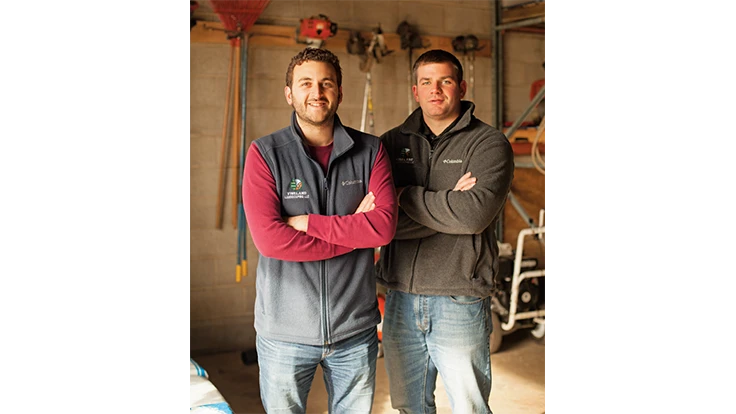
© Jon Arman
Last time we checked in:
Vineland Landscaping was working on improving accounts receivable, and have moved some clients to pre-billed contracts so they will pay for maintenance services before they are performed, similar to what Ed and Bill want Wade’s to do. They also hired a virtual assistant as a friendly reminder for clients to pay. At 30 days, the client gets an email and at 60 days they get a call. The company discovered customers aren’t annoyed, but more embarrassed they haven’t paid yet, says Will Gruccio, president.
“We were always of the mindset that we don’t want to harass people because no one likes that,” he says. “At the end of the day, people are actually happy about it, which is really interesting, because I did not think that would be the case.”
Gruccio alerted close customers ahead of time that they would be contacted via email as a reminder so they weren’t offended. Over all, he was happy with the change.
“It still is a problem, but it’s better than where we were. I won’t think that it’s fully corrected until next year, but we’re in a better place,” he says.
Latest update:
Two major problems arose recently, the first of which was taking on too much work. Gruccio says he wouldn’t have been able to get the equipment or employees soon enough to maintain the quality of work Vineland wants to deliver.
One idea floating around was dropping some subcontract work Vineland was doing. But that may have meant damaging their reputation with the company they were working with. So instead of dropping the subcontracted work, they did something they never have before and subbed out maintenance work.
“We came up with the solution of subcontracting to a sub that we’re very close with and who understood the quality we have to have,” Gruccio says. “It’s a smaller, local company, and they’ve been wanting to work together, maybe at some point even have a partnership.”
While construction helps keep maintenance afloat, Gruccio and his partner D’Orazio need to decide if they want to keep it long term. Gruccio is passionate about maintenance while D’Orazio is passionate about construction work.
“The difference is in maintenance, theoretically, it’s systemized,” Gruccio says. “The business runs itself once you get it to a certain point, which we’re not at, but I can see how it can become systematic. In construction, it’s impossible to become systematic, because you constantly have material orders. You constantly have issues on jobs.”
But construction work is profitable for Vineland and it’s actually supporting the maintenance work while the duo improves their accounts receivable.
They’ve asked Bill and Ed to find a company they can visit to see how a construction and maintenance company should work.
“My partner is in charge of operations and we’re not as efficient as we should be,” Gruccio says. “He takes responsibility for that. I mean, he’s doing a great job, but we want to see what we can change to get where we need to be. For me, I want to see what a larger company what it looks like from their CEO’s perspective.”
Bill and Ed’s take:
Ed says Vineland panicked a bit in dealing with the “100 days of Hell” and the new work they booked. Ed describes the 100 days of Hell as the start of the season to the Fourth of July, when work settles down. Subbing out the work took place of possibly buying new equipment, which they may have only needed temporarily.
“You can’t just go run out and buys trucks for $50,000,” Ed says. “You only need it for six weeks. Go rent trucks”
After getting through the 100 days of Hell, Ed and Bill received the phone call about possibly dropping construction.
The Harvesters try to drive people to recurring revenue, which is why they admit they don’t like construction. “We are guilty of that,” Bill says. “We’ll always sort of pooh-pooh construction because we’ve seen them go way up and we’ve seen them go crash into the ground.”
But Vineland is making money off construction, and enough money to support the maintenance division, so Bill and Ed recommended Vineland continue doing it. And once the construction job is done, Vineland is doing a good job of getting the maintenance work on the job.
“If you are just doing construction for construction and there is no line to long-range maintenance, then it better be making you money,” Bill says. “Otherwise you are just wasting energy.”
Latest from Lawn & Landscape
- Develon unveils -9 Series heavy excavators
- News you might've missed last week
- Lifescape Colorado's Hupf moves to regional role as Ostheimer becomes president
- Your most reliable predictor of success
- LandCare names McCallon, Miller as branch managers
- Takeuchi-US names Paul Wade, Eric Wenzel as dealer development managers
- CASE continues partnership with country artist Jon Pardi
- Greenlee debuts new battery-powered remote pruner





