Fall is a traditional time to put down applications for broadleaf weeds, but chemicals can be even more effective with management. We talked with Dr. Shawn Askew of Virginia Tech about how to handle them.
What can we do about broadleaf weed pressures?
Usually, we’ll go through one or two rounds of broadleaf weed control, and whatever remains are going to be those weeds that are not responding to your management program. So you’re going to have what I call the “sequentials,” which are weeds that require sequential applications or repeat applications to control. There’s a certain subset of broadleaf weeds that fit this category – so you’ll come in with a standard three-way herbicide and you’ll kill all the clover and dandelion and the easy ones, and then what’s left behind is broadleaf weeds that are really difficult to kill.
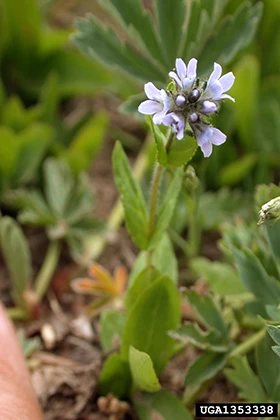
If I were to list the “most wanted broadleaf weeds in cool season turf,” it would be weeds like wild violet, wood sorrel and ground ivy, as well as speedwells. A three-way won’t control them. Really, those aren’t meant to be killed with a single application of a three-way herbicide. So the question becomes, what if I’m having dandelion and clover coming through my program? There are a couple of things that can make or break you in terms of getting overall effectiveness out of your broadleaf weed control.
And you know, I don’t think at the top of that list is necessarily product choice. It definitely factors in, but I would say other factors would be equally influential.
What other factors do you mean?
One would be spraying the product when it’s too cold. There’s a lot of product on the market that advertises that it would work well in cold weather. Well, all of the products have issues with cold weather, so it’s best to be avoided if you can. Ideally, we’re going to want to wait until air temperatures are getting up there into the 70s, soil temperatures are around the mid-50s – around 60 degrees F would be a great threshold for broadleaf herbicide.
The downside is you deal with broadleaf weeds while you’re waiting for this optimal timing, so if you have the budget, one solution would be to spray for broadleaf weeds sometime in the fall to try to catch seedlings, then come back in the spring with another application, or one to suppress the weeds and follow up to kill the remaining weeds.
There could be the potential for repeat applications like that to create resistance, but there’s no real evidence for that at this point. There’s a lot of literature that’s been done on various weeds that shows that an ineffective application can lead to a more difficult-to-kill weed later when conditions are better for effective control. In turf, there are no studies that have directly measured that, but in crops, there are several studies that have shown weeds can do that type of adaptation, that if you come out with ineffective rates, you can create a resistant weed.
I can’t say that 100 percent based on current research, but research would suggest that weeds have the ability to adapt to the herbicide. In most cases, we create weeds with resistance to herbicide through selection, or mutants that already existed in nature. But in some cases, we’re finding that weeds can adapt to ineffective applications, and what doesn’t kill you makes you stronger. There’s some literature that shows that applies to weeds and herbicides in some select cases. It’s just something to keep in mind, and a good reason to rotate your mode of action whenever possible.
Photo courtesy of Mary Ellen Harte, Bugwood.org