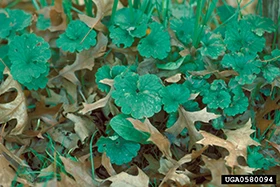
Fall can be a great time to get down to the root of broadleaf weed problems. The idea is to apply the herbicide when weeds are preparing for winter, storing carbohydrates in their roots. The chemical herbicide is taken to the roots along with the carbs, killing the entire plant. For fall applications, plant identification is key, according to the University of Nebraska-Lincoln Extension, since spraying annual weeds is unnecessary.
But there are other factors at play as well, like rainfall and mowing heights. “The effectiveness of broadleaf weed killer is somewhat dependent on the mowing height,” says Dr. Shawn Askew of Virginia Tech. “So if you’re able to time your spray and you can give it a few more days after you spray, before you come in and mow, by all means, do so. You’ll get much better control than if you just maintain your primary mowing regime regardless of when you’re going to spray.”
The problem is that if you mow too soon before or after application, there is less area of the weed to absorb the herbicide. But sometimes, it’s unavoidable. “Sometimes your hands are tied,” Askew says. “If your client wants the grass mowed too low, you’ve got to mow it low. That’s not good cultural practice, but it’s what’s required. But in situations where you can, paying attention to what needs to be done culturally, your turfgrass is going to kill more weeds than your herbicide. It kills those little seedlings every day.”
If the soil is too dry, or if rain comes too soon after an application, the chemicals will not be as effective as possible. If there is a lack of rainfall or drought conditions, the herbicide can damage the turfgrass and won’t be absorbed as easily by the weeds. And rain can wash away recently applied chemicals. The Purdue Extension recommends reapplying after 10 days if rain comes within 24 hours of application and no results are seen.
If you’re looking at repeating application in the spring, it’s important to note what’s recovered growth and what’s new growth since broadleaf weed seeds can live in the soil for 30 years or more. “The timing in this case is important,” Askew says.
Photo courtesy of Jil Swearingen, USDI National Park Service, Bugwood.org
Latest from Lawn & Landscape
- Develon unveils -9 Series heavy excavators
- News you might've missed last week
- Lifescape Colorado's Hupf moves to regional role as Ostheimer becomes president
- Your most reliable predictor of success
- LandCare names McCallon, Miller as branch managers
- Takeuchi-US names Paul Wade, Eric Wenzel as dealer development managers
- CASE continues partnership with country artist Jon Pardi
- Greenlee debuts new battery-powered remote pruner





