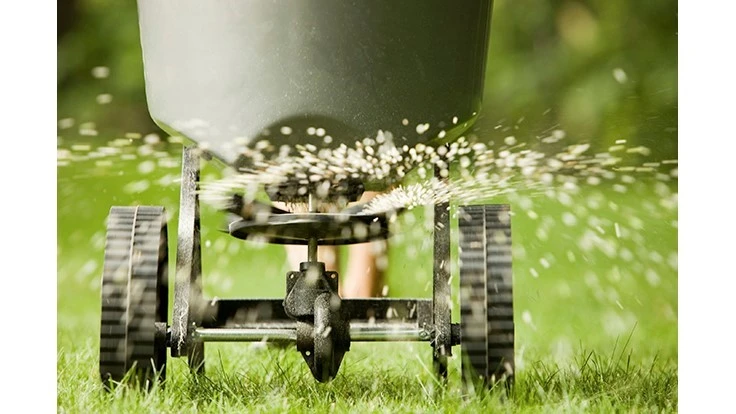
In the lawn care industry where profit margins can be tight and the competition stiff, it’s important that you’re getting all you can out of your equipment, including your spreaders and sprayers.
Not to be taken for granted, these pieces of equipment can save time and money, that is, if you have chosen the right pieces of equipment and maintain them properly. Here is the inside scoop on spreaders and sprayers from three lawn care operators, each who have been in the business for over two decades.
Nick Brummel and his crew at Brummel Lawn & Landscape can’t afford to have issues with their equipment, especially their spreaders and sprayers. They use them on a daily basis in the greater Kansas City area to service mostly commercial properties.
Like most lawn care companies, Brummel’s lawn care regimen includes a mix of granular and liquid applications at different times of the year. For smaller properties, they’ll use Lesco spreaders with 80-pound hoppers.
Technicians use them to apply granular pre-emergents. Brummel selects his brand of spreaders based on product reviews, making sure there aren’t issues with the spreader before making the investment. “We look at the quality and make sure they’re stainless steel and have grease points,” Brummel says.
These push behind units may be great for smaller properties, but they just don’t cut it for the larger properties they service.
“We’re spraying and fertilizing at some point every 10 days, compared to a residential lawn we only see six times a year,” Brummel says.
For large commercial properties and lawns they’ll use the ride-on Z-sprayers with their combination sprayer and spreader capability. They own two of these machines which sell for about $12,000 each.
Mark Black, owner of Country Club Lawn & Tree Specialists, out of South Roxana, Illinois, wants his spreaders and other equipment to be consistent from one job to the next.
“I’m looking for the McDonald (restaurant) effect,” Black says, which is evident in his fleet of vehicles, all mid-size pickup trucks, which are identical in appearance. The spreaders and sprayers his trucks are equipped with are identical as well.
Black prefers the Anderson spreaders. He says the hopper on these pieces of equipment hold 80 pounds, but he says technicians use a little common sense and don’t over work them.
“You have to look at the material,” Black says. “Bulkier material should be limited to about 50 lbs. The more you put in the hopper the more potential for damage, the gears tend to strip underneath a whole lot quicker when guys really fill them up.
He says one thing he has learned over the years is to fill them according to the square footage of the property. He says if the property is under 15,000 square feet, then only 25-30 pounds should be poured into the hopper.
For the guys doing routine spraying on what he calls the normal route, they use the ride-on PermaGreen and Z-spray units.
Paul Wagner and his crew at Fit Turf see it all when it comes to variable weather and climate conditions as it relates to lawn care. With four locations, two in rainy Michigan, and two out in drought-prone Denver, Colorado, Wagner and his crew face a challenge keeping turf in tip top shape; it’s made a little easier by the equipment he has chosen.
Like Black, Wagner appreciates the versatility of the Z-spray, and thinks the investment is worth it. “I’ve found with over 30 years in this business that you’re always better off spending a little extra,” Wagner says.
Although these machines are generally safe to operate, it is nevertheless prudent to follow some safety precautions. He says the Z-Spray isn’t the best choice for real hilly properties. In fact, an employee rolled one, so he makes sure one of his more experienced crew members operate this machine, although he occasionally trains new hires to operate one.
One feature Wagner likes about his ride-on sprayer/spreader is the fact that it causes less fatigue for his crew. This is important in the Denver area, where the summer temperatures routinely top 90 degrees.
“For automated equipment you don’t have to have a 25-year-old person,” Wagner says. “You can have an older individual out there with a lot of experience and they’re not killing themselves.”
The crew also uses tanks mounted on a pick-up truck for lawn and tree care applications. The tanks have separate pumps and hoses concealed from view.
They use the front tank for lawn care and the back tank for trees.
Latest from Lawn & Landscape
- Develon unveils -9 Series heavy excavators
- News you might've missed last week
- Lifescape Colorado's Hupf moves to regional role as Ostheimer becomes president
- Your most reliable predictor of success
- LandCare names McCallon, Miller as branch managers
- Takeuchi-US names Paul Wade, Eric Wenzel as dealer development managers
- CASE continues partnership with country artist Jon Pardi
- Greenlee debuts new battery-powered remote pruner





