Upcoming summer weather means summer weeds are going to start popping up in your customers’ lawns. That means it’s time for post-emergent herbicide applications to protect all of the hard work you put into lawns in the fall.
If you’re dealing with grass weeds like quackgrass, tall fescue or creeping bentgrass, a nonselective herbicide is best in spot treatments when weeds are actively growing. Because nonselective herbicides will kill your customers’ lawns, be very careful with applications.
The end of the month is also ideal to start applying post-emergent control of crabgrass, goosegrass and nutsedge.
Here’s how to take care of some weeds you might be seeing this season:
Nutsedge.
Yellow nutsedge can be identified by its triangular-shaped stems and yellow-green leaves. Thriving in warm weather and wet areas, you’ll see it pop up in late spring and early summer. Correctly identifying the weed is important since it oftentimes looks like a grass, but is in fact a sedge.
Nutsedge is tough to control because the nutlets that form on roots can grow up to 14 inches deep in the soil. So simply pulling up the weed won’t solve the problem. If you find it in your customers’ lawns, look for halosulfuron, penoxsulam, sulfosulfuron or trifloxysulfuron-sodium.
Doveweed.
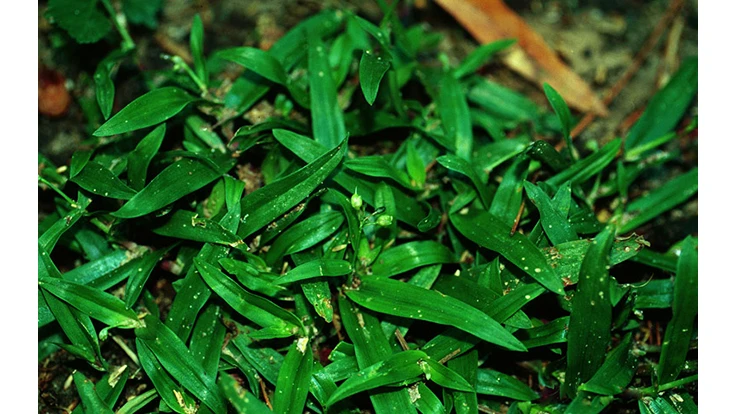
Down South, the summer annual doveweed can take over a lawn before you know it. Doveweed germinates later in the growing season and can be identified by short leaf sheaths with short hairs on the upper margins.
This weed prefers wet areas, so check for bad drainage or overwatering. And because doveweed seeds can live for several years in the soil, it will take two to three years of continuous control to get rid of the weed.
“Repeat applications of the two- to three-way broadleaf herbicide mixture products have shown the best activity, but results are very inconsistent because doveweed can regrow after treatments,” says Patrick McCullough with the University of Georgia Extension.
Latest from Lawn & Landscape
- Develon unveils -9 Series heavy excavators
- News you might've missed last week
- Lifescape Colorado's Hupf moves to regional role as Ostheimer becomes president
- Your most reliable predictor of success
- LandCare names McCallon, Miller as branch managers
- Takeuchi-US names Paul Wade, Eric Wenzel as dealer development managers
- CASE continues partnership with country artist Jon Pardi
- Greenlee debuts new battery-powered remote pruner





