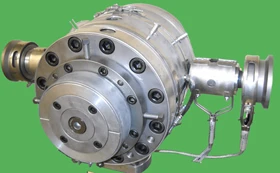
Guill Tool & Engineering has new advanced tooling that utilizes three layers to produce the necessary tubing for efficient and environmentally safe drip irrigation. The technology is based on the company’s 800 Series for advanced medical tooling as well as other Guill tooling innovations, all of which are designed together to create this uniquely engineered product.
How It works
The head/die engineering utilizes a spiral flow that handles three layers. Prior to this advancement, only two layers were common. One of the key benefits of this tooling is that it allows an inexpensive regrind polymer, or most any type of polymer, to be the bulk of the material inside the tube, hose or pipe.
The new drip irrigation crosshead/die is designed to produce a tube that uses an ABA, ABC or virtually any type of three-layer construction. In this application, the inner layer is composed of a majority of a less expensive regrind material (or any polymer desired) and is typically surrounded by a very thin layer of virgin polymer, often times only 1/1000th (.0001) of an inch (.00254 mm) or less.
With Guill’s flow design, the walls of the tubing require less polymer material to achieve the desired or mandated tube-burst strength requirements, saving money for the drip-irrigation user.
The new Guill three-layer design is suitable for flat or round tubing in a wide a variety of user requirements for various types of emitters – sprays, drip holes, etc.
Extrusion Objectives
The objective is to enable tube, hose and pipe makers to have the most cost-effective drip-irrigation systems that control the exact amount of water and fertilizer required to serve the expanding agricultural and horticultural global market.
According to Bill Conley, Guill’s technical sales manager, “Our current three-layered solution for drip irrigation is one of our most popular layered technologies being offered. It can have stripes or other markings for identification on all pipe, hose and tubing extrusion. The most important aspect of this three-layer design is total confidence for the user – the virgin material completely and securely surrounds all other layered materials utilized, such as regrind. This ensures protection against any potential environmental concerns with hosing or tubing today with increasingly stricter regulations likely to follow.”
Conley adds, “This is important because the U.S. and other countries are accelerating their efforts to minimize the effect of contaminants in the environment and on individuals. Guill remains at the forefront in assisting tube, hose and pipe producers’ of end products that meet all environmental requirements while maintaining precise production control. In addition, Guill has addressed the demand for lower manufacturing costs as a key benefit of this three-layer technology.”
Guill’s new drip-irrigation tooling is created especially for this drip-irrigation process. The primary features include:
Split or patent-pending single flow to the body of the die.
Patented spiral engineering for upstream thermal balancing, which achieves an equal flow resulting in extremely-close-tolerances, thin-walls and multilayered products.
Optimized deflectors offer minimum chamber residence time for the extrusion material.
Patented Feather Touch design for easy concentricity adjustment enables low-effort concentricity adjustment without choking off the upstream. It is never compromised by the clamping forces necessary to create a proper seal, as is often the case with ordinary tooling systems.